Hair Growth Spray Guide: What Actually Speeds

Most hair growth spray disappointment comes down to one habit: spraying the ends of already-dry, already-styled hair instead of the scalp underneath, then giving up before the formula gets a fair shot. A hair growth spray only works if it actually reaches the skin where the follicle lives, stays there long enough to be absorbed, and matches the real reason your hair slowed down in the first place.
Quick answer: a hair growth spray can genuinely help with shedding tied to stress, thinning from styling damage, or a sluggish growth phase, especially formulas built around caffeine, rosemary extract, peptides, or low-dose minoxidil. It won’t reverse genetic pattern loss on its own, and it can’t do anything for a scalp condition that needs a dermatologist’s attention. The rest of this guide covers which ingredients have real evidence behind them, how to apply a spray so it reaches the follicle instead of your hairbrush, and how to tell which type actually fits your situation.
The One Mistake That Makes a Good Spray Look Useless
Crack open the instructions and you’ll usually be told to spray your roots and figure out the rest yourself. Three habits quietly wreck the results for most people. They spray it over hair that already has leave-in conditioner or dry shampoo on it. They rinse it out within the hour because they don’t like the feel. And they judge the entire bottle after two weeks.
Two weeks isn’t enough. Not even close.
Hair grows from a follicle sitting a few millimeters under the skin. A spray applied to the strands, no matter how shiny it makes them look, never gets near that follicle. It needs to land directly on scalp skin, ideally through a parted section where the skin is actually exposed, and it needs a few minutes of contact before you tie your hair up or lie down on a pillow and wipe half of it away.
There’s a timing problem baked into hair biology too. A single follicle spends roughly two to six years in its active growth phase, then rests for a few months before shedding and starting over. A topical spray can’t skip that clock. It can support follicles that are already gearing up to grow, but it can’t force a resting one to start early. That’s usually the exact point where people quit, right before a formula was about to start showing something.
What’s Actually Inside a Hair Growth Spray

Read the ingredient list on ten different bottles and you’ll find the same small cast of characters playing slightly different roles.
| Ingredient | What It’s Meant to Do | Evidence Strength |
|---|---|---|
| Minoxidil (2% or 5%) | Widens blood vessels near the follicle and extends the growth phase | Strong — the only ingredient with FDA approval for hair loss |
| Rosemary extract | Improves scalp circulation, often with less irritation than minoxidil | Moderate — small trials show results close to low-dose minoxidil |
| Caffeine | May offset some of the effects of DHT at the follicle | Limited — mostly lab and small in-vivo studies |
| Peptides | Signal the follicle to stay in its growth phase longer | Early — promising but not verified at scale yet |
| Biotin | Supports keratin production in the hair shaft | Weak for growth — helps mainly if you have an actual deficiency, which is uncommon |
The clearest head-to-head data involves rosemary. In a randomized trial comparing rosemary oil with minoxidil 2%, both groups saw a meaningful increase in hair count after six months, with rosemary causing less scalp itching along the way. That’s one modestly sized study, not a guarantee, but it’s a real reason rosemary shows up in so many newer formulas instead of just being a trend ingredient.
Caffeine and peptides sound more exciting on packaging, but their evidence mostly comes from lab dishes and small samples, not large human trials. That doesn’t mean they’re useless. It means you should treat them as a supporting player, not the whole plan.
Match the Spray to What’s Actually Slowing Your Hair Down
This is the step most routines skip, and it’s the reason two people can use the same bottle and get completely different results.
If thinning follows a pattern — a receding hairline, a widening part, a shrinking crown — genetics is almost always the driver. The American Academy of Dermatology’s list of hair loss causes names this as the most common type of hair loss worldwide, in both men and women. For this pattern, a spray built around minoxidil or rosemary extract, used daily and kept up long-term rather than for six weeks, is the category with real biology behind it.
If the shedding is diffuse instead of patterned, more hair in the shower drain, more on the pillow, spread evenly across the scalp rather than concentrated at the temples or crown, the trigger is usually a stressor: illness, a crash diet, childbirth, a medication change, or a stretch of poor sleep. A growth spray can still help here, but the bigger lever is addressing whatever triggered the shedding in the first place.
Then there’s a category that gets mislabeled as “no growth” when it’s really breakage. Hair that snaps a few inches from the ends looks like it isn’t growing, even though the roots are working fine. No spray fixes that, because the problem isn’t the follicle, it’s the hair shaft losing strength from heat, bleach, or over-brushing. That distinction, growth versus length retention, is the single most useful thing to figure out before spending money on any bottle.
Also Visit : How to Use Oil for Hair Growth (Properly)
What to Expect, Week by Week
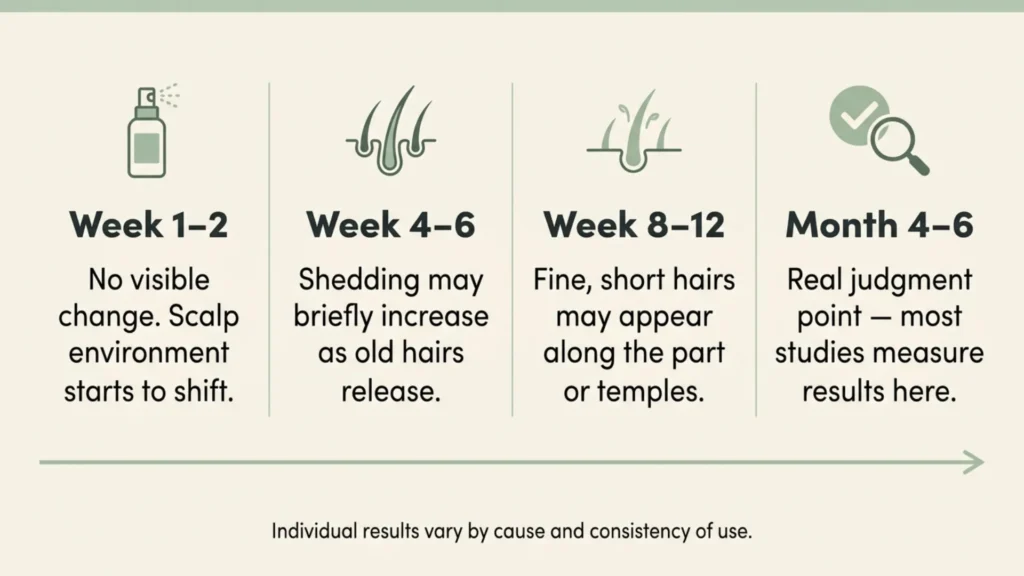
Expectations are where most reviews go wrong, because everyone starts checking for results the day the bottle arrives.
In the first one to two weeks, there’s usually nothing visible. The scalp environment is shifting, but hair you can see today started growing months ago. Around week four to six, some people notice a temporary uptick in shedding. That’s not the product failing. It’s often older, already-resting hairs being pushed out to make room, a normal part of a follicle waking back up. By week eight to twelve, fine, shorter hairs sometimes appear along the part line or temples if the formula is a fit for the cause. The honest judgment point sits around month four to six, which lines up with how most of the clinical research on scalp treatments is actually measured.
Also Visit : Why Isn’t Your Hair Growing? A Natural Hair Growth Guide
How to Apply It So It Actually Reaches the Follicle
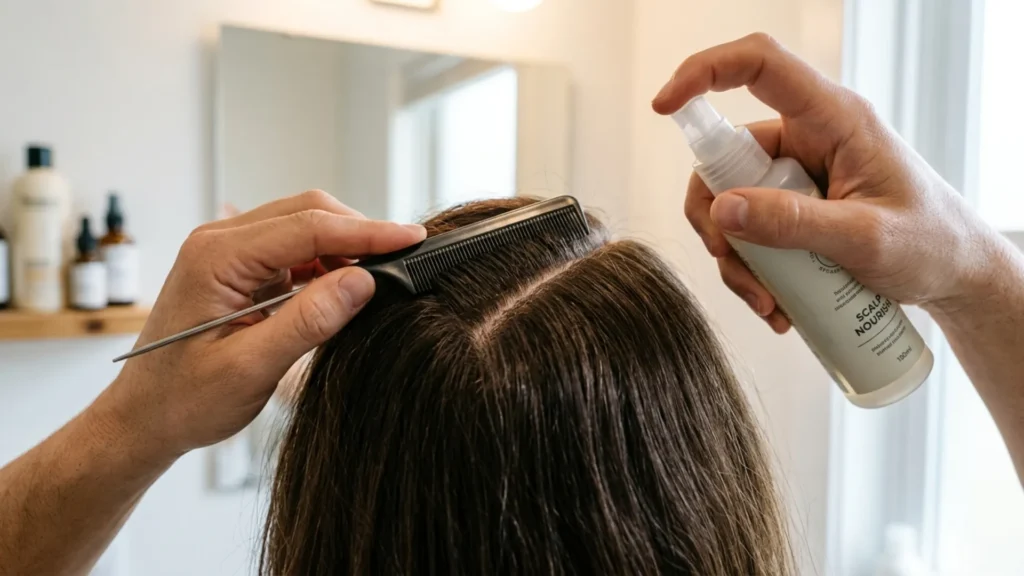
Technique matters more than the brand on the label. A few adjustments make the difference between a spray that does nothing and one that gets a real chance.
- Section the hair into two-inch partings rather than spraying blindly through a full head of hair.
- Aim the nozzle directly at the scalp along each part, not at the mid-lengths or ends.
- Massage the scalp with your fingertips for one to two minutes to help distribute the product and improve local circulation.
- Leave it in. Rinsing it out within the hour, unless the label specifically says to, undoes most of the benefit.
- Apply at the same time each day, most people find evenings easier since there’s no styling to work around afterward.
- Stick with it through at least one full shedding cycle before deciding whether it’s working.
Using It on Color-Treated or Chemically Processed Hair
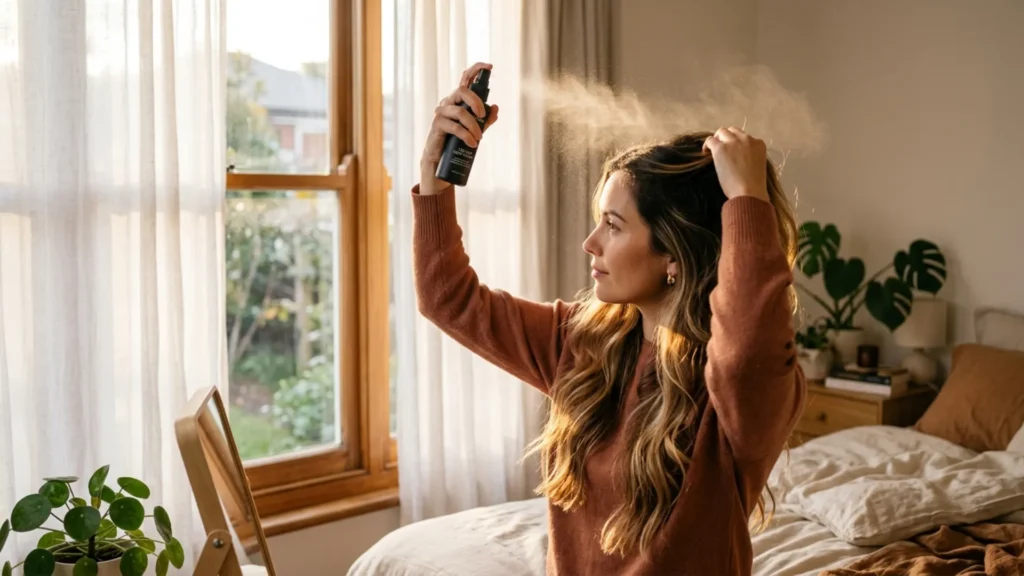
Most hair growth sprays are safe on colored or highlighted hair. The scalp is what absorbs the active ingredients, and the dye sits in the hair shaft itself, so the two rarely interact. Look for alcohol-free formulas if your hair is already dry from bleach or repeated color services, since high alcohol content can add to that dryness over time.
Timing around chemical services is the part people miss. Wait at least 48 hours after bleaching, relaxing, or a perm before applying anything new to the scalp, since freshly processed skin is more sensitive and more likely to react. A patch test behind the ear a day beforehand is a small step that saves a lot of irritation.
When a Spray Isn’t Going to Fix It
A spray, however well formulated, isn’t a substitute for a diagnosis. Sudden clumps of hair coming out, a coin-sized bald patch, scalp pain, redness, or flaking that doesn’t clear up all point to something a bottle can’t solve.
Cleveland Clinic’s overview of telogen effluvium describes a type of diffuse shedding that shows up two to three months after a stressor and usually resolves on its own within several months, but it’s still worth having a doctor confirm that’s actually what’s happening rather than assuming.
If shedding has lasted more than six months with no improvement, or if it’s accompanied by other symptoms like fatigue or irregular cycles, that’s a conversation for a dermatologist, not another product swap.
Also Visit : Does Shampoo for Hair Growth Actually Work?
Frequently Asked Questions About Hair Growth Spray
Do hair growth sprays really work?
Some do, for some causes. Formulas with minoxidil or rosemary extract have real evidence behind them for pattern thinning and stress-related shedding. They won’t help breakage or a scalp condition that needs medical treatment.
How often should you use a hair growth spray?
Most formulas are designed for once or twice daily use. Skipping days repeatedly resets the clock more than people expect, since consistency matters as much as the ingredient list.
Can a hair growth spray cause more shedding at first?
Yes, and it’s usually a good sign rather than a bad one. A temporary increase around week four to six often means resting hairs are being pushed out to make room for new growth.
Is it safe to combine a hair growth spray with other hair loss treatments?
Often yes, but combining active ingredients like minoxidil with prescription treatments should go through a doctor first, since layering isn’t always additive and can sometimes increase irritation.
How long until you actually see results?
Most people need three to six months of consistent use before judging whether a formula is working, which matches how long a hair follicle takes to complete enough of its growth cycle to show a visible change.
Key Takeaways
- A hair growth spray only works if it reaches the scalp, not just the strands.
- Minoxidil and rosemary extract have the strongest evidence; biotin sprays mostly help if you’re actually deficient.
- Match the spray to the cause: pattern thinning, stress-related shedding, and breakage each need a different approach.
- A temporary rise in shedding around week four to six is often normal, not a failure.
- Sudden bald patches, scalp pain, or clumps of falling hair call for a dermatologist, not another bottle.
This article is for general information only and isn’t medical advice. For persistent hair loss, scalp pain, or sudden shedding, see a dermatologist or trichologist.
Written by Anna Anderson for Trend Cottage.