Does Shampoo for Hair Growth Actually Work?

Type “shampoo for hair growth” into any search bar and you’ll find bottles promising thicker, longer hair inside eight weeks. Here’s the myth worth killing first: a shampoo can’t create a new hair follicle. Follicles form before you’re born, and no bottle changes that number.
The honest answer is this: shampoo for hair growth can help your existing hair reach its full potential by fixing a scalp environment that was working against it. It does nothing to your DNA, your hormones, or the follicle count you started with. If you want less shedding, thicker-looking strands, and a scalp that isn’t fighting you, the right one helps. If you want bald patches to fill back in, it won’t.
What People Mean by “Shampoo for Hair Growth”
The label covers a mix of very different products, and that’s part of the confusion. Some formulas lean on caffeine and peptides borrowed loosely from minoxidil research. Others use ketoconazole or zinc pyrithione, ingredients built for dandruff that also calm inflammation linked to hair loss. A few just clean gently enough that they stop stripping hair that was already thin and fragile.
None of these are drugs the way minoxidil or finasteride are. They’re cosmetics, which means there’s no requirement to prove they regrow hair before they reach shelves. That’s not automatically a red flag. It just means the marketing copy and the clinical reality often live in two different rooms.
What Actually Happens Under Your Scalp When Hair Grows
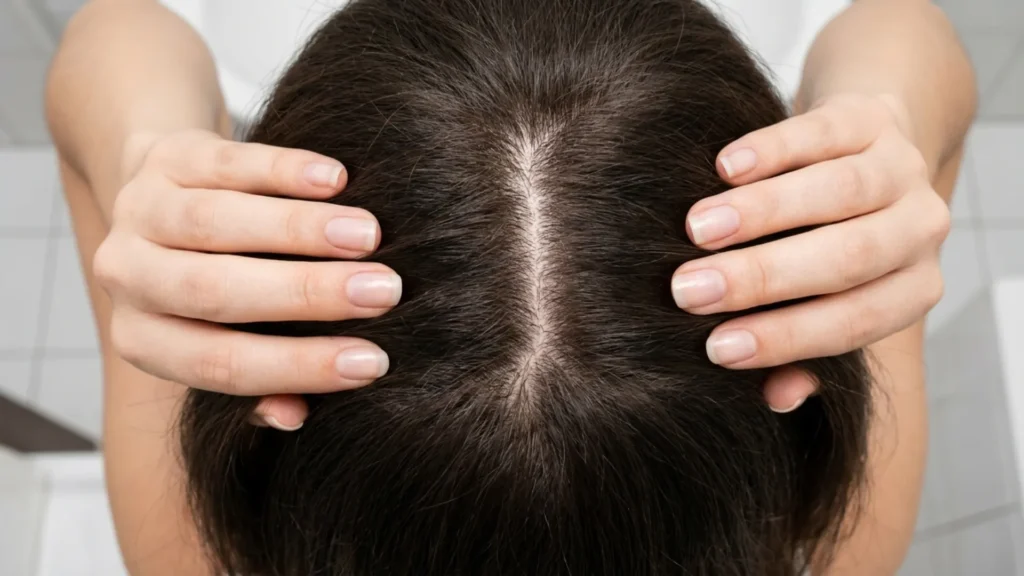
Every hair on your head runs on its own clock. It spends two to seven years actively growing, called anagen, then a few weeks shutting down, then two to four months resting before it falls out and a new hair starts the cycle. At any given moment, roughly 85 to 90 percent of your hairs sit in that active growing phase.
The part doing the actual growing sits deep in the dermis, the second layer of skin, well below where shampoo ever reaches. That growth machinery, the follicle that produces each strand of hair, is wrapped around its own blood supply and, in men and some women, hormone receptors that can shrink it slowly over years.
Shampoo spends two or three minutes on the surface of your scalp before you rinse it away. It can reach the opening of the follicle, plus the sebum and buildup sitting in and around it. It cannot reach the blood vessels or the hormone receptors that actually decide whether a follicle keeps producing hair or starts shrinking. That’s the ceiling on what any wash-off product can do.
Also Visit : What Should a Hair Growth Routine Actually Include?
Can a Shampoo Actually Reach the Follicle?
Not the way marketing implies, no. What it can reach is everything sitting on top of, and just inside, the follicle opening: oil, dead skin, product residue, and sometimes the yeast that triggers dandruff and mild inflammation. Clear that out, and a follicle that was already struggling gets a slightly better environment to keep doing its job.
Think of it less like fertilizer and more like clearing weeds around a plant that’s already rooted. The plant doesn’t grow faster because the ground looks tidier. But if weeds were blocking its access to water and light, removing them lets it perform closer to its actual potential. A shampoo for hair growth works on roughly that logic. It removes obstacles. It doesn’t add horsepower.
That distinction matters because it sets expectations correctly. You’re not buying growth. You’re buying fewer things standing in growth’s way.
What a Good Shampoo Can Realistically Improve

Three outcomes are realistic, and marketing rarely says them this plainly.
Less breakage at the strand level. Sulfate-heavy shampoos can roughen the hair cuticle, which leads to snapping partway down the shaft. Switch to a gentler, sulfate-free formula, and hair that used to break off before it reached shoulder length gets to keep growing toward the length it was always capable of. That reads as “faster growth” in the mirror, even though the follicle’s speed never changed.
A calmer scalp. Ketoconazole and zinc pyrithione reduce overgrowth of Malassezia yeast, which is tied to inflammation that can shorten the active growth phase in some people. A calmer scalp is simply a better environment for hair that’s already trying to grow.
Reduced shedding, not new growth. Caffeine and peptide-based formulas appear to extend the growth phase slightly and may reduce hair lost during the resting phase. That shows up as a fuller ponytail, not as follicles waking up out of nowhere.
None of this touches genetics, hormones, or an underlying medical cause. If those are driving your hair loss, the shampoo bottle is a supporting player at best.
Also Visit : Natural Hair Growth Tips That Actually Move the Needle
Ingredients With Real Evidence Behind Them
Caffeine has more research behind it than any other ingredient sold in a shampoo bottle. A 2025 review pooling nine clinical studies found that topical caffeine reduced hair loss and supported growth-related outcomes across trials, with few reported side effects, though the researchers still called for larger, more standardized studies.
Ketoconazole 1 percent, the over-the-counter strength, holds up reasonably well in several small trials against low-dose minoxidil for reducing shedding, likely because it works on yeast and inflammation rather than hormones. Saw palmetto has weaker, more mixed evidence: a handful of small studies suggest it may interfere with some of the same enzyme activity that hormone-blocking treatments target, but the sample sizes are tiny.
| Ingredient | What It’s Meant to Do | Strength of Evidence |
|---|---|---|
| Caffeine | Extends the growth phase, may reduce shedding | Moderate — several small controlled trials |
| Ketoconazole 1% | Reduces scalp yeast and inflammation | Moderate — comparable to low-dose minoxidil in small trials |
| Zinc pyrithione | Antifungal, calms flaking and itch | Limited but consistent for dandruff-related shedding |
| Saw palmetto | May reduce hormone activity at the follicle | Weak — small, inconsistent studies |
| Biotin (in shampoo) | Rinses off before it can be absorbed | Very weak — works better taken orally if you’re actually deficient |
Biotin deserves its own callout because it’s on nearly every bottle in this category. True biotin deficiency is rare, and even when it’s present, a rinse-off product has almost no time to deliver anything through the skin. If biotin is the reason you’re picking a shampoo for hair growth, that reason doesn’t hold up under scrutiny.
How to Use It So You’re Not Wasting the Bottle
Frequency matters more than most people think. Using an active shampoo two or three times a week, rather than daily, gives ingredients like ketoconazole time to work without over-stripping the scalp in between washes.
Contact time matters just as much. A ten-second rinse never gives an active ingredient a real chance to do anything. Massage it into the scalp, not just the lengths, and let it sit for two to three minutes before rinsing, the way you would with a scalp treatment rather than a quick wash.
Follow with a lightweight conditioner on the lengths only, keeping it off the scalp so you don’t undo the cleansing step you just did. Be patient with the packaging math, too: a bottle lasts roughly six to eight weeks at normal use, which is barely enough time to judge whether shedding has slowed, let alone whether hair looks thicker.
Also Visit : How to Build a Hair Growth Oil Recipe for Your Hair Type
Common Mistakes That Undo Any Benefit
A few habits quietly cancel out whatever the shampoo is doing:
- Washing with hot water, which strips the scalp barrier and can add to shedding through the same stress-response pathway involved in postpartum hair loss
- Piling on other scalp products, like oils, serums, or dry shampoo, that sit on top of an active ingredient and block it from reaching the skin
- Skipping the scalp entirely out of fear of oily roots, when the scalp is exactly where an active ingredient needs contact time
- Expecting a four-week verdict. Hair grows roughly half an inch a month, and a shed hair took months to reach that stage before it ever fell out
A Realistic Timeline: What to Expect at Week 1, Week 4, and Week 12
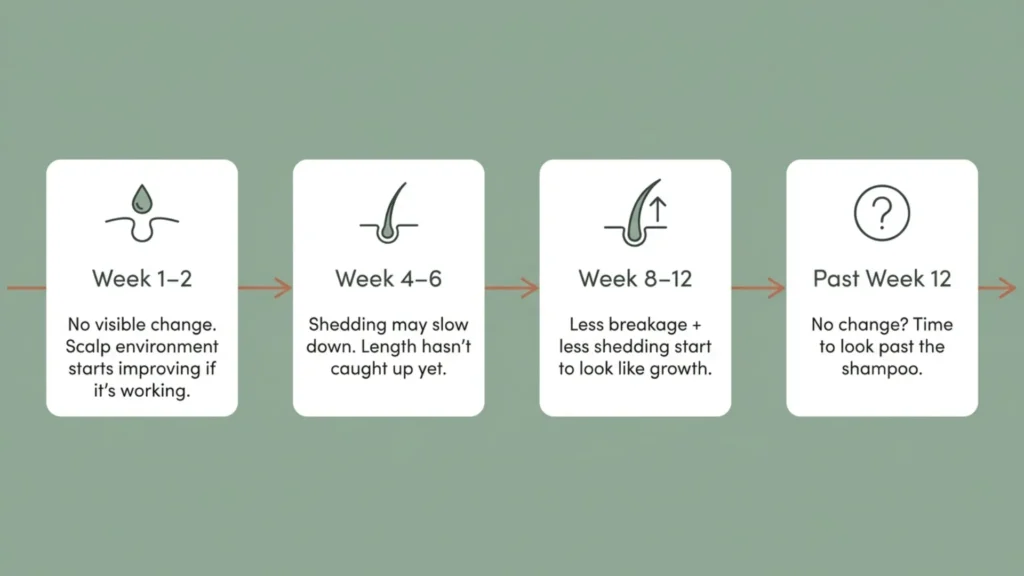
Week 1 to 2: nothing looks different yet, but a healthier scalp environment is already forming if the shampoo is doing its job.
Week 4 to 6: if shedding was going to slow down, this is usually when you’ll notice fewer hairs on the pillow or in the shower drain. Length hasn’t caught up yet.
Week 8 to 12: reduced breakage and reduced shedding start to look like actual growth, because hair that would have snapped or fallen out is still attached and still getting longer.
Past week 12: if nothing has changed by this point, the shampoo probably isn’t the right lever for whatever’s causing your hair loss. That’s worth looking into instead of buying a second bottle of the same thing.
When It’s Not About the Shampoo Anymore
Sudden hair loss, patchy bald spots, scalp pain, or shedding that doesn’t slow down after three months of consistent use point to something a shampoo was never built to fix. Thyroid changes, iron deficiency, and hormonal shifts are common drivers of hair loss that no topical wash-off product can touch.
No shampoo for hair growth marketed today, regardless of price, treats those underlying causes. A dermatologist can run bloodwork or examine the scalp directly and tell you whether you’re dealing with something a bottle was never meant to solve.
Key Takeaways
- Shampoo can’t create new follicles or change your genetics — it works on the scalp surface only
- Real, realistic benefits are less breakage, a calmer scalp, and reduced shedding, not new growth
- Caffeine has the most clinical evidence of any ingredient sold in this category; biotin in shampoo has the least
- Give it 8 to 12 weeks of consistent, correct use before judging whether it’s working
- Sudden or patchy hair loss needs a dermatologist, not a different bottle
Frequently Asked Questions
Does shampoo for hair growth actually work?
It can help existing hair look fuller by reducing breakage and shedding and calming scalp inflammation. It can’t grow new follicles or reverse hormone-driven hair loss.
How often should you use a hair growth shampoo?
Most active formulas work best two to three times a week rather than daily. Daily use of a strong active can over-strip the scalp and cause the dryness and irritation it’s meant to prevent.
Can a hair growth shampoo cause more shedding?
Occasionally, yes, usually from over-washing, hot water, or an ingredient the scalp reacts to rather than the active ingredient itself. Switching to lukewarm water and cutting back frequency usually resolves it within a couple of weeks.
Is it safe to use every day?
For gentler, sulfate-free formulas, daily use is generally fine. For strong actives like ketoconazole, two to three times weekly is the safer default unless a dermatologist says otherwise.
What’s the real difference between this and minoxidil?
Minoxidil is an FDA-approved drug applied directly to the scalp and left on, with real evidence it can stimulate follicles. Shampoo is rinsed off within minutes and works on the surface environment, not the follicle itself. They’re not interchangeable.
This article is for general information only and isn’t medical advice. For persistent hair loss, scalp pain, or sudden shedding, see a dermatologist or trichologist.
Written by Anna Anderson for Trend Cottage.