What Should a Hair Growth Routine Actually Include?

There’s a popular idea floating around hair forums and comment sections: the more you do to your hair, the faster it’ll grow. Layer on a scalp serum, a protein mask, a growth oil, and a supplement, all in the same week, and surely something in that stack will work. It’s a tidy theory, and it’s mostly wrong.
Quick answer: a hair growth routine should be built around frequency, not volume. Daily steps should be gentle and protective, weekly steps should do the heavier repair work, and monthly or as-needed steps should handle deep treatments like protein or clarifying. Stacking too many active products in the same week is one of the most common reasons a routine stalls, since it can throw off the balance between protein and moisture that healthy hair actually needs.
Once you sort your hair growth routine by how often each step should happen, the whole thing gets a lot less overwhelming, and a lot more effective.
The Myth That’s Driving Most Routines Off Track
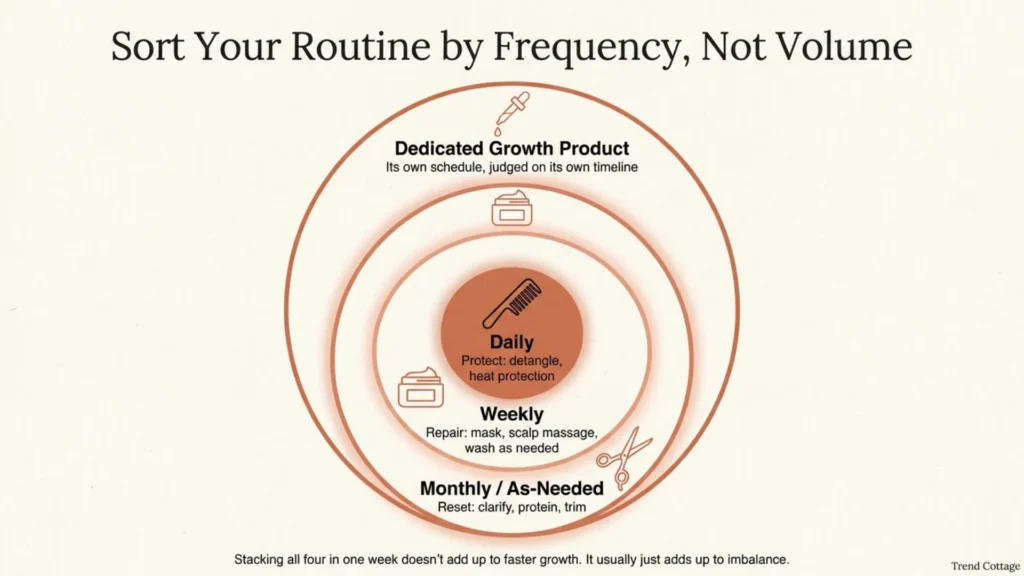
The idea that more products or more frequent treatments speeds up growth doesn’t hold up once you look at how hair actually works. Every hair on your head is already growing at whatever rate your genetics and health allow, and no amount of daily stacking changes that underlying pace. What daily overuse can do is throw hair out of balance long before it has a chance to grow longer.
A routine built around frequency instead of volume solves this. Each step gets assigned to how often it should realistically happen, based on what it actually does to your hair, not on how good it feels to add one more product to the shelf.
What Belongs in Your Daily Routine
Your daily routine should be doing the least, not the most. This is where protection lives: detangling gently before styling, using a heat protectant before anything hot touches your hair, and avoiding tight styles that pull on the hairline every single day. None of this is glamorous, and none of it involves a growth-focused ingredient, but skipping it undoes a lot of the more intensive work you do on other days.
If you’re using a leave-in conditioner or a lightweight oil on the ends daily, that’s fine, as long as it’s genuinely light. A daily product that leaves hair feeling coated or heavy by the next morning is doing more harm than good and belongs in your weekly rotation instead.
What Belongs in Your Weekly Routine
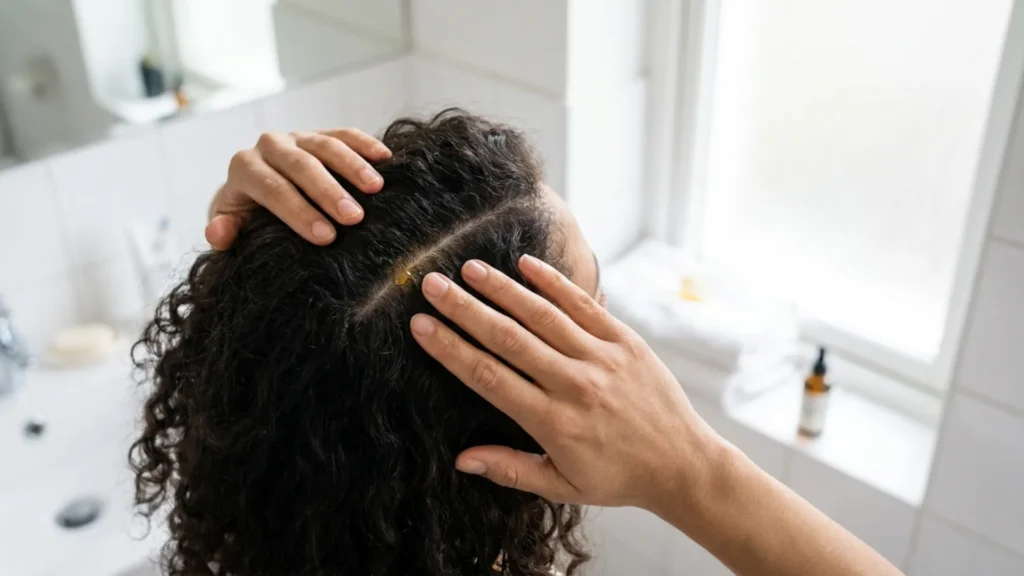
Weekly steps are where most of the real repair happens: a deep conditioning mask, a scalp massage to work in a lightweight oil, and washing based on how oily your scalp gets, since that varies enormously from person to person. Fine, oily hair might need washing every other day, while coarse or coily hair can often go a week or two between washes without a problem.
A weekly mask focused on protein or moisture, depending on what your hair needs that month, gives the strand time to actually absorb what you’re applying instead of just sitting on top of it. Scalp massage a few times a week, even just a couple of minutes while shampoo is already in your hair, is a low-cost way to work circulation and product distribution into a routine that’s already happening anyway.
Also Visit : Pro Tips for Faster Hair Growth Naturally at Home
What Belongs in Your Monthly (or As-Needed) Routine
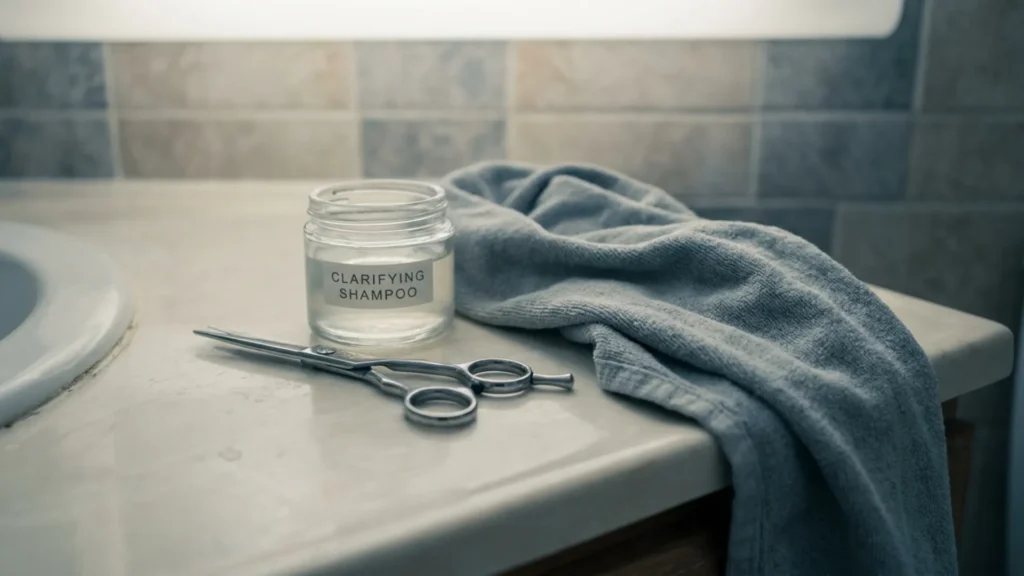
Monthly or as-needed steps are the ones people either skip entirely or overdo, and both mistakes cause problems. A clarifying wash to remove buildup from styling products, dry shampoo, or hard water should happen roughly once a month, more often if you use a lot of product, and it resets your scalp so weekly treatments can actually do their job.
Protein treatments belong here too, not in a weekly rotation. Hair genuinely needs protein to stay strong, but too much of it without enough moisture to balance it leaves strands feeling stiff and prone to snapping instead of stronger. A trim every eight to twelve weeks also belongs in this tier, since it removes split ends before they travel further up the strand and undo the length you’ve been growing.
Where Most Routines Go Wrong
Stacking too many active steps into the same week is where most routines quietly sabotage themselves. A protein mask on Monday, a clarifying shampoo on Wednesday, and a heavy oil treatment on Friday sounds thorough, but it gives your hair no time to actually settle between interventions. Every product on your head is competing for the same limited absorption, and piling them up doesn’t multiply the benefit, it just increases the odds that something cancels something else out.
The underlying growth rate doesn’t respond to how busy your week was. Hair growth runs on its own independent cycle at the follicle regardless of how many products touched the strand that week, so a packed routine isn’t buying you extra length, it’s just adding risk of irritation or imbalance for no real return.
Also Visit : Does Hair Growth Serum Really Work, or Is It Marketing?
If You’re Adding a Dedicated Growth Product
If you’re adding a dedicated growth product like a scalp serum, topical treatment, or supplement into this mix, give it its own space in the schedule rather than layering it into an already busy week. Supplements in particular need time before they mean anything: biotin deficiency is rare in people eating a normal diet, so unless a blood test says otherwise, a supplement is unlikely to speed things up no matter how consistently you take it.
A dedicated growth product also needs a fair, undisturbed trial period to show whether it’s doing anything at all, which is hard to judge if you’re also changing three other things in your routine at the same time.
How Long to Give Each Part of the Routine Before You Judge It
Different tiers of a hair growth routine earn different amounts of patience before you can fairly judge them. Daily protective habits show their value almost immediately, since less breakage from gentler handling is visible within a week or two. Weekly treatments like masks need four to six weeks of consistent use before you can tell if they’re actually helping.
| Frequency tier | What belongs here | How long to judge it |
|---|---|---|
| Daily | Gentle detangling, heat protection, a light leave-in if needed | One to two weeks |
| Weekly | Deep conditioning mask, scalp massage, washing matched to oil production | Four to six weeks |
| Monthly or as-needed | Clarifying wash, protein treatment, trims | Two to three months |
| Dedicated growth product | Serum, topical treatment, or supplement, only if a deficiency is confirmed | Two to three months minimum |
Monthly steps and dedicated growth products need the longest runway, often two to three months, since they’re working with a growth and shedding cycle that moves in months rather than days. Judging any of these too early is the single most common reason people bounce between products before any of them had a real chance.
When Your Routine Might Be the Problem
A hair growth routine can also become the problem itself, and it’s worth knowing the signs. Increased shedding, a scalp that’s suddenly itchy or tight, or hair that feels stiff and straw-like despite regular conditioning often points to overuse rather than an underlying health issue. Scaling the routine back to basics for two to three weeks is usually enough to tell the difference.
If shedding is sudden hair loss or bald patches that doesn’t improve once you’ve simplified the routine, that’s worth bringing to a dermatologist rather than continuing to adjust products on your own, since an underlying cause needs ruling out before any routine will help.
Also Visit : How to Choose Hair Growth Products That Fit Your Hair
Key Takeaways
- A hair growth routine works best sorted by frequency, not stacked with as many products as possible in one week.
- Daily steps should protect, weekly steps should repair, and monthly steps should handle protein, clarifying, and trims.
- Stacking too many active treatments into the same week can throw off the protein-moisture balance hair needs, not speed anything up.
- Give each tier a fair trial before judging it: days for daily habits, weeks for weekly treatments, months for anything monthly or growth-focused.
- Sudden or patchy shedding that doesn’t improve after simplifying your routine needs a dermatologist, not another product.
Frequently Asked Questions
What should a hair growth routine actually include?
At minimum, gentle daily protection, a weekly deep conditioning or mask step matched to your hair’s needs, and monthly maintenance like a trim and an occasional clarifying wash. Anything beyond that, like a dedicated growth serum, is optional and works best added on its own schedule.
How often should each step in a hair growth routine be done?
Daily for protective basics, weekly for deep conditioning and scalp massage, and monthly or as-needed for protein treatments, clarifying washes, and trims. Doing weekly or monthly steps more often usually causes more problems than it solves.
How long before a hair growth routine actually works?
Daily habits show up fastest, often within a week or two, since you’re mainly reducing breakage. Weekly treatments need four to six weeks, and anything monthly or growth-focused needs two to three months before it’s fair to judge.
Can doing too much in a routine actually hurt hair growth?
Yes. Layering too many protein treatments, heavy oils, or active ingredients in the same week can leave hair stiff, dry, or more prone to breakage, which looks like slower growth even though the follicle itself is unaffected.
This article is for general information only and isn’t medical advice. For sudden, patchy, or persistent hair loss, see a dermatologist or trichologist.
Written by Anna Anderson for Trend Cottage.