Hair Growth Challenge: How to Build One That Works

The most common mistake in a hair growth challenge isn’t impatience — it’s not knowing what you’re actually trying to change. Most people start one expecting their hair to suddenly grow faster. It won’t. Hair grows at a genetically fixed pace, roughly half an inch a month, and no 30-day protocol changes that number.
What a challenge can change is how much of that growth you keep. Length equals growth minus breakage. If your hair grows half an inch but snaps off a quarter-inch at the ends, you’ve gained almost nothing you can measure.
Quick answer: A hair growth challenge is a structured, time-limited protocol designed to support scalp health and reduce breakage, so natural growth becomes visible length. Done well, it takes at least 60 days to show results worth measuring.
What a Hair Growth Challenge Can (and Can’t) Change
Hair grows in cycles. Each strand moves through an active growth phase called anagen, a brief transitional pause called catagen, and a resting phase before it sheds, called telogen. The anagen phase for scalp hair lasts anywhere from two to seven years — and that ceiling is set by genetics, not by what you put on your scalp or swallow as a supplement.
What you can influence are the conditions that cut growth short or cause grown hair to snap before it reaches any real length. A congested or inflamed scalp, nutritional gaps, chronic stress, and mechanical damage from daily styling are all within your control. These are the levers a hair growth challenge actually pulls.
So the honest framing is this: a challenge doesn’t unlock faster growth. It removes the things that were slowing your visible progress down, often without you realising they were a factor at all.
Also Visit : The Hair Growth Secrets Behind a Healthier Scalp
Why Most Challenges Fall Apart Before Week Four
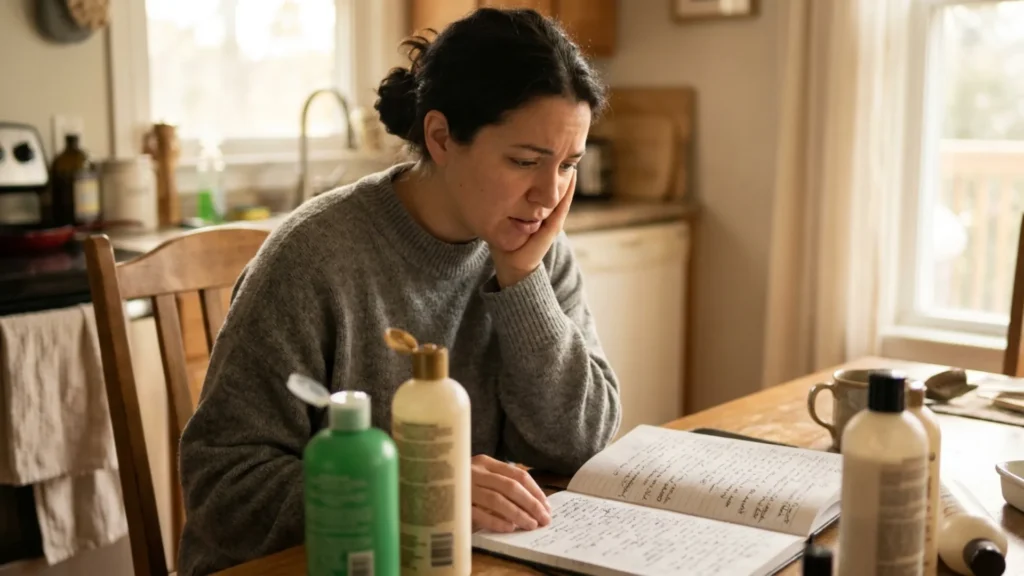
The failure usually isn’t motivation. It’s design. Most hair growth challenges circulating online are built like a mood board — drink more water, take biotin, massage your scalp, trim your ends. That’s a collection of vaguely connected habits, not a protocol. There’s no baseline, no structure, and no way to tell whether anything is actually working.
A few specific problems come up again and again:
- Starting without a baseline measurement. Without one, there’s nothing to compare results against. You can do eight weeks of genuine work and still not know whether anything changed, because you have no reference point.
- Chasing too many changes at once. If you add a new supplement, change your wash routine, start protective styling, and cut back on heat all at the same time, you can’t identify what’s helping. You learn nothing from the experience.
- Picking 30 days for a goal that biologically needs 60 to 90. Hair recovering from a stressful period, a nutritional dip, or a chemical service doesn’t reset in a month. The hair cycle alone means some changes won’t show up at the scalp surface for several weeks after you start.
- Tracking feelings rather than facts. “My hair feels softer” is real, but it isn’t a growth metric. A challenge without measurement stays permanently subjective.
Fixing these four design problems is what the rest of this article covers.
Setting a Baseline Before Day One

This step gets skipped more than any other, and it’s the difference between a challenge with evidence and one that just felt good to do.
On day one, take a length measurement using a soft tape measure held flat from your scalp to the tip of your hair. Measure at three consistent points — crown, nape, and one side — and write the numbers somewhere you won’t lose them. A timestamped photo of the measurements in your camera roll works perfectly.
Take a photograph the same day. Consistent lighting matters more than it sounds: the same hair can look like two different lengths under a bathroom bulb versus natural light. Pick one spot, one light source, one angle. Repeat that shot every two weeks for the duration of the challenge.
Two more things worth noting at the start:
- Your current shedding level. Most people lose roughly 50 to 100 hairs a day under normal conditions. If you’re losing noticeably more than that, record it — reduced shedding is often the earliest measurable sign that a protocol is working, appearing weeks before any length change shows up.
- Your hair porosity, if you know it. Low-porosity hair resists moisture; high-porosity hair absorbs it fast but loses it just as quickly. Knowing your porosity shapes which products and techniques belong in your protocol — and saves you weeks of guessing.
How Long Should Your Challenge Run?
The right timeline depends on what you actually want to see at the end. Here’s a plain breakdown of what each length can and can’t show:
| Challenge Length | What You Can Realistically Expect | Best For |
|---|---|---|
| 30 days | Habit formation, possible improvement in scalp feel, early reduction in shedding | Resetting a neglected routine; testing whether a product suits your scalp |
| 60 days | Roughly 1 inch of potential new growth, measurable change in breakage, results that span more than one phase of the hair cycle | Most people — long enough to see real progress without losing momentum |
| 90 days | Around 1.5 inches of potential new growth, clearer before-and-after photos, enough data to adjust the protocol with confidence | Anyone recovering from damage, a prolonged stressful period, or a heavy chemical service |
The word “potential” in that table is doing real work. Half an inch a month is the average, but individual rates vary and visible gains depend heavily on how much breakage you prevent. Sixty days is the minimum that gives you a result worth reading.
Also Visit : Hair Growth for Black Women: What Actually Works
Building the Protocol: Two Pillars, Not Twenty Habits
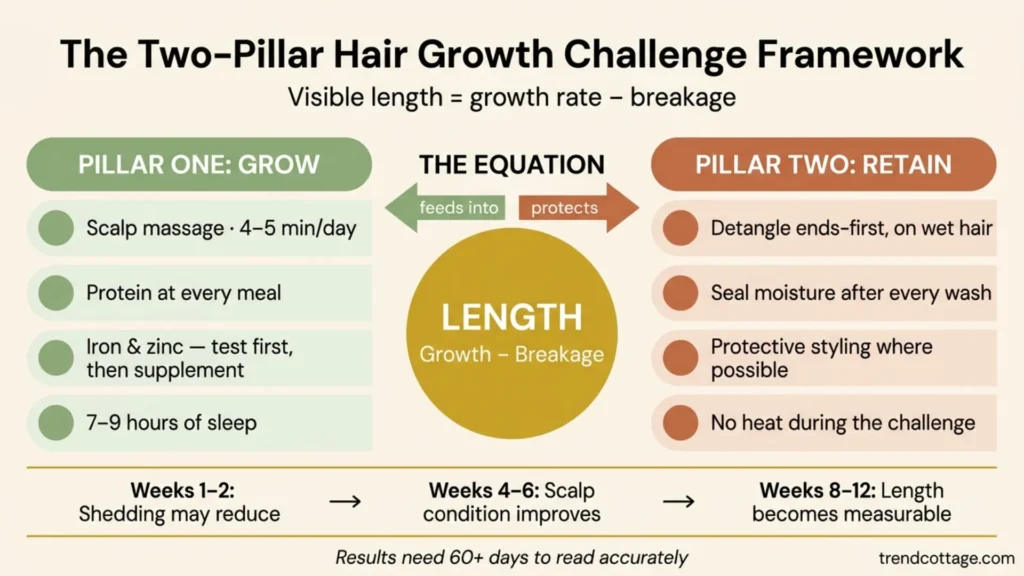
The simplest way to build a protocol that doesn’t collapse under its own weight is to sort every habit into two categories: what supports growth at the root, and what protects the length you already have. Everything in a hair growth challenge belongs to one of these two pillars.
Pillar one — scalp and internal health. The follicle sits in the scalp and responds to blood flow, nutrition, and inflammation levels. You don’t need all of the following; pick two or three based on where your actual gaps are:
- Scalp massage for 4–5 minutes daily. A 2016 study found that people who maintained a standardized scalp massage routine over 24 weeks showed increased hair strand thickness compared to their starting measurements, with the proposed mechanism being mechanical stretching of the dermal papilla cells that regulate follicle activity. It takes no product and costs nothing.
- Adequate protein. Hair is made of keratin, which is a protein, and a diet genuinely short on it does show up as increased shedding and more fragile strands. You don’t need to overhaul your eating habits — just be honest about whether your current diet is covering the basics.
- Iron and zinc, if shedding is your main concern. Both nutrients are linked to hair cycle disruption when they run low. The NIH Office of Dietary Supplements notes that biotin deficiency is uncommon in people eating a varied diet, meaning a biotin supplement is often unnecessary if your meals are reasonably balanced. Iron and zinc deficiencies are more common, particularly in people who menstruate. A blood panel tells you more than any supplement taken blind.
- Sleep. Growth hormone is released during deep sleep, and hair follicles are one of its targets. Chronic poor sleep disrupts this pathway, quietly and consistently. It’s not the most exciting addition to a challenge, but the biology behind it is real.
Pillar two — length retention. This is the pillar most challenges skip, because retention habits feel less exciting than a new growth serum. But if your ends are breaking off faster than your roots are producing, no amount of scalp massage will show up as visible length.
- Reduce mechanical damage. Tight elastics, rough-towel drying, and detangling dry hair all break strands. Switching to a microfibre towel or a soft cotton T-shirt for drying, and working a wide-tooth comb from the ends upward on conditioned, wet hair, makes a measurable difference over 60 days.
- Seal moisture after every wash. Dry, brittle ends break. The habit is: wet hair, a conditioner or leave-in, then something to seal — a light oil or butter. The specific product matters far less than doing this consistently.
- Limit heat for the challenge duration. You don’t need to give it up permanently. A 60–90 day break lets you see what your hair does without it, and removes one of the main causes of mid-shaft breakage.
Three or four solid habits done consistently will outperform twelve done halfway. Keep the list short enough to follow on a tired Wednesday evening — that’s the real test of whether a protocol is sustainable.
What to Track Each Week
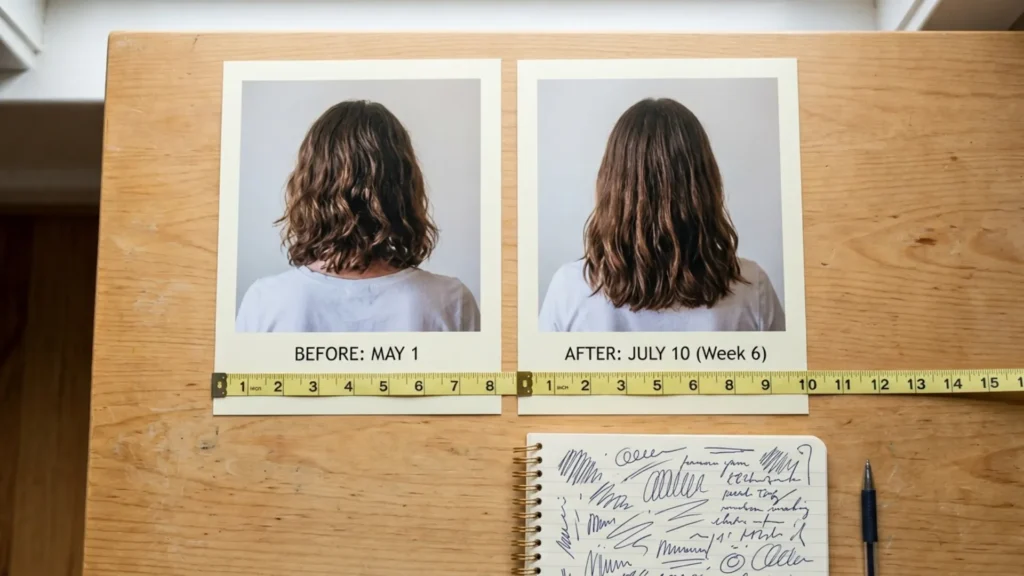
Tracking doesn’t need to be elaborate. Once a week, spend five minutes on these four things:
- A photo from your standard angle in your standard light
- An honest note on shedding — more, less, or roughly the same as the week before?
- How your ends feel — soft and flexible, or dry and rough? End condition is your most direct signal for how retention is going
- Whether you followed the protocol, and what slipped if anything did
Every two weeks, take a length measurement at the same three points as your day-one baseline. These are the numbers that tell the real story of your hair growth challenge.
What you don’t need to track: how your hair feels on a random Tuesday morning, whether it looked different on one particular day, or how a product felt after one use. Daily texture shifts come from humidity, water hardness, and sleep position. They’re real, but they don’t reflect growth or retention trends — tracking them just creates noise without signal.
Also Visit : Do Hair Masks for Hair Growth Really Work?
Reading Your Results Without Fooling Yourself

At the end of 60 or 90 days, compare your final measurements to your day-one baseline. At an average growth rate, a 60-day challenge should show roughly one inch of new growth. If your measurements show more than that, retention improved — more of the growth was actually being kept. If they show less, breakage is still winning, and pillar two needs more focus in the next round.
Photos are useful but imprecise. Curl shrinkage, head position, and lighting shifts make hair photography unreliable for measuring exact length. Use photos to assess texture, density, and end condition — not to argue about millimetres.
One thing that trips people up: the first two to four weeks of any new protocol tend to show the least visible change. The hair cycle means follicles already in the resting phase need to complete their cycle before new growth surfaces. Progress that feels slow at week two often looks genuinely different by week eight. This is normal, and it’s the clearest reason a 30-day window is a limited format for a goal with this kind of biological lag built into it.
If, after a genuine 90-day challenge with consistent tracking, you’re still seeing heavy daily shedding, thinning at the crown, or a widening part, those are signs worth discussing with a dermatologist rather than adjusting your product list. A challenge addresses lifestyle and mechanical factors. It isn’t designed to diagnose or treat a clinical cause of hair loss.
Frequently Asked Questions
Does a hair growth challenge make hair grow faster?
No — not in the sense of exceeding your genetic growth rate. What a well-designed challenge does is reduce the obstacles to visible progress: scalp issues, nutritional gaps, and breakage. The growth rate stays roughly fixed; more of it accumulates as length because less is being lost along the way.
How do I know if my challenge is working?
Your measurements tell you. With a day-one baseline and checkpoints every two weeks, you can see whether length is accumulating at or above the rate your growth rate would predict. Reduced shedding is usually the first measurable sign, often showing up weeks before any length change does.
Do I need to buy specific products to run a hair growth challenge?
No. The most impactful habits — daily scalp massage, reduced heat, protective styling, better sleep, consistent moisture sealing — cost nothing or very little. Products matter at the margins. Spending on serums while still rough-towel-drying and detangling dry won’t produce results that changing those two habits would.
Can I do a hair growth challenge with chemically treated hair?
Yes, with adjustments. Chemically processed hair is more prone to breakage at the points of overlap, which makes retention habits even more critical. Avoid layering chemical services during the challenge period, handle the hair with extra care at those overlap points, and consider a protein treatment if strands feel limp or snap easily when stretched gently.
What if I don’t see results after 90 days?
Start by reviewing the tracking data honestly. If measurements are consistent and still show minimal change, look at root causes rather than product choices: iron levels, thyroid function, and chronic stress are common factors that a lifestyle challenge alone can’t address. A GP or dermatologist can run a blood panel that tells you more in one appointment than months of experimenting would.
Key Takeaways
- A hair growth challenge doesn’t make hair grow faster — it removes the breakage and scalp issues that were stopping growth from showing up as visible length.
- Most challenges fail because they skip the baseline measurement, choose too short a timeline, or try to change too many things at once.
- Sixty days is the minimum for results worth measuring; 90 days is better when recovering from damage or a prolonged stressful period.
- Build the protocol around two pillars only: scalp and internal health, and length retention. A short list done consistently beats a long list done halfway.
- Track length measurements and shedding from a set baseline every two weeks. Day-to-day feelings aren’t data.
If this gives you a clearer structure than the usual challenge checklist, save this page before you start — a challenge with a real plan is a different thing entirely. Drop your day-one measurements in the comments if you want a record somewhere you’ll find it again, or share what’s worked and what hasn’t in previous attempts.
This article is for general information only and isn’t medical advice. For persistent hair loss, scalp pain, or sudden changes in shedding, see a dermatologist or trichologist.
Written by Anna Anderson for Trend Cottage.