Hair Growth Tips That Actually Change Your Rate

Most hair growth tips focus on what you apply to your strands. That’s logical: products are easy to buy and the marketing is convincing. The problem is that once a hair strand emerges from the follicle, it’s already made of dead protein. You can condition it, protect it, and reinforce the surface, but nothing topical changes how fast the scalp below produces new length.
Quick answer: The average scalp grows about half an inch of hair per month, or roughly six inches a year. No habit pushes meaningfully past that ceiling, which genetics controls. What the right habits can do is stop the rate from dropping below your natural potential: keeping follicles healthy, reducing excess shedding, and preventing breakage from cancelling out the length your scalp is already producing.
The difference between someone gaining length steadily and someone stuck at the same length for years is almost always in those three areas. Not in the raw growth speed.
What Your Growth Rate Is Actually Made Of
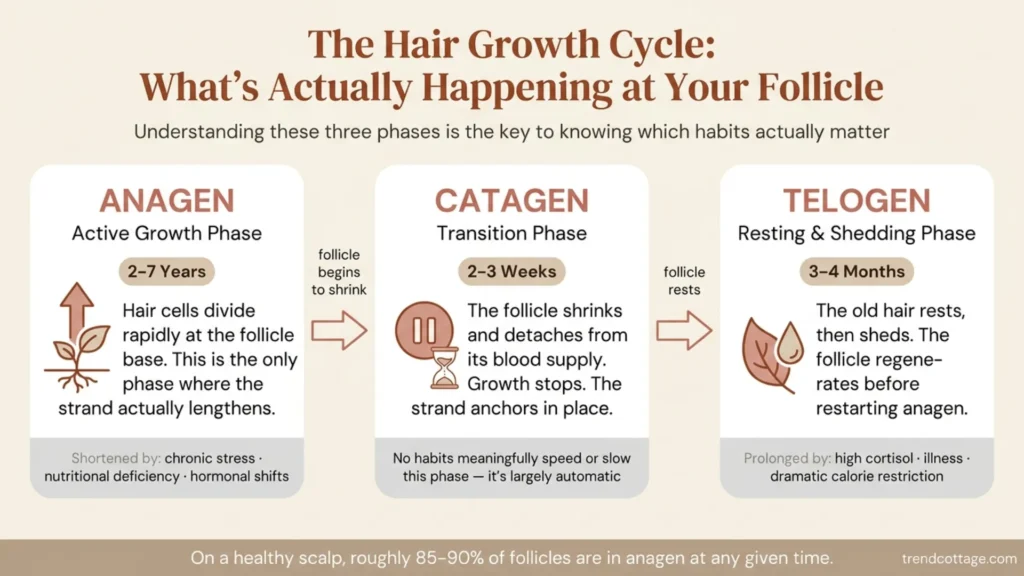
Hair doesn’t grow continuously. Each follicle cycles through three phases on a loop. The anagen phase (active growth) lasts two to seven years, depending almost entirely on your genetics. Catagen follows: about two to three weeks where the follicle shrinks and pulls away from its blood supply. Then comes telogen, a three-to-four-month resting period that ends with the old hair shedding and the cycle restarting.
At any given moment, roughly 85 to 90 percent of your follicles are in anagen. Fifty to a hundred hairs shed per day falls within what the American Academy of Dermatology describes as normal daily hair shedding. What pushes that number higher is when an unusual share of follicles shifts to telogen at once — a response to physical stress, low nutrition, hormonal shifts, or illness.
That’s the key reframe. Most effective hair growth tips aren’t making follicles work faster. They’re preventing anagen from cutting short earlier than it should. That’s a different problem, and it’s a solvable one.
Hair Growth Tips Start With the Scalp
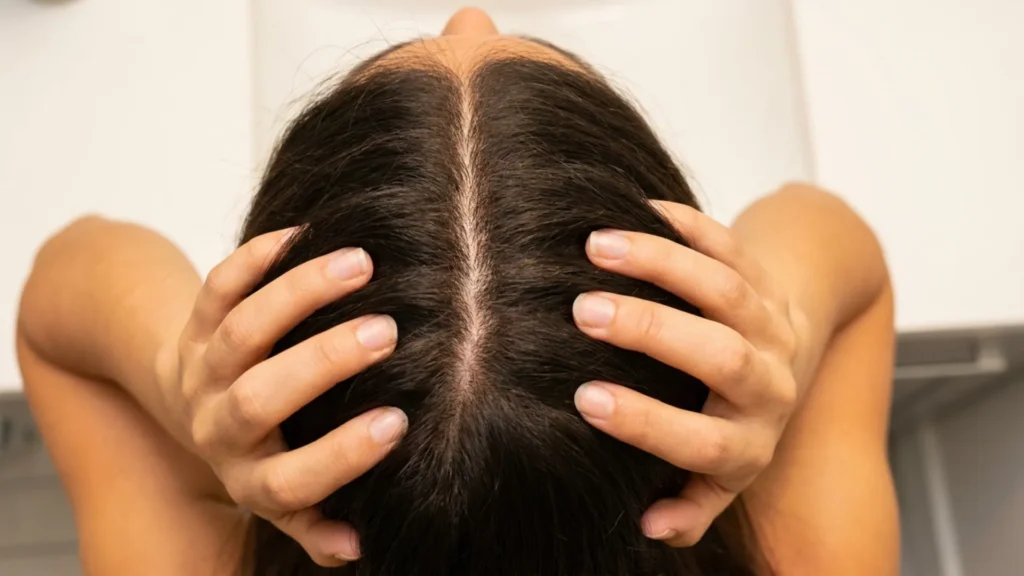
Each follicle is a small, living structure that needs oxygen and nutrients delivered through blood flow. Habits that support scalp circulation and keep chronic inflammation low protect that environment, not as a dramatic fix, but as the baseline the follicle needs to stay in anagen.
Scalp massage is the most studied habit in this category. A 2016 study published in ePlasty found that participants performing nine minutes of daily scalp massage for 24 weeks ended up with measurably thicker hair strands [EXTERNAL SOURCE NEEDED: Koyama T et al., ePlasty 2016, “Standardized Scalp Massage Results in Increased Hair Thickness by Inducing Stretching Forces to Dermal Papilla Cells in the Subcutaneous Tissue”]. The proposed mechanism is mechanical: pressure at the scalp stretches the dermal papilla cells at the follicle base, which appears to trigger a growth-promoting response. Four minutes per session is the practical minimum that’s been studied, using fingertips (not nails) with slow circular pressure across the whole scalp.
Sebum and product residue also accumulate around the follicle opening over time, creating a low-grade inflammatory environment that’s bad for follicle health. A clarifying shampoo used once a month, or more often with heavy product use, clears this without stripping the scalp’s natural barrier.
Persistent itching, tightness, or flaking tells you the scalp’s environment isn’t stable. Chronic scalp inflammation doesn’t resolve on its own, and growth serums layered over it don’t address the problem at the source.
Also Visit : How to style fine hair for fuller volume every day
What Your Body Needs to Build Hair
Hair is made almost entirely of keratin, a fibrous protein. The body needs adequate dietary protein to produce it, and when intake drops substantially, hair is one of the first non-essential functions to slow. No supplement fixes this; getting enough from regular food does.
Of all the nutrients connected to hair growth, iron is the most commonly overlooked. Low ferritin (stored iron, not just the iron level on a standard blood panel) has been connected to increased shedding and shorter active growth periods in women. If you’re losing more hair than usual and your diet and scalp both look healthy, asking your doctor to test ferritin specifically is a low-effort first step.
Biotin is the supplement most aggressively marketed for hair growth. The NIH Office of Dietary Supplements confirms that biotin deficiency can cause hair loss, but genuine deficiency is uncommon in people eating a varied diet. Supplementing when you’re not deficient won’t accelerate growth; the evidence doesn’t support that.
Cutting calories dramatically is one of the most reliable ways to trigger a growth disruption. Very low intake pushes the body into conservation mode, and hair is deprioritised. The shedding typically shows up two to four months after the restriction ends, which is why the connection is so often missed.
The Length-Retention Problem
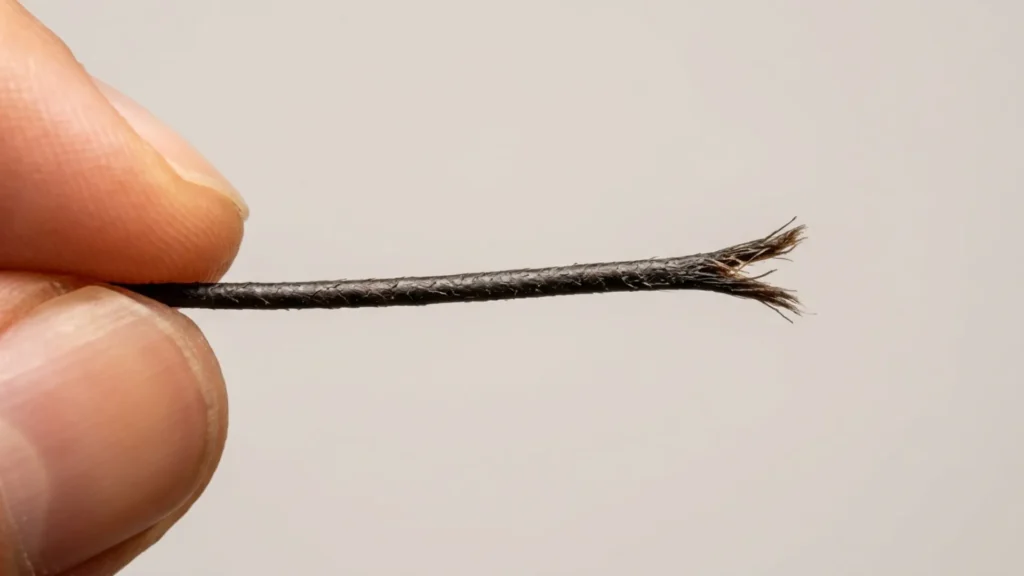
This might be the most practically useful section in this article, because most people don’t know they have this problem.
If your scalp grows six inches of hair a year but two or three of those inches break off before you can see them, you end up with only three or four inches of apparent growth. It feels like hair refuses to grow. The growth was real. The retention wasn’t.
Feeling stuck at the same length for years is almost always a retention problem, not a growth problem. The hair is growing. It’s breaking faster than it’s being kept.
Breakage concentrates at the weakest points in the strand: wherever the cuticle has been damaged repeatedly. The usual spots are around elastic bands worn in the same place every day, the hairline under tight styles, the mid-shaft where heat tools hit most often, and the ends, which are the oldest and most porous part of the strand.
Habits that directly reduce breakage:
- Detangle from the ends upward, working toward the root, not the other way around
- On wet hair, use a wide-tooth comb or fingers; a bristle brush on soaking-wet strands causes snapping
- A silk or satin pillowcase (or a satin bonnet worn overnight) prevents the friction that roughens the cuticle on cotton
- Keep heat tools below 180°C (350°F) on fine or colour-treated hair, and apply a protectant first
- Alternate tight styles with looser ones; consistent tension at the hairline can cause gradual follicle damage — slow to develop and slow to reverse
Moisture and protein balance matters here too. Hair that’s chronically dry snaps easily; hair that’s been over-treated with protein goes brittle. Most people lean toward the dry side and benefit more from regular hydrating conditioners than from frequent protein treatments.
Also Visit : How to DIY Hair Highlights at Home Without Foil (7 Methods That Actually Work)
Stress, Sleep, and the Growth Cycle

Telogen effluvium is the clinical term for temporary, diffuse shedding triggered by something that puts the body under significant strain: surgery, illness, childbirth, severe weight loss, or sustained psychological stress. Chronically elevated cortisol appears to suppress the activity of dermal papilla cells and can push an unusually high share of follicles into the resting phase at once.
People often can’t make the connection because telogen lasts three to four months before shedding begins; by that point, the triggering event has often passed and the hair loss seems to come from nowhere.
Sleep affects the equation differently. Growth hormone, which drives cellular repair and regeneration throughout the body, is released mainly during deep sleep. Chronic sleep deprivation doesn’t cause a sudden, dramatic change in hair growth, but it quietly erodes the recovery processes that keep follicles functioning well over time.
None of this means you can meditate your way to faster growth. What it does mean is that if your scalp health and nutrition are solid and you’re still shedding more than usual, stress and sleep quality are worth examining, not as a last resort, but as an equally valid variable in the same category as everything else.
How to Tell If Anything Is Working

The most common reason hair growth tips don’t seem to produce results isn’t that they’re ineffective. It’s that people stop before the lag period resolves.
Hair growing now reflects follicle conditions from months past. Any change you make today (better scalp habits, dietary adjustments, less heat damage) takes at least three months to show up as measurably different new growth. Six months is a more honest window for drawing any real conclusions.
A tracking method that actually works: photograph your hair from the same angle and in the same light on the first of each month. Separately, measure from the scalp to the tip of a section at the nape. That spot is easiest to compare consistently, since it isn’t affected by styling choices the way the rest of the hair is. Six months of measurements gives you a trend line that actually means something.
Healthy progress looks like roughly half an inch — about 12 millimetres — of net new length per month when retention is solid, slightly less during or after chemical processing. If you’re consistently seeing much less than that, the gap between growth rate and breakage rate is the first place to investigate.
Also Visit : How to Protect Natural Hair From Heat Damage (2026 Guide)
Frequently Asked Questions
Can you actually make hair grow faster?
Marginally, in specific situations, but the ceiling is genetic, not habitual. Most hair growth tips work by preventing the rate from dropping below your natural potential, not by pushing past it. Keep the follicle environment healthy, reduce excess shedding, and stop breakage from erasing what you’ve grown, and you’ll see most of what your genetics allow.
How long before a new routine shows results?
Give it at least three months before drawing any conclusions, and six months for a fair picture. The hair you’re currently growing reflects what your follicles experienced months ago, not what you started doing last week. Consistency over that window is what separates people who see changes from those who don’t.
Does brushing your scalp stimulate growth?
Some stimulation happens, but aggressive or frequent brushing is more likely to cause breakage than meaningful growth. A focused four-minute scalp massage with fingertips achieves more with less risk. Brushing is most useful as a detangling and sebum-distribution tool, not a growth method.
Is shedding 50 to 100 hairs a day normal?
For most people, yes. The scalp has around 100,000 follicles, and those in the telogen phase shed naturally at the end of each cycle. Fifty to a hundred strands a day is within the normal range; it tends to look like more than it is, especially on wash days when already-detached hairs come loose at once. Sustained shedding well above that, particularly with visible thinning, is worth discussing with a dermatologist.
Does trimming your ends make hair grow faster?
No. Trimming affects only the strand’s tip, not the follicle, and follicles are where growth happens. What a trim does is remove split ends before they travel further up the shaft, which reduces breakage and helps you keep the length you’ve already grown. Results look like faster growth because you’re losing less to damage, not because the rate itself changed.
Key Takeaways
- Your natural growth rate is largely genetic. Hair growth tips work by protecting that rate from dropping, not by pushing past it.
- Scalp health (blood flow, cleanliness, low inflammation) is the foundation everything else builds on.
- Adequate protein and healthy ferritin levels matter more for growth than any supplement. Biotin only helps if you’re genuinely deficient.
- Most people who feel stuck at the same length have a retention problem. Reducing breakage often produces more visible change than chasing growth speed directly.
- Stress and poor sleep affect the growth cycle through cortisol and hormone patterns, and their effects show up months later, which makes them easy to overlook.
If any of this shifts how you’re thinking about your routine, save this post for the next time you’re wondering why your hair doesn’t seem to be growing. Or drop a question in the comments about what you’ve tried and where you’re stuck.
This article is for general information only and isn’t medical advice. For persistent hair loss, scalp pain, or sudden shedding, see a dermatologist or trichologist.
Written by Anna Anderson for Trend Cottage.