How to Build a Coily Hair Care Routine That Lasts

Most people build a coily hair care routine around wash day and forget the other six days. The hair gets a great Sunday, a dry Wednesday, and a tangled Friday.
A coily hair care routine has to cover the whole week, and tight coils make that trickier than it sounds. Scalp oil has a long, twisty road to travel down each coil, so the roots often feel fine while the ends stay dry.
Quick answer: A coily hair care routine that lasts has three parts. Wash every one to two weeks, add a five-minute water-and-sealant refresh midweek, and cover your hair with satin at night. Start with those three, then add one step at a time only when your hair asks for it.
Start With the Smallest Routine That Works
Long routines fail because they’re built for your best day. A twelve-step wash day sounds lovely until it’s 9 p.m., you’re tired, and your hair is still wet. A routine you skip isn’t a routine.
So begin small. Three habits carry most of a coily hair care routine: one proper wash day, one midweek refresh, and one nightly cover. Everything else, from steamers to scalp serums, is optional extra credit.
Why those three? Coily hair bends sharply, and every bend is a spot where the strand can be a little more fragile. The bends also slow scalp oil down, and shrinkage packs your length into a small space where strands rub and tangle. Water and conditioner deal with dryness. Gentle handling deals with breakage. A satin cover cuts down the rubbing overnight.
Also Visit : Hair Care Routine After Wash: What Actually Matters First
Your Coily Hair Care Routine, Day by Day
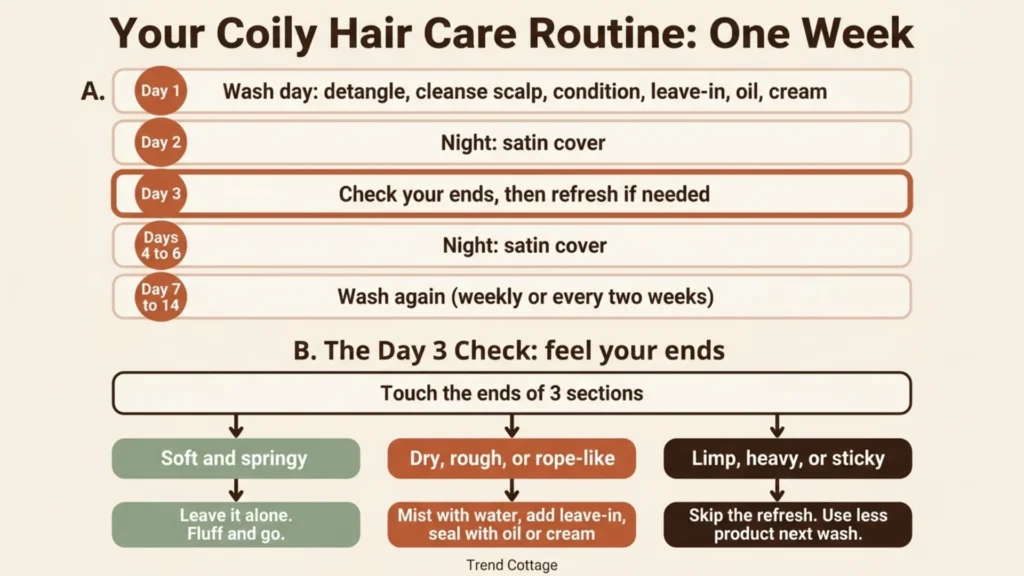
Here’s the whole week in one line: wash on day 1, check your hair on day 3, cover it every night. The sections below unpack each piece.
Day 1: Wash day
Plan on two to three hours the first few times, plus drying. It gets quicker once your hands learn the order. Divide your hair into four to six sections, clip them up, and unclip one at a time. Sections keep coils from knotting into each other while you work.
Loosen tangles first, while the hair is damp and slippery with conditioner or oil (the detangling section below shows how). Then cleanse. Shampoo goes on the scalp only. The suds that run down are plenty for the lengths, and scrubbing shampoo through dry ends just roughs them up. If your hair feels squeaky and stiff afterwards, try a gentler, sulfate-free formula. If flakes keep showing up between washes, read up on the symptoms and causes of dandruff, since it’s common and treatable.
Next comes conditioner. Smooth it on from the ends upward, leave it for a few minutes, and rinse most of it out. Every second or third wash, swap in a deep conditioner and sit under a plastic cap for 20 to 30 minutes. Many people add gentle warmth, like a hooded dryer or a warm towel over the cap, to help the product settle in.
Now style while the hair is still dripping wet, because coils clump best then. The layering order most people use is called LOC: liquid (a water-based leave-in), oil to seal it in, then a cream to hold the shape. Some people swap the last two, which is called LCO. Both work. Pick one and stay with it for a few washes before you judge it.
Let it air dry, or use a diffuser on low heat. Skip the rough towel rub. A cotton T-shirt or microfiber towel presses water out without ruffling the surface.
Day 3: The check and the refresh
Here’s a small habit that saves a lot of guesswork. On day 3, touch the ends and middle of a few sections. How they feel tells you what to change.
- Soft and springy: leave it alone. Fluff any flat spots and move on.
- Dry, rough, or rope-like: moisture is leaving. Mist with water, add a dab of leave-in, and seal with oil or cream. On your next wash day, use more leave-in or deep condition more often.
- Limp, heavy, or slightly sticky: you’re using too much product. Skip the refresh and cut the amount at your next wash.
The refresh itself takes about five minutes. Dampen your hair with a spray bottle, working section by section from the ends. Smooth on a small amount of leave-in, then seal with a light cream or oil. Don’t soak the whole head. That just undoes the style you set on day 1.
Every night: Cover your hair
Cotton pillowcases can pull moisture from your hair and rough up the surface of the strands as you move. A satin or silk bonnet, scarf, or pillowcase cuts down on both. If bonnets slip off in your sleep, try a satin-lined cap or switch to a satin pillowcase. For twist-outs and wash-and-gos, gather the top into a loose pineapple ponytail first so the coils don’t get squashed.
How to Detangle Without Breaking Strands
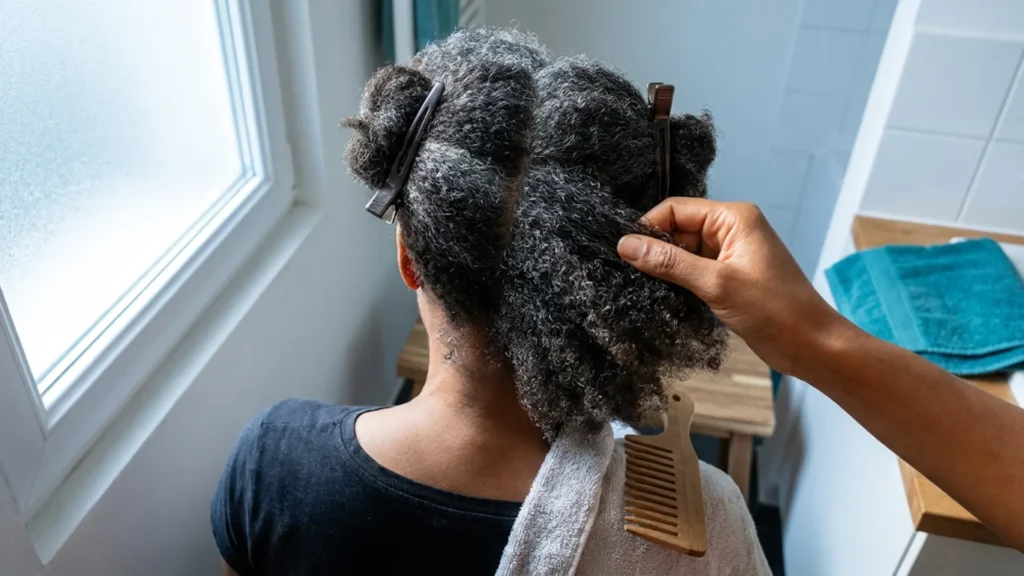
Detangling is where a lot of breakage happens, and it’s usually rushed. Coils wrap around each other by nature. That’s their shape, not a sign of damage.
Do it on damp hair with plenty of slip. Conditioner, a detangling spray, or a light oil all give the strands something to glide on. Dry hair is far more likely to snap.
Start with your fingers. Pull each section apart gently and free any knots you can feel before a comb goes anywhere near. Then use a wide-tooth comb or detangling brush, starting at the ends and moving up in small steps. Going root to tip pushes every knot down into the strand below it.
Finish one section, twist it loosely, clip it away, and take the next. If you hit a snag that won’t budge, stop. Add more product and work at it from the edge. A stubborn knot usually needs a few minutes of patience and a little oil, not a harder pull.
Expect to see a good amount of hair come out on wash day. Shed hairs collect in the coils between washes, so that’s normal. Broken pieces tend to be short and uneven. If you’re mostly seeing short pieces, slow down and add more slip. If shedding seems much heavier than usual for several weeks, or you notice thin patches, see a doctor or dermatologist.
Also Visit : What’s the Best Dyed Hair Care Routine for Color That Lasts?
Choosing Products for Each Step
A good coily hair care routine doesn’t need a shelf full of bottles. One product per job is enough to start, and changing one at a time shows you what’s really working.
| Step | What it does | What to look for |
|---|---|---|
| Shampoo | Cleans the scalp and lifts buildup | A gentle cleanser for regular use, plus a clarifying one for occasional buildup |
| Conditioner | Softens hair and gives it slip for detangling | A creamy, slippery feel; fatty alcohols such as cetyl or cetearyl alcohol on the label |
| Deep conditioner | Adds extra softness every second or third wash | A thicker mask you can leave on under a cap |
| Leave-in | Puts a layer of water-based moisture on the hair | Water as the first ingredient |
| Oil | Seals moisture in | Lightweight options like jojoba or grapeseed for fine strands; heavier oils for thick, dry ends |
| Cream or butter | Holds moisture and helps coils clump | Shea butter-based creams if your hair is thick and dry |
Read labels from the top down, since ingredients are listed from most to least. Test any new product on a small patch of skin, like behind your ear or on your inner arm, for a day before it goes near your scalp. If a product causes burning or a rash, stop using it, and see a dermatologist if it doesn’t settle.
When the Routine Isn’t Working

Every coily hair care routine needs tuning. These are the problems that come up most, and the first thing to change for each one.
- Hair feels dry by day 2. Add a deep condition to wash day, and make sure you’re sealing with oil or cream after the leave-in. Water alone evaporates.
- Tangles and knots form fast. Cover your hair at night and style in smaller sections. Snip single-strand knots (sometimes called fairy knots) with small, sharp scissors.
- Hair looks dull and product feels stuck on. Buildup is the likely cause. Use a clarifying shampoo once, follow it with a deep conditioner, and use less product afterward.
- Scalp is flaky or itchy. Dry skin, product residue, and dandruff can all cause it. Wash more gently and rinse thoroughly. If itching lasts more than a few weeks, see a dermatologist.
- Hair doesn’t seem to grow. Length is often lost to breakage or hidden by shrinkage rather than stalled. Stretch a section out to see its real length, and look for short broken ends.
Change one thing at a time and give it two or three washes. Swap five products at once and you’ll never know which fix worked.
Protective Styles and Trims

Twists, braids, and buns tuck your ends away, which cuts daily handling. They suit busy weeks and cold, dry weather. Protective styles can sit inside your coily hair care routine, but they shouldn’t replace it.
They only help if the hair underneath is looked after. Moisturize the lengths every few days, keep your scalp clean, and take the style down before shed hair and new growth turn it into one big tangle. Think weeks, not months.
Tension matters too. Styles that pull at your edges or leave your scalp sore can cause a hair loss called traction alopecia. If a style hurts, loosen it or take it out.
As for trims, snip a small amount when you see split ends or single-strand knots, so the damage doesn’t travel up the strand. Many people do this a few times a year. Some do it more often. Your ends will show you.
Also Visit : How to Pick Hair Care Routine Products What You Actually Need
Key Takeaways
- Three habits carry a coily hair care routine: a wash every one to two weeks, a midweek refresh, and a satin cover at night.
- On day 3, feel your ends. Dry means seal more. Heavy means use less.
- Detangle damp hair with slip, using fingers first, then a wide-tooth comb from the ends up.
- Change one product or step at a time, and wait two or three washes before you judge it.
- Loosen or remove any style that hurts your scalp.
Questions About Coily Hair Routines
Can I wash coily hair every day?
Most people with coily hair don’t need to, and frequent shampooing can leave hair drier unless you condition well afterwards. If you work out daily, rinse with water between shampoos, or cleanse with a conditioner-only wash (called co-washing).
How long until a new routine shows results?
Softer, more defined coils often show up within a few washes. Length is slower. Hair grows gradually, so keeping more length shows up over months, not weeks.
What’s the difference between LOC and LCO?
Both layer the same three things: liquid, oil, and cream. LOC puts oil before the cream, and LCO puts the cream before the oil. Try each for a few washes and keep the one that leaves your hair softer for longer.
Save this coily hair care routine for your next wash day, and tell us in the comments which step you’ll try first.
Written by Anna Anderson for Trend Cottage.