How to Build a Natural Hair Care Routine That Actually Holds

Most natural hair routines don’t stop working because of the products. They stop working because the steps are in the wrong order — or because the routine was quietly borrowed from someone with a different hair type, different porosity, different water.
Quick answer: A natural hair care routine that holds comes down to three things: a clean scalp, moisture applied in the right sequence for your porosity, and a sealant that locks it in before it escapes. Get the sequence right and the products you already own will perform better than anything new in a bottle.
What follows isn’t a product list. It’s a framework for understanding why certain steps come before others, what goes wrong when they don’t, and how to adapt the structure when your hair stops cooperating.
Why Most Natural Hair Routines Fall Apart
The most common version of routine failure looks like this: you follow a new routine carefully for six weeks, your hair responds, and then somewhere around week eight it stops. Same products. Different results. The instinct is to blame the formula.
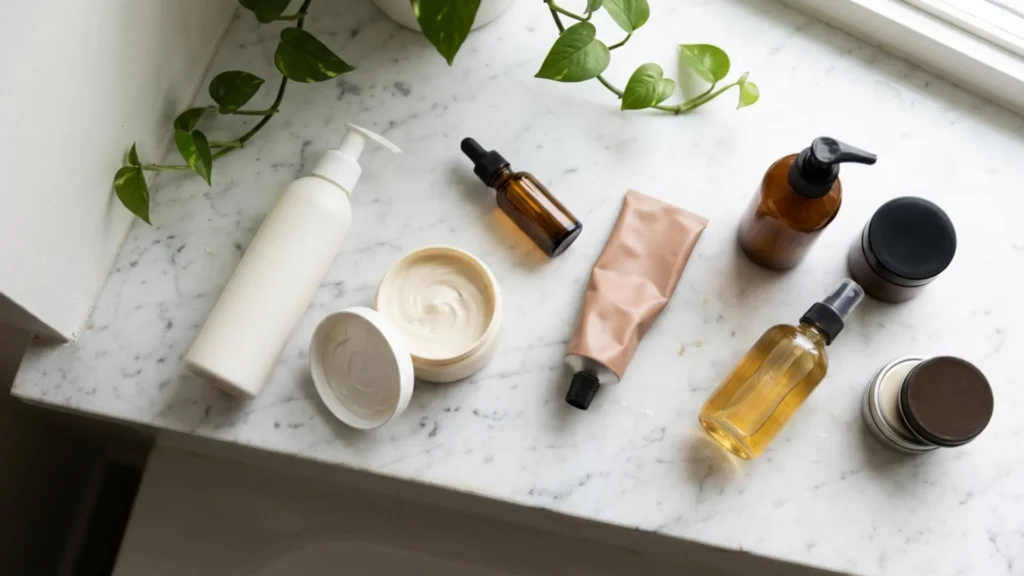
What’s usually happening is one of three things. Buildup from a butter or cream that never fully penetrated is now sitting on the hair shaft and blocking whatever you apply on top. Or the hair’s moisture needs have shifted — routines built for humid summer air often feel completely wrong by autumn because dry air pulls water from the strand faster. Or, most overlooked: the steps were never quite in the right order to begin with, and the early results came from the products working despite the routine, not because of it.
Understanding which of those three is your situation tells you exactly what to fix. It’s almost never “buy something new.”
Also Visit : Build a Hair Care Routine for Thick Hair Step by Step
Start With the Scalp, Not the Strands
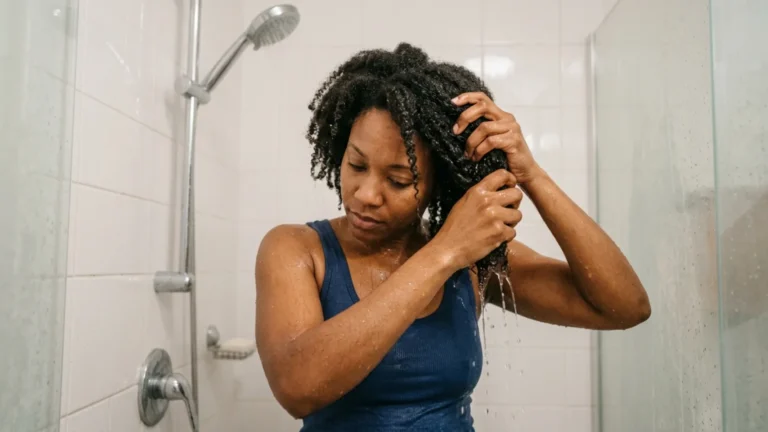
Hair grows from follicles embedded in the scalp. When that environment is congested with oil, dead skin, or product residue, strands are emerging from a blocked root before they’re even an inch long. Most routines treat the scalp as something that gets conditioner rinsed across it — not something that needs attention of its own.
The first real step of any natural hair care routine is a proper cleanse. For most hair types, that means rotating between a clarifying shampoo and a gentler moisturising shampoo or co-wash. The American Academy of Dermatology’s healthy hair tips put scalp care at the centre of healthy growth — a clean, balanced scalp is the condition hair needs to behave normally. Product buildup from heavy butters and creams accumulates faster on natural hair because tight curl patterns trap residue close to the root.
How often you clarify depends on how heavy your styling products are. Using a butter or dense cream every wash day means a clarifying shampoo at least once a month — that’s a floor, not a luxury. Co-washing weekly without periodic clarifying lets residue pile up faster than most people expect.
Once the scalp is actually clean, everything else in the routine absorbs the way it’s designed to.
Porosity Changes the Order of Everything
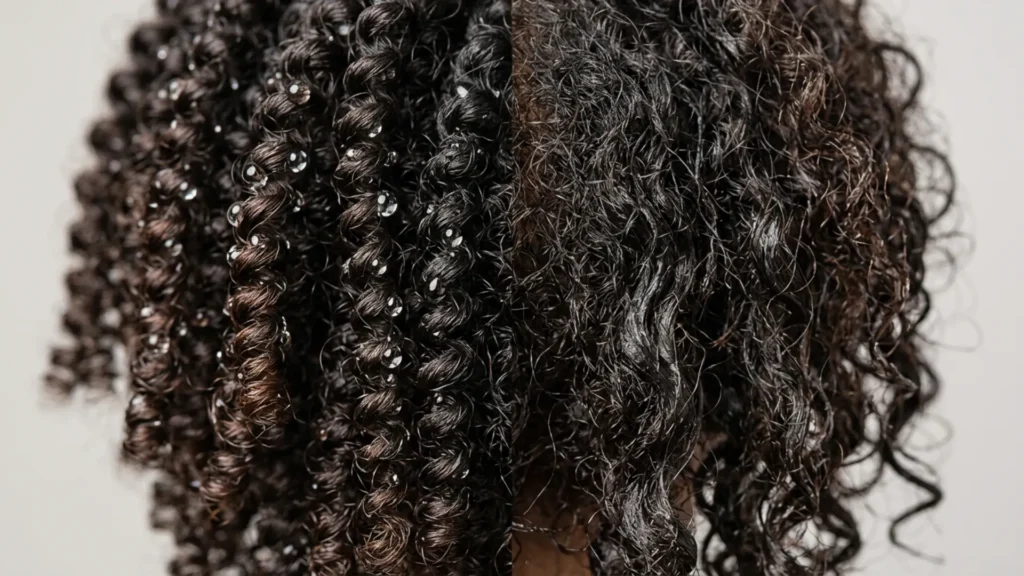
Porosity is the most misunderstood concept in natural hair care — not because it’s complicated, but because most articles mention it and then go straight back to a generic routine that ignores it entirely.
Every strand has a cuticle layer: overlapping scales arranged like roof tiles. Low-porosity hair has cuticles that lie flat and close together. High-porosity hair has cuticles that are raised or have gaps, often from chemical processing, heat use, or genetics. The difference isn’t about which is healthier. It’s about how each one responds to water and to product.
Low-porosity hair resists water going in. Products tend to sit on the surface rather than absorbing, which is why this type builds up fast and why lighter, fewer products work better than heavy layering. High-porosity hair absorbs moisture quickly but loses it just as fast. Strands can feel dry within a day or two no matter how much was applied, because the structure that holds moisture isn’t intact.
This difference changes the practical routine, not just the product picks. Low-porosity hair responds well to applying products on damp hair in a warm environment — wrapping a warm towel around the hair for a few minutes can help open the cuticle just enough for products to get inside. High-porosity hair does better with a cold water rinse after conditioning (which helps close the cuticle), followed by heavier sealants applied while the hair is still wet.
Knowing which one your hair is doesn’t just change what you reach for. It changes the order you reach for it in.
Also Visit : Hair Care Routine: Build One That Actually Sticks
LOC, LCO, and How to Know Which One Your Hair Needs
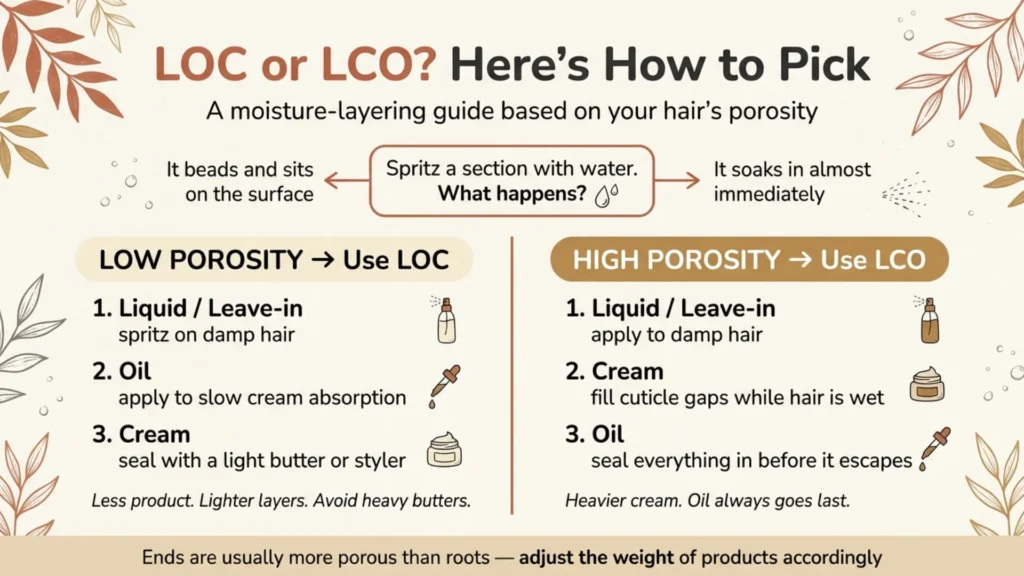
LOC and LCO are both moisture-layering methods for natural hair. The letters stand for Liquid (or leave-in conditioner), Oil, and Cream. The only difference between them is whether the oil or the cream comes second — and that small shift matters more than it sounds.
The method that tends to suit low-porosity hair is LOC: Liquid, then Oil, then Cream. The oil sits between the leave-in and the cream, slowing how quickly the cream tries to penetrate. Low-porosity hair doesn’t need encouragement to absorb; it needs less product pressure to do so. Putting oil in the middle prevents cream from piling up on the surface before it’s had a chance to get through.
High-porosity hair does better with LCO: Liquid, then Cream, then Oil. The cream goes on while the hair is still damp from the leave-in, helping fill in the gaps in the cuticle structure. The oil goes on last, sealing over the top before moisture escapes. Think of it as filling a wall before painting it — the cream fills; the oil seals.
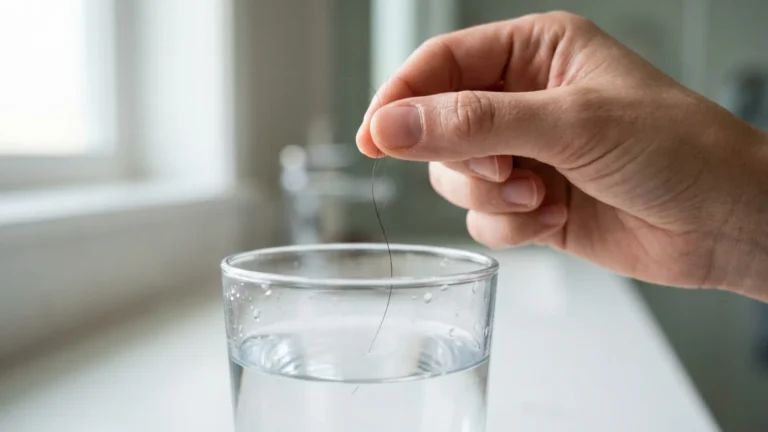
A practical way to figure out where your hair falls: spritz a small section with water and watch what happens. If it beads on the surface and takes more than a minute to absorb, you likely have low-porosity hair — try LOC. If it soaks in almost immediately, your hair is probably high-porosity — try LCO.
This isn’t a law. Ends are typically more porous than roots because of years of friction and age, so some people use LCO on their ends and a lighter touch at the root. The framework is a starting point, not a rule without exceptions.
Wash Day Frequency: The Number Nobody Agrees On
Twice a week, once a week, every ten days — wash day frequency is one of the most debated questions in natural hair communities, and the genuinely honest answer is that it depends on two things: how fast your scalp produces oil, and how heavy your styling products are.
For most natural hair types, once a week to once every ten days is a reasonable starting point. Scalp signals are the guide. Flaking, itching, or visible buildup before that mark means your interval is too long. Hair that feels brittle and stripped after every wash — especially if you’re using a sulfate shampoo — suggests you’re cleansing more often than the hair can handle.
What gets lost in the frequency debate is the difference between a full wash day and a mid-week scalp rinse. Rinsing with water and a small amount of conditioner between washes doesn’t disrupt a routine. It can actually extend it by keeping the scalp comfortable without stripping the moisture already sitting in your strands.
Keeping Moisture Between Wash Days

Wash day sets the foundation. What happens in the nights and days after determines whether it holds.
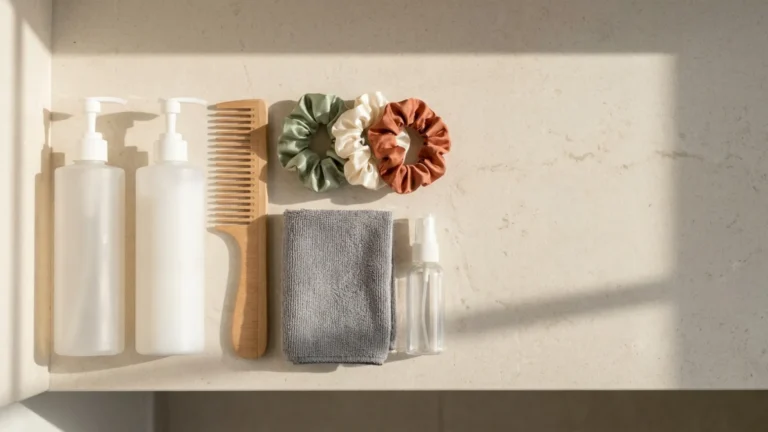
Cotton pillowcases draw moisture from the hair through the night — a slow, consistent pull that most people don’t notice until they wake up to hair that feels dry by day two. Switching to a satin or silk pillowcase, or sleeping with a satin bonnet, makes a real difference. It’s not a styling technique. It’s basic protection from a friction surface that natural hair is especially vulnerable to.
Refreshing between wash days doesn’t have to mean starting the routine over. A small amount of leave-in conditioner diluted with water in a spray bottle, applied to sections and re-smoothed, can revive most styles without disturbing the sealant layer that’s already there. The key is not to over-wet — soaking the hair completely between wash days resets the moisture cycle and forces you into wash day work in the middle of the week.
Protective styles (twists, braids, buns) help by reducing friction and daily manipulation. But they only protect moisturised hair. Dry hair put into a protective style stays dry — the style just keeps it contained.
Also Visit : Hair Care Routine Step by Step: Why the Order Matters
When Your Natural Hair Care Routine Needs to Change
A natural hair care routine isn’t a fixed document. Hair responds to seasons, hormonal shifts, water quality, heat, and even diet changes. Something that worked well for two years can start underperforming with no obvious cause — because the cause is often invisible, like a change in your water’s mineral content after a move, or a gradual hormonal shift that made the scalp oilier without any visible sign.
The AAD’s hair and scalp care guidance points to over-manipulation as a cause of breakage that gets routinely mistaken for dryness or product failure. If a routine involves a lot of detangling, restyling, and touching throughout the week, the physical stress on strands is worth considering before blaming the method.
| What Changed | What It Can Affect | First Adjustment to Try |
|---|---|---|
| Season (autumn/winter) | Faster moisture loss from drier air | Heavier sealant; less frequent clarifying |
| Recent heat styling | Raised cuticle, more porous behaviour | Switch to LCO method temporarily |
| Harder tap water | Mineral deposits; products stop absorbing | Chelating shampoo once a month |
| More frequent manipulation | Micro-breakage mistaken for dryness | Add protective styling 2–3 days a week |
| Hormonal changes | Texture shift; oilier or drier scalp | Reassess scalp cleanser frequency |
One rule that holds across all of these: change one variable at a time. Swap the shampoo, or the sealant, or the frequency — not all three in the same week. Give whatever you changed four to six weeks before deciding whether it worked.
If this helped you rethink how your routine is sequenced rather than what’s in it, save it for your next wash day — or drop a comment below with which step you’re adjusting first.
Key Takeaways
- Routine failure is almost always a sequencing or buildup problem, not a product problem.
- The scalp needs deliberate attention — clarifying regularly is what lets everything else absorb properly.
- Porosity (low vs high) determines whether LOC or LCO is the right moisture method for your hair.
- Between wash days, satin protection and a light mid-week refresh preserve moisture better than re-soaking the hair.
- A natural hair care routine is a living system — expect to adjust it seasonally and after any significant change in your hair’s condition.
Frequently Asked Questions
How long does it take to see results from a new natural hair routine?
Two to three wash days is usually enough to notice an initial change. A fair read on whether a routine is actually working takes four to six weeks — long enough for the hair to cycle through its response to the new approach and for seasonal variables to average out.
Can you use the same routine across different curl patterns?
Not always. Tighter curl patterns (4b, 4c) tend toward dryness and often do better with heavier sealants and less frequent clarifying. Looser patterns (3a, 3b) often prefer lighter products and more frequent washing. Porosity is a more reliable guide than curl pattern — two people with the same curl type can have completely opposite porosity needs.
Do you need to deep condition every wash day?
Not necessarily. Deep conditioning is most valuable when hair feels brittle, is recovering from heat, or has been chemically processed. If your leave-in and sealant are doing their job, deep conditioning every two to three weeks is usually enough. Using it every wash day can cause over-conditioning, which leaves strands feeling limp and weak rather than genuinely moisturised.
What causes natural hair to feel dry even with a full routine in place?
The most common culprits are product buildup (ingredients sitting on rather than inside the strand), the wrong moisture method for your porosity, mineral deposits from hard water coating the shaft, or micro-breakage from over-manipulation that reads as dryness. Going through those four in order is a faster diagnostic than switching products.
Is it bad to skip wash day occasionally?
Missing a single wash day isn’t harmful. Going consistently longer than your usual interval without clarifying allows oil and product to accumulate at the root, which can cause scalp irritation and create a less healthy growth environment over time. The scalp’s needs — not the hair strands’ — are what make wash day non-negotiable.
This article is for general information only. For persistent scalp conditions, unusual shedding, or a sudden change in hair texture, it’s worth speaking to a dermatologist or trichologist.
Written by Anna Anderson for Trend Cottage.