Hair Care Routine for Coloured Hair: Keep Colour Longer

Colour fades slower than most people think, and that changes how you look after it. In a lab study of 55 red dyes, every dye faded with washing, but clear fading only showed after three weeks of daily washes. So one shampoo isn’t the problem. The slow build-up of hot water, strong cleansers, sun and rough towelling is.
Quick answer: A good hair care routine for coloured hair comes down to four habits. Wait two to three days before the first wash, use lukewarm water and a gentle shampoo, condition every time, and keep sun and heat off your ends. The details shift with your colour type, so this guide covers the first 72 hours, the six weeks after, and the run-up to your next touch-up.
Why Coloured Hair Fades
Where the colour sits decides how fast it goes. Permanent dye lodges inside the strand, in the middle layer called the cortex. Semi-permanent and vivid shades stay nearer the surface, so they rinse out sooner.
Whatever the dye, the outer layer does the guarding. That layer is the cuticle, a stack of tiny overlapping scales. Bleach, heat, rough brushing and hot water all roughen it. Rougher hair lets colour slip out and scatters light, which is why faded hair looks dull as well as pale.
That red-dye study used hair samples in a lab, so treat it as a clue rather than a promise. Real life adds sun, chlorine and hot showers on top.
The First 72 Hours After Colouring

The usual advice is to wait two to three days before your first shampoo. Your colourist, or the leaflet in the box, comes first if they say something different. The gap gives the colour time to settle and keeps fresh hair away from extra water and friction.
Those days aren’t about doing nothing. Sleep with your hair loose on a satin or silk pillowcase, or in one loose braid, so it isn’t dragging across cotton all night. Skip tight ponytails, hot tools and the pool. If your roots look greasy on day two, a little dry shampoo at the scalp does the job without wetting anything.
Then comes the first wash. It pays to do it slowly:
- Rinse with lukewarm water until your hair is fully wet. It should feel comfortable on the inside of your wrist, not hot.
- Shampoo only your scalp. The suds clean the lengths as they rinse out.
- Squeeze the water out of your lengths and smooth conditioner from mid-length to ends.
- Leave it on for two or three minutes, then rinse with cooler water.
- Pat dry with a soft cotton T-shirt or a microfibre towel. Don’t rub.
Don’t panic if the first rinse runs coloured, especially with reds, pinks and other vivid shades. That’s loose surface dye leaving, and it usually eases after a few washes. Use an old dark towel until it does, because fresh colour can stain pale fabric. If the water keeps running heavily coloured for weeks, mention it to your colourist.
Detangle with a wide-tooth comb while the conditioner is still in, starting at the ends. Wet hair stretches and snaps more easily, and treated hair has little give to spare.
Also Visit : How to Pick Hair Care Routine Products What You Actually Need
A Routine for Weeks One to Six
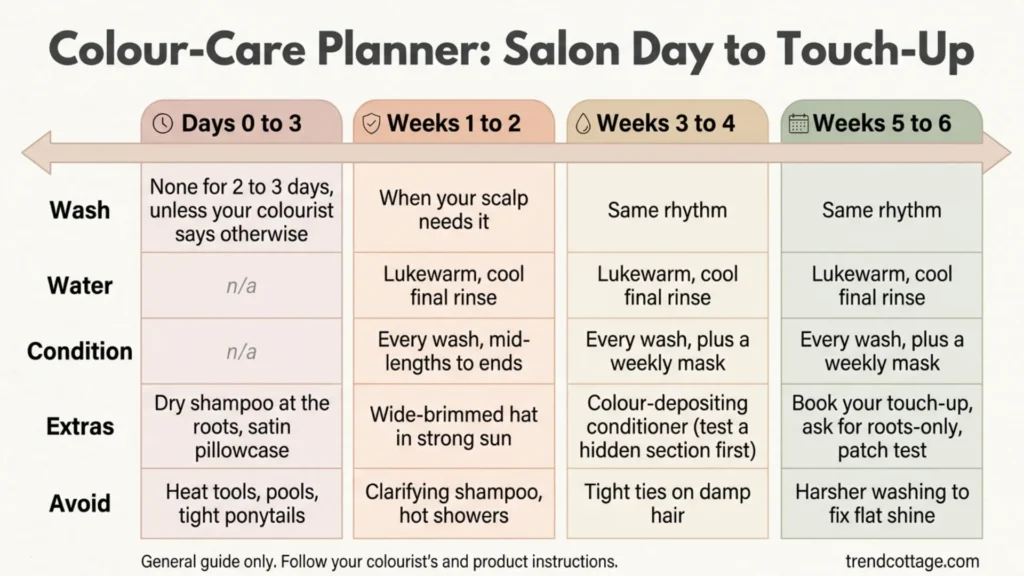
After that first wash, your hair care routine for coloured hair should change a little as the weeks pass.
In weeks one and two, the aim is to protect what you’ve just paid for. Wash when your scalp needs it, not on a rigid schedule, because a greasy, itchy scalp isn’t worth stretching for. Where you can, let dry shampoo cover an extra day. Stick to a gentle shampoo, condition at every wash, keep the water lukewarm, and leave clarifying shampoo alone for now. It strips a lot.
Weeks three and four are when the shade often starts to soften. Add a mask once a week, and think about a colour-depositing conditioner in a shade near your own. These leave a little pigment behind at each wash. Test one on a hidden section first, because the wrong shade can turn muddy on lighter hair.
On mask days, shampoo first, squeeze the water out, then work the mask through from mid-lengths down and comb it in. Leave it for the time on the label and rinse cool. Skip your usual conditioner that day, since the mask already does that job.
Between washes, detangle from the ends upward and don’t tie damp hair tightly. Wet hair stretches, and tension in the same spot day after day can start breakage.
By weeks five and six, regrowth appears and the shine can look flat. Don’t answer that with harsher washing. A cooler rinse and your weekly mask do more for shine than scrubbing ever will.
Hair Care Routine for Coloured Hair by Colour Type
One routine can’t fit every colour. Bleached blonde and a semi-permanent pink behave nothing alike, so here’s how the main types differ.
| Colour type | How it behaves | Where to put your effort |
|---|---|---|
| Bleached or highlighted blonde | Lightening opens up the hair, so it soaks up water fast, dries fast and turns yellow or orange as the toner wears off. | Weekly mask, gentle detangling, violet or blue shampoo now and then. |
| Permanent, all-over colour | The colour sits inside the strand, so it lasts longer. Reds and coppers have a reputation for fading first. | Sun cover, lukewarm water, a cool final rinse. |
| Semi-permanent or vivid shades | The colour sits nearer the surface and rinses out a little with every wash. | Fewer washes if your scalp allows, cold rinses, a matching colour-depositing conditioner. |
| Grey coverage | Fading shows first at the parting, and grey hair is often wirier, so it can take colour differently. | Regular root touch-ups and a moisturising conditioner. |
If you can’t tell which row fits you, go by the biggest change you’ve made. Bleach outranks everything else because it alters the hair the most, and vivid shades outrank permanent ones because they wash out fastest. Follow the more demanding row.
Also Visit : The Hair Care Routine for Men That Actually Works
Sun, Heat and Water Temperature

Sunlight is the fading factor people forget. The American Academy of Dermatology warns that sunlight can dry out and fade dyed hair, and it suggests a wide-brimmed hat.
Lab work points the same way. In a Journal of Cosmetic Science fading study, filtering out UV light with glass cut colour loss by roughly a quarter to nearly two-thirds, depending on how much light the hair got. A hat or scarf does the same job on a bright day. Leave-ins with UV filters can help too, though they only protect the hair they actually reach.
Heat is the other slow leak. Blow-dry on medium, air-dry when you can, and put a heat protectant on damp hair before any hot tool. With a flat iron, pick the lowest setting that works rather than the one you’re used to. Treated hair often can’t take the heat it once did.
Water temperature is the easiest fix. Hot showers feel good but rough up the cuticle, so wash lukewarm and finish with a cool rinse. Chlorine and salt water dry hair out too. Wet your hair with fresh water before you swim, and rinse it soon after.
Getting Ready for Your Next Touch-Up

Regrowth shows up long before the rest of your colour fades, and that’s when a box of dye starts looking tempting. Ask for a roots-only application instead. Re-dyeing the lengths every time layers colour onto hair that’s already been through it, and that’s where dryness and muddy tones tend to start. If the lengths look tired, a gloss or a colour-depositing conditioner can refresh the shade without another full dye session.
Patch test every time, even if you’ve used the same dye for years. Follow the FDA’s patch test instructions: rub a little dye on your inner elbow or behind your ear, leave it for two days, and skip the dye if a rash appears. A salon should run the same test before colouring you.
If you’re going lighter, dermatologists advise staying within three shades of your natural colour. Bigger jumps need stronger peroxide, and that does more damage.
Also Visit : Hair Care Routine: Build One That Actually Sticks
Fixing Common Colour Problems

Brassy or yellow tones
On lightened hair, toner is usually the first layer to wear off, and warm yellow or orange tones creep in. Violet shampoo counters yellow and blue shampoo counters orange, because they sit opposite those tones on the colour wheel. Use one every few washes at most and follow the label, since overuse can leave pale hair looking dull or tinted.
Flat, dull colour
Dullness usually comes from a rough cuticle or product build-up, not from the colour itself. Try a cooler rinse and a lighter hand with styling products. A salon gloss leaves a thin, shiny film on the surface if the shine won’t come back. If build-up is the culprit, one gentle clarifying wash can help, as long as it isn’t in the first weeks after colouring.
Patchy fade
Patchy colour often means some sections are more porous than others, usually the ends or areas that were bleached before. Don’t stack more dye on top. A colourist can even things out with a targeted gloss or a corrective service.
Dry, straw-like ends
Your ends are the oldest and most processed part of your hair, so they take the worst of it. A weekly mask makes them feel softer, but it can’t repair a split. A trim removes damaged hair for good.
Key Takeaways
- Colour rarely vanishes after one wash. It fades as hot water, sun, heat and friction add up.
- Wait two to three days before the first shampoo unless your colourist says otherwise, then wash lukewarm and rinse cool.
- Condition at every wash, add a weekly mask by week three, and cover your hair in strong sun.
- Bleached hair needs the most moisture. Vivid and semi-permanent shades need the fewest washes.
- Ask for roots-only touch-ups, and patch test every single time.
Frequently Asked Questions
How often should you wash coloured hair?
As often as your scalp needs, and no more. Going a day longer between washes helps colour last, but there’s no magic number. If your hair gets greasy fast, wash with a gentle shampoo and cool water, and use dry shampoo at the roots when you want to stretch it.
Do you actually need colour-safe shampoo?
Not necessarily. “Colour-safe” is usually a marketing label rather than a tested standard, so it tells you little. Look for a mild, sulphate-free formula instead, because gentler cleansers tend to suit dry or bleached hair better. Your washing habits matter more than the label.
Is purple shampoo safe on coloured hair?
Yes, in small doses. Violet pigment cancels yellow tones in blonde, silver and highlighted hair, and blue shampoo does the same for orange tones in brown hair. Use either one every few washes, and stop if your hair starts to look dull or tinted.
Does dry shampoo strip colour?
It doesn’t wash colour out, because there’s no water involved. It sits at the roots and soaks up oil. Heavy layers do build up though, so shampoo properly once the powder feels gritty or your scalp gets itchy.
Can you use a hair mask right after colouring?
Yes, from your first wash onwards. Until then, keep your hair dry. After that, start with a mask once a week on mid-lengths and ends. Fine hair can feel weighed down, so keep the mask away from the roots.
Got a trick that keeps your colour looking fresh between appointments? Tell us in the comments, and save this hair care routine for coloured hair for your next salon visit.
This article is for general information only and isn’t medical advice. For persistent hair loss, scalp pain, or sudden shedding, see a dermatologist or trichologist.
Written by Anna Anderson for Trend Cottage.