
A Hair Care Routine for Dry Frizzy Hair That Actually Works

Most routines for dry, frizzy hair fail for the same reason. They treat frizz as one problem with one solution, when the actual fix depends on something they don’t ask about: your hair’s porosity.
Porosity describes how well your hair absorbs and holds moisture. It changes everything — which products work for you, how long conditioning needs to sit, even which oils make frizz better or worse. A hair care routine for dry, frizzy hair that doesn’t account for porosity is basically a guess.
Quick answer: Low-porosity hair needs heat during deep conditioning and lighter, water-first layering (the LCO method). High-porosity hair needs rich formulas that absorb fast and heavier sealants to lock moisture in (the LOC method). Both types need gentle washing, real sit time for conditioner, and a few simple protective habits between washes — all of which this routine covers in order.
Why Most Hair Care Routines for Dry Frizzy Hair Don’t Work
Hair porosity describes how tightly the cuticle (the outer layer of the hair shaft, made up of overlapping scales) lies flat. When cuticles sit tightly together, water takes longer to get in but stays put once it does. When they’re raised or gapped, water rushes in and rushes back out almost as fast.
There are two ends of the spectrum worth knowing:
- Low porosity — cuticles lie tightly closed. Hair takes a long time to get fully wet, products tend to coat the surface rather than absorb, and build-up between washes is a familiar problem.
- High porosity — cuticles are raised or uneven, often from heat damage, bleaching, repeated colour, or naturally coarser and curlier hair textures. Hair soaks up water quickly but can feel dry again within a few hours.
Both types can look frizzy, but for different reasons. On low-porosity hair, frizz is often a product mismatch — heavier formulas sit on top of tightly closed cuticles instead of penetrating, and that coating creates a rough, puffed-out surface. On high-porosity hair, frizz is more of a retention problem — the gaps in the cuticle let humidity in and moisture out at the same time, regardless of how much you applied in the shower.
A rough way to check: take a clean, dry strand with no product on it and drop it into a glass of room-temperature water. If it floats for a minute or two before slowly sinking, low porosity is likely. If it sinks straight to the bottom within a few seconds, high porosity is more probable. It isn’t a lab test, but it gives you something to act on.
| Low Porosity | High Porosity | |
|---|---|---|
| Getting hair wet | Takes a while to soak through | Absorbs water immediately |
| Drying time | Slow to dry | Dries quickly |
| Common complaint | Product sits on surface; build-up | Feels dry again within hours |
| Shampoo choice | Clarifying monthly; gentle otherwise | Gentle and moisturising every wash |
| Deep conditioning | Needs heat to absorb | Rich formula; no extra heat needed |
| Layering method | LCO (cream before oil) | LOC (oil before cream) |
| Protein treatments | Rarely | Every few weeks |
| Best sealants | Light oils (jojoba, argan) | Richer butters (shea, mango) |
The table above is worth bookmarking. Each step in the routine below splits along the same porosity lines.
Also Visit : Hair Care Routine: Build One That Actually Sticks
The Wash Step
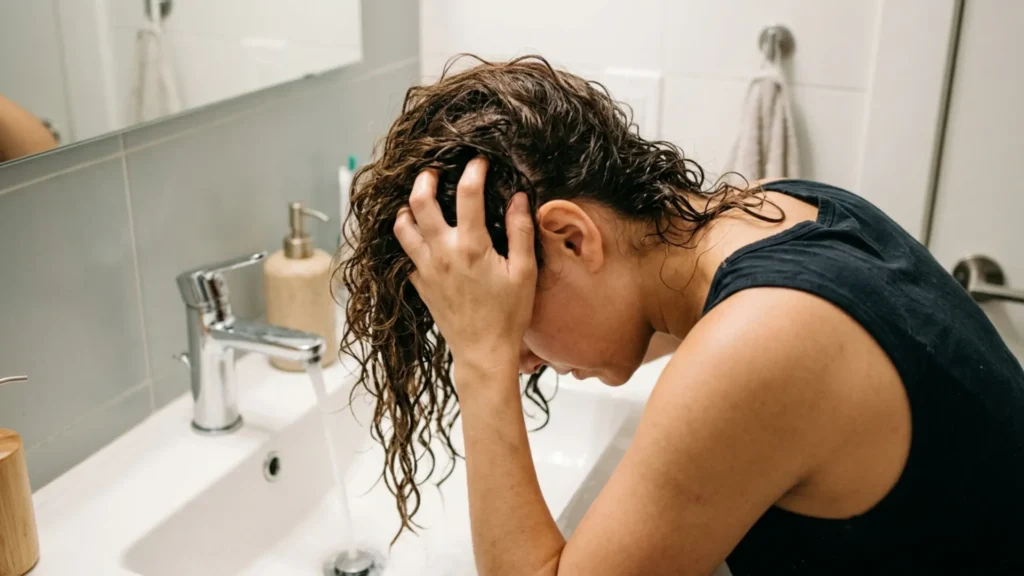
The wash step causes more damage than most people realise — especially when hot water and rough technique have become automatic.
Hot water opens the cuticle aggressively. It strips the natural sebum your scalp produces to protect and condition the hair shaft, and it leaves the cuticle harder to close again even after conditioning. Lukewarm water — warm enough to be comfortable, cool enough that you’d notice if it turned hotter — is the better temperature for washing dry hair.
How often to wash: Two to three times a week is a reasonable starting point for most dry, frizzy hair. Going longer between washes gives the scalp’s natural oils time to travel down the shaft, which is genuinely useful for frizz. If the scalp gets oily before you’re ready to wash, a co-wash (conditioner-only, no shampoo) keeps things manageable without stripping moisture from the lengths.
Shampoo by porosity: Low-porosity hair benefits from a clarifying shampoo roughly once a month to clear the product build-up that accumulates on tight cuticles. For every other wash, a gentle sulphate-free shampoo works well. High-porosity hair shouldn’t use clarifying shampoos regularly — they remove too much of the little moisture the hair holds. A moisturising, sulphate-free formula every wash is the safer, consistent approach.
For both types, apply shampoo only at the scalp and work it in with fingertip pads rather than nails, then let the rinse carry it through the lengths. The mid-lengths and ends are already the driest part of frizzy hair; scrubbing product through them adds mechanical damage without any real cleaning benefit.
Deep Conditioning: The Step You Should Stop Rushing
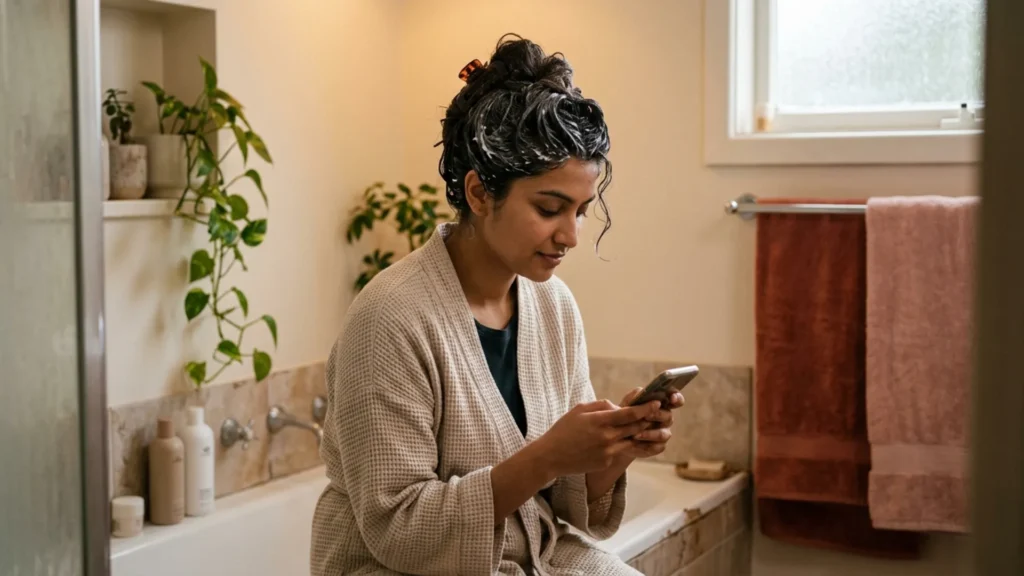
If one step makes the biggest single difference in a hair care routine for dry, frizzy hair, it’s this one — and it’s the step most people cut short.
Deep conditioning is not the same as leaving your regular rinse-out conditioner on for an extra two minutes. A proper deep conditioner or hair mask has a higher concentration of conditioning ingredients and needs 15 to 30 minutes to do anything useful. Anything less and you’ve essentially done a long rinse.
Low-porosity hair benefits most from applied heat during this step. Because the cuticle is tightly shut, a mask applied in a cool bathroom may sit largely on the surface no matter how good the formula is. A hooded dryer, a warm towel wrapped around the head, or even a shower cap trapping your own body heat gives the cuticle enough lift to let the ingredients in. Without that warmth, low-porosity hair can deep condition for 45 minutes and gain very little.
High-porosity hair doesn’t need extra heat. The cuticle is already raised, so a rich mask will absorb without help. What matters more here is the formula: heavier conditioning agents like shea butter, cetyl alcohol, or behentrimonium methosulfate give high-porosity hair something substantial enough to fill in and temporarily smooth those raised cuticle gaps.
The protein question: High-porosity hair — particularly if it’s been chemically processed or regularly heat-styled — often benefits from a protein treatment every few weeks alongside regular moisture conditioning. Hydrolysed proteins (keratin, wheat protein, silk protein) temporarily bond to and reinforce weak sections of the hair shaft. [EXTERNAL SOURCE NEEDED: search PubMed for a named study on hydrolysed protein adhesion to damaged hair fibre — link the specific article page, not a search results URL. A paper from the International Journal of Cosmetic Science on protein penetration and hair cuticle repair would be ideal.] Low-porosity hair rarely needs this. Too much protein makes compact strands stiffer and prone to snapping. A moisture-focused mask is the better regular routine for low-porosity hair, with protein added only if hair feels weak or struggles to hold a style.
A useful check before you condition: take a wet strand and stretch it gently. Hair with good elasticity stretches a little and springs back. Hair that snaps immediately needs protein. Hair that stretches and doesn’t spring back needs more moisture. Running this test occasionally saves a lot of guessing about why a routine isn’t working.
Also Visit : Hair Care Routine for Hair Growth: Build It Right
How to Layer Products Without Weighing Hair Down
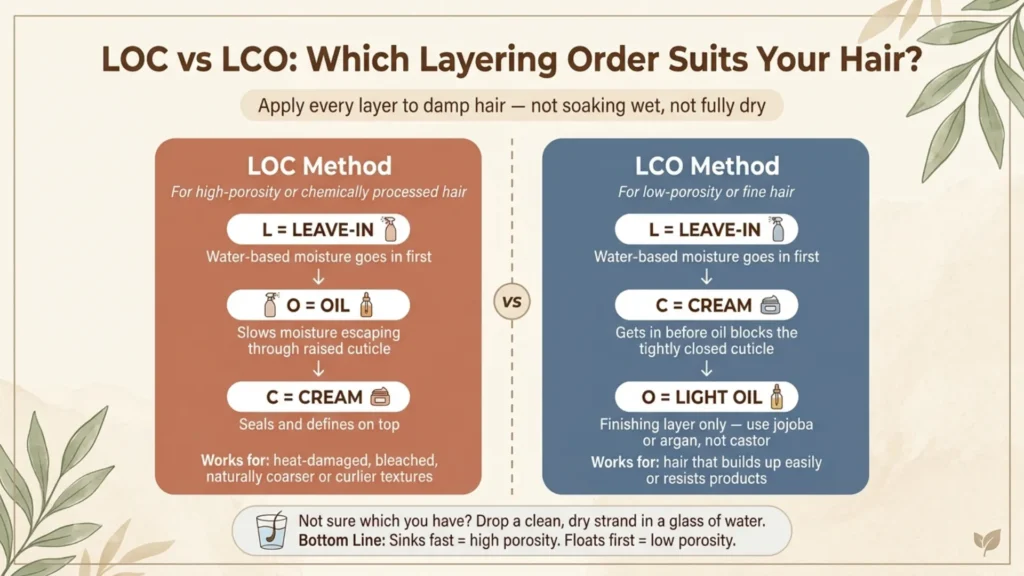
Product layering order matters more than most styling advice admits. Get the sequence wrong and you can lock moisture out instead of in — a problem that shows up immediately as frizz or stiffness, not something you’d blame on a product later.
Two methods cover most hair types: LOC and LCO. Which one works better comes down to porosity.
LOC (Leave-in conditioner, Oil, then Cream) works well for high-porosity hair. The leave-in brings water-based moisture into the strand first. The oil goes on second and slows the rate at which that moisture evaporates through the raised cuticle. The cream layers over the top, sealing everything in. That sealing step is what high-porosity hair needs most — without it, moisture walks right back out.
LCO (Leave-in, Cream, then Oil) suits low-porosity hair better. A heavy oil applied early tends to sit on top of tightly closed cuticles and blocks the cream from reaching the strand at all. Putting the cream second gives the moisturising step a real chance. The oil goes on last, as a light finishing layer, and lighter oils — jojoba, argan — work better for low-porosity hair than heavier ones like castor or coconut, which contribute to the build-up that’s already a frequent complaint.
Apply every layer while hair is still damp, not dripping and not fully dry. The water already held in the strand is what you’re locking in. Applying product to completely dry hair means there’s nothing left to seal.
Between Wash Days
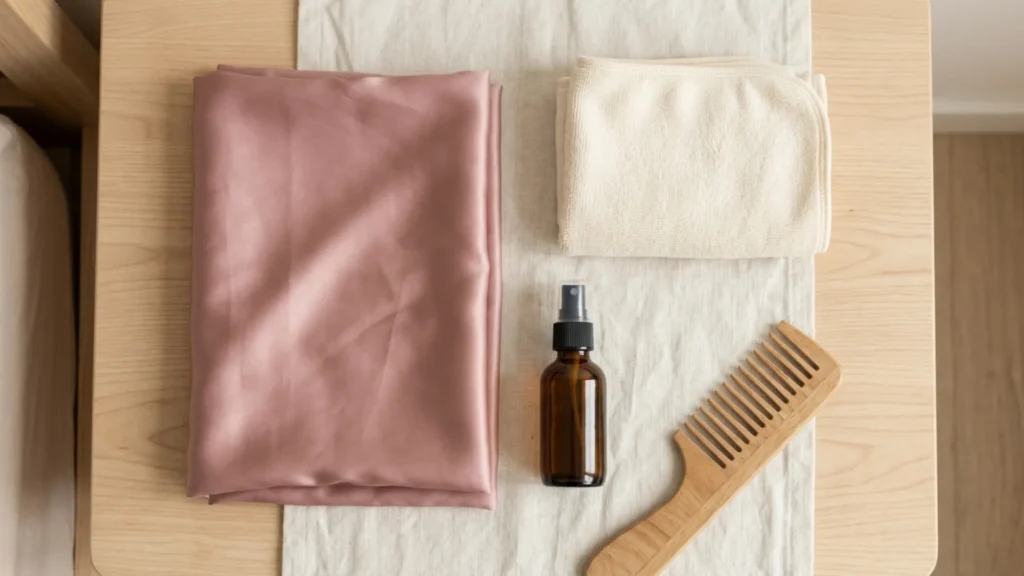
Between-wash frizz usually comes from two sources: friction and moisture escaping faster than it should.
Friction builds up quietly — from cotton pillowcases rubbing against hair overnight, from rough towel-drying, from running dry hands through the lengths. A satin or silk pillowcase cuts a noticeable amount of overnight frizz because it doesn’t catch and roughen the cuticle the way cotton weave does. It’s a small, consistent change.
For drying, a microfibre towel or a clean cotton T-shirt pressed gently against wet hair causes far less mechanical damage than a regular terry towel rubbed back and forth. Blotting and squeezing rather than rubbing takes the same amount of time and leaves the curl or wave pattern much more intact.
Refreshing between washes works well with a light mist of water mixed with a small amount of leave-in conditioner, applied in sections and scrunched upward from the ends. For low-porosity hair, keep the amount of leave-in small — too much product on tightly closed cuticles overnight can leave strands sticky or matted by morning. Either let the refresh dry fully before sleep, or apply it in the morning rather than the night before.
Also Visit : Hair Growth Hacks That Actually Work (And What Doesn’t)
Ingredients That Actually Help (and a Few That Don’t Always)
Not all moisturising ingredients behave the same way in every condition, and understanding a few exceptions saves a lot of frustration when a supposedly great product consistently disappoints.
Glycerin is in nearly everything marketed at dry hair, and in moderate humidity it earns its place — it draws moisture from the surrounding air into the strand. In very dry climates, the effect reverses: it pulls moisture from the hair into the drier surrounding air. In very high humidity, it causes the strand to swell unevenly, adding frizz rather than reducing it. Research into how humectants perform at different relative humidity levels [EXTERNAL SOURCE NEEDED: search PubMed or the International Journal of Cosmetic Science for a named study on glycerin or humectant behaviour in hair at varying humidity — link the specific article page, not a search URL] shows this isn’t a minor or occasional effect. If you live somewhere very dry or very humid and glycerin-heavy products consistently disappoint, look for glycerin lower in the ingredient list, which means a smaller concentration and a weaker effect in either direction.
Aloe vera behaves more predictably across a wider range of humidity levels. It’s a gentler humectant, lighter in consistency, and doesn’t add weight to fine or low-porosity hair. It works well as the water-based first step in a leave-in conditioner or spray.
Shea butter and mango butter are heavier sealants that suit high-porosity hair well. They’re rich enough to fill in gapped cuticles and hold moisture in over time. On low-porosity hair, they tend to sit on the surface rather than penetrate, showing up as greasiness within a day and contributing to the build-up problem.
Hydrolysed proteins are worth including in a high-porosity or heat-damaged hair routine — occasionally in a deep conditioner or as a standalone treatment every few weeks. If hair feels straw-like or snaps at the mid-length after a protein treatment, that’s a clear sign to dial back. The American Academy of Dermatology’s guidance on hair health [EXTERNAL SOURCE NEEDED: link to a specific AAD page on healthy hair, hair damage, or hair care — such as a page under aad.org/public/everyday-care/hair-scalp-care/ — do not link the homepage] is a useful reference if you’re introducing new treatments to a routine that’s already been stressing the hair.
Common Questions About Dry Frizzy Hair Routines
How often should you wash dry, frizzy hair?
Two to three times a week works for most people, though scalp behaviour varies. If the scalp gets oily before you’re ready for a full wash, a co-wash — conditioner only, no shampoo — keeps the lengths from being stripped in between. Activity level, climate, and whether you’re using a lot of styling products all affect how quickly the scalp produces oil, so this is a starting point rather than a fixed rule.
Is frizz a sign of hair damage?
Not always. Completely healthy hair that’s naturally coarse, curly, or low-porosity can be frizzy without any underlying damage. Damaged high-porosity hair looks similar but usually behaves differently — it tends to feel dry even right after conditioning, and a wet strand that snaps without stretching suggests the hair structure has weakened. The behaviour pattern tells you more than the frizz itself.
Can you reduce frizz without cutting your hair?
A consistent routine will reduce frizz and dryness noticeably — but split ends won’t recover. The cuticle at the tip of a split strand is structurally gone, and no conditioner repairs it. Trimming split ends stops the split from travelling further up the shaft, which prevents it from undoing the work of the rest of the routine. The trim doesn’t fix the hair; it removes the part that’s working against the fix.
What’s the difference between frizz and flyaways?
Frizz is a texture issue along the full length of the strand — the cuticle isn’t lying flat, which creates a roughened, expanded surface. Flyaways are usually shorter strands: broken hairs, new growth, or baby hairs that don’t follow the pattern of the surrounding hair. The routine approaches overlap, since sealing the cuticle and reducing friction help both. For flyaways specifically, pressing a tiny amount of a light finishing serum palm-to-hair on dry strands (rather than stroking down from root to tip) smooths them without disturbing the rest.
Does water temperature actually affect frizz?
Yes. Hot water lifts the cuticle during washing, and without something to close it back down, it stays slightly raised through the drying process — making frizz easier to form. Rinsing out conditioner with cooler water helps close the cuticle before stepping out of the shower. It doesn’t need to be cold to work; noticeably cooler than the wash temperature is enough. This is the same principle behind the cool rinse in professional colour services, where a sealed cuticle matters for both shine and colour retention.
If your routine still isn’t calming the frizz after a few consistent weeks, the porosity table earlier in this article is worth revisiting. Most adjustments come back to whether the products you’re using match how your cuticle actually behaves.
Key Takeaways
- Hair porosity — how tightly the cuticle lies — determines which steps and products will actually work. Knowing yours saves a significant amount of trial and error.
- Low-porosity hair needs heat during deep conditioning and lighter products overall. High-porosity hair needs richer formulas and a strong sealing step after conditioning.
- Deep conditioning with a genuine 15–30 minute sit time is the single step that makes the biggest difference in most dry, frizzy hair routines.
- Product layering order matters: LOC (Leave-in, Oil, Cream) for high porosity; LCO (Leave-in, Cream, Oil) for low porosity. Apply to damp hair, not dry.
- Glycerin, heavy butters, and protein all help in the right conditions and make things worse in the wrong ones — porosity is the filter that tells you which way they’ll go for your hair.
Found this useful? Save it for your next wash day. If your hair sits somewhere in the middle of the porosity spectrum, drop a comment — the middle ground has its own quirks and they’re worth covering separately.
Written by Anna Anderson for Trend Cottage.