7 Benefits of Jojoba Oil on Natural Hair (Backed by Science)
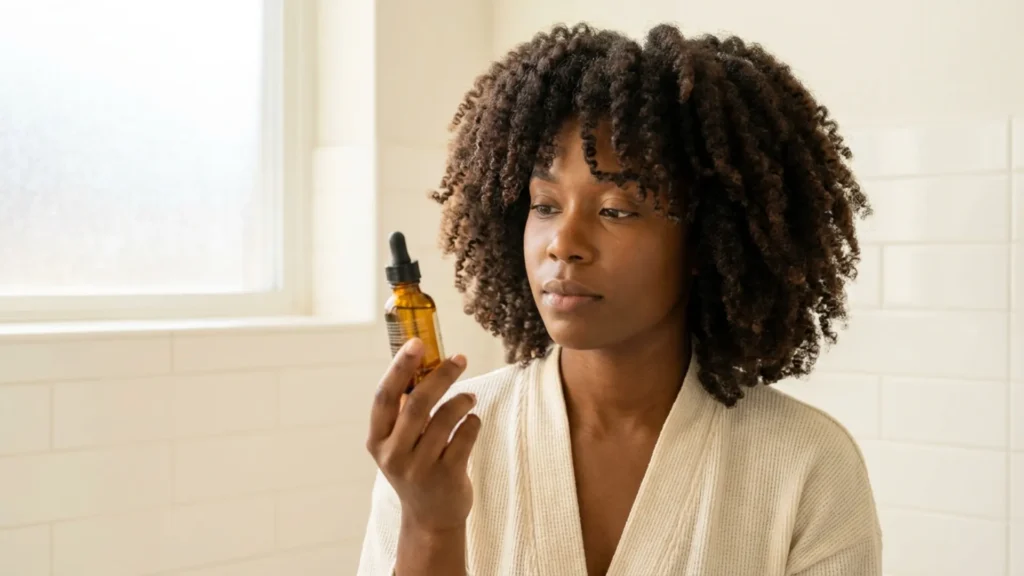
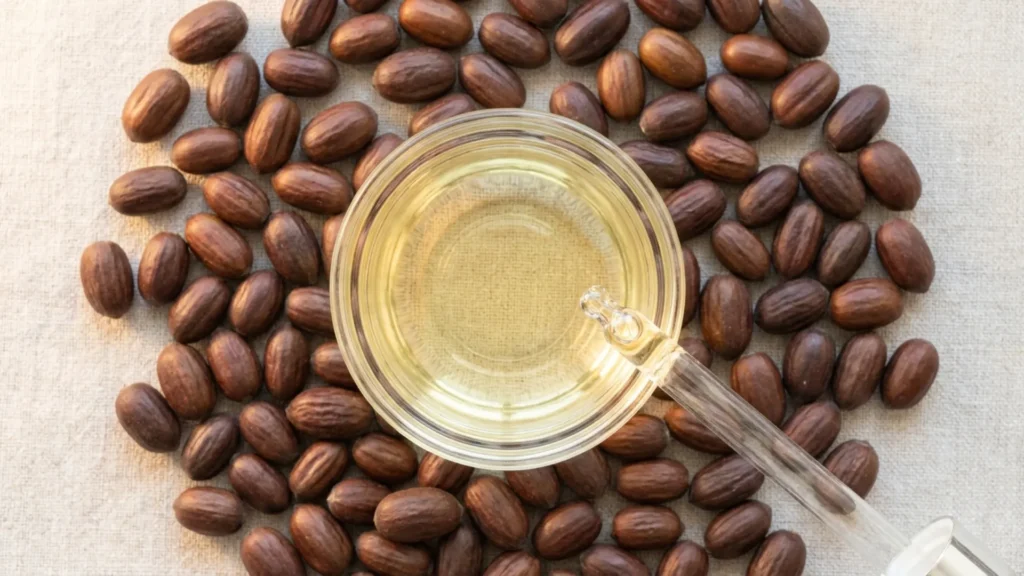
Most carrier oils are exactly that — oils. Jojoba is different. What gets sold as “jojoba oil” is technically a liquid wax, pressed from the seeds of a desert shrub native to the Sonoran Desert. That distinction isn’t just botanical trivia. It changes how the substance behaves on your scalp and strands in ways that most product descriptions never bother to explain.
The benefits of jojoba oil on natural hair are rooted in chemistry rather than marketing. Jojoba’s wax-ester structure shares key components with the sebum your scalp already produces, which means it can lubricate, condition, and support scalp health without the greasiness or follicle congestion that heavier oils leave behind. For coily and kinky textures — where dryness is a persistent challenge despite an active scalp — that difference is meaningful.
Key Takeaways
- Jojoba is a liquid wax, not a true oil — and its wax-ester structure shares components with the sebum your scalp naturally produces.
- It seals moisture into the strand without the heavy residue that weighs coils down or clogs scalp follicles.
- It’s one of the few oils that works reliably on low-porosity natural hair, which typically rejects thicker plant-based oils.
- Three to five drops per session is sufficient for most hair types — more doesn’t proportionally increase the benefit.
- Scalp and retention results develop over several weeks of consistent use, not in a single application.
It’s Not Actually an Oil — and That Changes the Whole Picture
Almost every carrier oil used in hair care — coconut, castor, argan, olive — is composed of triglycerides. That’s the chemical name for fatty acid chains bonded to a glycerol backbone. Jojoba contains almost none. Instead, it’s made up almost entirely of long-chain wax esters: fatty acids bonded to fatty alcohols in a molecular arrangement that is exceedingly rare in the plant kingdom.
Why does that matter for hair? Human sebum — the substance your scalp follicles secrete to naturally lubricate and protect each strand — contains a notable proportion of wax esters alongside its triglycerides and squalene. Wax esters are a component present in very few plant-derived ingredients. Most carrier oils share essentially nothing structurally with sebum. Jojoba, with its wax ester base, is chemically far closer to sebum’s actual composition than any other commonly used carrier oil, which is why it behaves differently on the scalp and strand when you apply it.
This is the foundation beneath every real benefit of jojoba on natural hair. The rest of the list only makes sense once you have this part.
Also Visit : Avoid Natural Hair Protective Styling Mistakes That Cause Breakage
What Natural Hair Is Already Working Against
Sebum travels down the hair shaft from the follicle toward the tip — but only when the strand’s geometry allows it. Straight hair provides a relatively smooth path. Coiled and kinky hair does not. Each bend and spiral in a 4A or 4C strand is a point where sebum’s journey stalls, which is why the ends of highly textured hair are often dry regardless of how healthy and productive the scalp is.
Hair porosity — the cuticle’s ability to absorb and retain moisture — adds another layer to this. Low-porosity natural hair has tightly packed, flat-lying cuticle scales that resist absorbing both water and most oils. Products sit on the surface rather than penetrating. High-porosity hair absorbs quickly but loses moisture almost as fast. Jojoba behaves usefully at both ends of that spectrum, which is part of what makes it worth understanding rather than just reaching for whatever oil is already on the shelf.
The Benefits of Jojoba Oil on Natural Hair, Explained
Because jojoba contains wax esters structurally similar to sebum’s own, applying it to the scalp doesn’t introduce a foreign substance that the skin has to process and compensate for. Heavy occlusives and silicones can create a barrier that prompts the scalp to produce more oil in response. Jojoba, by working in closer alignment with the scalp’s existing lipid environment, may temporarily satisfy the moisture threshold at the follicle surface without triggering that rebound effect.
Over several weeks of consistent use — not days — some people notice their scalp feels less reactive, with fewer swings between the tight-and-dry and the greasy-by-midweek patterns that product-dependent scalps tend to cycle through. This isn’t guaranteed, and results are genuinely individual. But the mechanism is more plausible than most “balances your scalp’s oil production” claims you’ll find on a product label.
2. It Seals Moisture Without Leaving Residue
Jojoba works best in a hair routine as a sealant, not a moisturiser. Moisture comes from water-based products: leave-in conditioners, aloe vera, water spritzes. Jojoba’s job is to slow that moisture’s exit from the strand by forming a light, pliable film on the cuticle surface.
That flexibility separates it from heavier sealants. Castor oil creates a denser, more viscous barrier — genuinely effective for high-porosity or severely damaged hair that needs intense sealing, but often too much for fine or low-porosity coils, where it sits visibly on the strand and makes styling difficult. Jojoba’s film is thin enough to move with the hair’s natural flex, and regular use doesn’t accumulate into the waxy, dull coating that some heavier oils produce over time.
3. It Reduces Breakage at Your Most Vulnerable Points
Natural hair breaks most often where manipulation is highest: where a comb catches a tangle, where a curl bends sharply back on itself, where repeated tension from braids or twists concentrates on the same strand length. Jojoba’s lubricating property reduces inter-strand friction during detangling — which is where a significant amount of everyday breakage actually originates, whether on wash day or during mid-week styling.
To be precise about what this means: jojoba doesn’t structurally strengthen the hair. That requires protein. What it does is reduce the mechanical friction at the strand’s most vulnerable moments, which is a genuine breakage-reduction mechanism, not a marketing claim. Less friction during combing means fewer snapped strands per session.
4. It Won’t Clog Your Scalp’s Follicles
Jojoba scores a zero on the comedogenic scale, which measures how likely an ingredient is to block pores. For a scalp product, this matters more than most people realize. Product buildup around the follicle is an underappreciated contributor to scalp irritation, and in persistent cases, to the kind of congested, inflamed scalp environment that disrupts healthy hair growth cycles. Jojoba can be applied directly to the scalp without creating that kind of accumulation, which is why it functions well as a dedicated scalp massage oil rather than just a mid-length treatment.
5. It’s One of the Few Oils That Works on Low-Porosity Hair
Low-porosity natural hair is notoriously difficult to moisturise. The tightly packed cuticles repel both water and most oils — a palmful of heavy oil does nothing except sit on the strand’s surface, attract lint, and make the hair look greasy rather than nourished. Jojoba’s lighter wax-ester molecules are absorbed more readily through a slightly-raised cuticle, making it one of the few oil options that actually makes contact with the strand rather than bouncing off it.
It won’t work miracles — low-porosity hair still responds best to water-based products and warmth during the conditioning process. But among oils, it sits at the more absorbable end, which is more than most options can say.
Also Visit : Coconut Oil for Natural Hair Growth Moisture and Strength
6. It Acts as an Effective Pre-Shampoo Barrier
Applying jojoba 20–30 minutes before shampooing creates a protective layer of wax esters before the detergent in your shampoo makes contact. Shampoo — particularly sulphate-based formulas — lifts the cuticle aggressively to remove buildup, but it also strips the strand’s natural lipid coating in the process. A pre-applied layer of jojoba reduces how much the cuticle lifts during washing and buffers the shampoo’s stripping effect on the strand’s own lipids.
In practical terms, the result is hair that comes out of the wash feeling softer and less stripped than usual — which also means the detangling step that follows is faster and causes less mechanical damage. Focus the pre-poo application on ends and mid-lengths, which see the most dryness and least sebum coverage.
7. It Improves Slip and Manageability During Detangling
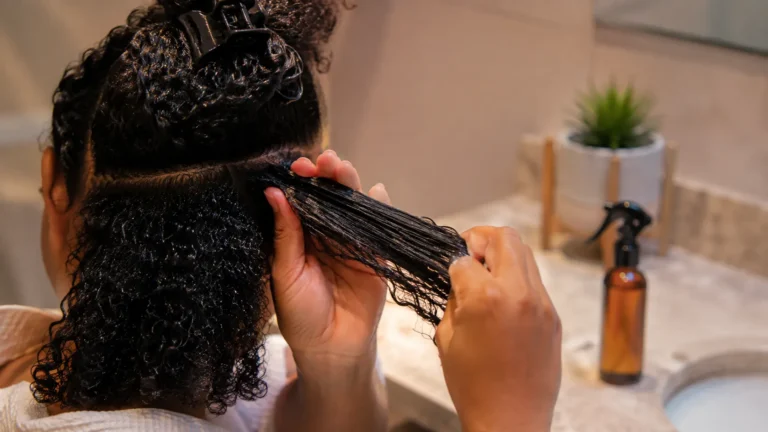
Applied to damp, conditioned hair on wash day, jojoba adds a layer of slip that lets your fingers or a wide-tooth comb move through coils with less snagging resistance. Most oils provide some degree of slip — but jojoba’s lighter consistency means it distributes evenly through dense, high-volume natural hair without requiring you to warm it extensively or wrestle it through the strands. Emulsify a few drops between your palms with a small amount of leave-in or water, and it spreads efficiently without pilling or balling up around shed hairs.
How to Use Jojoba Oil on Natural Hair

The method matters as much as the product. Four approaches work specifically well for natural hair:
- Pre-shampoo treatment: Apply three to five drops to dry or lightly dampened hair, focusing on ends and mid-lengths. Leave for 20–30 minutes, then shampoo as normal. A shower cap during this time helps, especially on dense coils, but isn’t required.
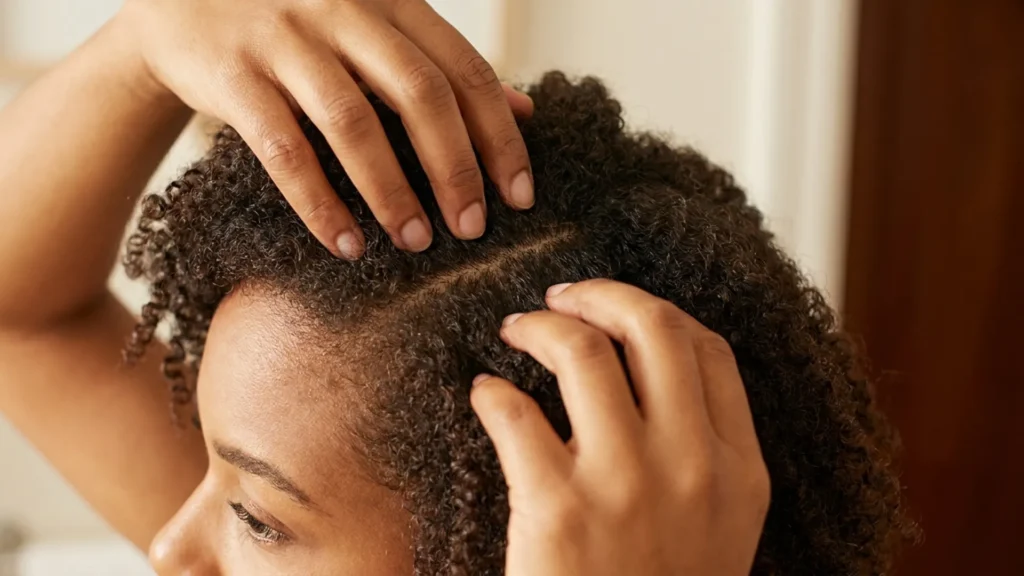
- Scalp massage: Warm three to four drops between your palms and work through the scalp with your fingertips using small circular movements. Once or twice a week is sufficient — daily scalp application is unnecessary and risks buildup accumulation over time.
- Oil step in the LOC or LCO method: Add two to three drops during the oil step after your leave-in conditioner. Jojoba pairs well with lighter leave-ins because it won’t override their texture with its own heaviness.
- Dry ends treatment between wash days: One drop pressed between your palms and smoothed over dry ends reduces the brittleness and fraying that leads to breakage. Genuinely, one drop. This is where most people overapply.
The most consistent mistake is using too much in a single session. Jojoba is light — but applying several drops beyond what you need creates the exact greasy, weighted appearance most people are trying to avoid. Start with three drops, assess the result after the hair dries, and scale from there.
How Jojoba Compares to Other Popular Oils for Natural Hair
Context helps here. Jojoba is not the right tool for every job, and knowing where it sits relative to the oils already in circulation makes it easier to use intentionally rather than just adding it to a cabinet that doesn’t change.
| Oil | Texture / Weight | Best Porosity Match | Comedogenic Rating | Scalp-Safe? | Primary Limitation |
|---|---|---|---|---|---|
| Jojoba | Ultra-light (liquid wax) | Low to medium | 0 | Yes | Doesn’t penetrate the hair cortex deeply |
| Coconut oil | Medium (solid below ~24°C / 75°F) | High porosity | 4 | Moderate | Prone to buildup; can contribute to protein overload |
| Castor oil | Heavy and viscous | High porosity, very dry ends | 1 | Moderate | Very thick; difficult to distribute evenly through coils |
| Argan oil | Light to medium | Medium to high | 0 | Yes | Premium cost; many commercial formulas are diluted |
Before You Start: A Few Practical Notes

Patch test before applying anything new to the scalp — a small amount to the inside of the wrist or behind the ear, left for 24 hours, is the standard check. Jojoba reactions are uncommon, but documented, and the scalp is a reactive site for any unfamiliar product.
Pure jojoba has an unusually long shelf life compared to most carrier oils — the wax ester structure is highly resistant to oxidation and rancidity, which is why it doesn’t go off quickly the way oils like flaxseed or evening primrose do. If a refrigerated bottle appears cloudy or semi-solid, that’s normal wax crystallisation. It clears completely at room temperature without any loss of quality.
When buying, look specifically for 100% pure, cold-pressed Simmondsia chinensis seed oil on the ingredient label. “Jojoba fragrance oil” is an entirely separate, synthetic product that smells like jojoba but shares none of its functional properties — the naming overlap causes genuine confusion. If an ingredient list shows anything other than Simmondsia chinensis seed oil, the product is blended or diluted.
Frequently Asked Questions
Can I use jojoba oil every day on natural hair?
Daily scalp application isn’t necessary and can contribute to buildup over time, even given jojoba’s low comedogenic rating. Using it two or three times a week — or as part of your standard wash-day routine — covers most hair types. Daily application to dry ends only, in very small amounts, is generally fine.
Does jojoba oil help with natural hair growth?
Not directly. The hair growth cycle is governed by biology that a topical oil doesn’t alter. What jojoba can do is support a cleaner scalp environment and reduce mechanical breakage from friction and manipulation — which means more of the hair that grows makes it to a visible length. That combination can feel like faster growth, but the more accurate description is better retention of length that was already growing.
Is jojoba oil better than coconut oil for natural hair?
It depends on your hair’s porosity. Coconut oil’s smaller lauric acid molecules can penetrate the cortex, which makes it genuinely useful for protein-depleted or high-porosity hair. Jojoba sits closer to the cuticle surface rather than penetrating deeply, making it the better fit for low-porosity hair or anyone whose natural hair consistently rejects heavier oils. Neither is universally superior — they serve different porosity profiles and routine positions.
Will jojoba leave buildup on 4C natural hair?
In the amounts recommended here — three to five drops — no. It absorbs without leaving the visible film that heavier oils produce. Overuse across multiple sessions without regular clarifying is where buildup becomes an issue. A clarifying shampoo once or twice a month, if you’re using jojoba regularly, keeps the slate clean.
If you’re still figuring out where your hair sits on the porosity spectrum — because that really does determine which oils and application methods will and won’t work for you. And if you use jojoba in a routine that’s already working for you, drop it in the comments — real-world specifics are genuinely useful for everyone else still sorting out what fits their hair.
Also Visit : Oils for Dreadlocks That Actually Work on Scalp and Locs