Oils for Dreadlocks That Actually Work on Scalp and Locs

Choosing the right oils for dreadlocks is one of the most misunderstood parts of loc maintenance — and using the wrong oils, or applying the right ones incorrectly, causes two of the most common and stubborn loc problems: buildup inside the locs and mildew odor that is nearly impossible to fully remove. This guide separates what actually works from what causes problems, explains the critical difference between scalp oiling and loc oiling, and gives you the complete knowledge to keep both your scalp and your locs healthy at every stage.
Why Oiling Dreadlocks Is Fundamentally Different From Loose Hair
When you have loose natural hair, applying oil to the hair strands is normal and beneficial — it coats the cuticle, seals in moisture, and reduces frizz. With dreadlocks, this logic breaks down. The tightly matted, interlocked structure of a loc means that oil applied to the outside of the loc does not penetrate inward to nourish the inner strands. It sits on the outer surface and accumulates with every application.
Over weeks and months, this surface accumulation becomes a sticky layer that attracts lint, dust, and product residue — creating the hard, crusty, odor-prone buildup that ruins the appearance and health of locs. Worse, any moisture trapped inside the loc with an oil-coated exterior cannot evaporate properly, creating the warm, damp internal environment where mildew grows — the source of the unpleasant smell that some loc wearers experience.
The purpose of oils for dreadlocks is therefore almost entirely scalp-focused — keeping the scalp healthy, moisturized, and stimulated for growth — rather than coating the loc body. Understanding this distinction is the single most important thing a loc wearer can learn about oil use.
The Scalp-Only Rule — The Foundation of Loc Oiling
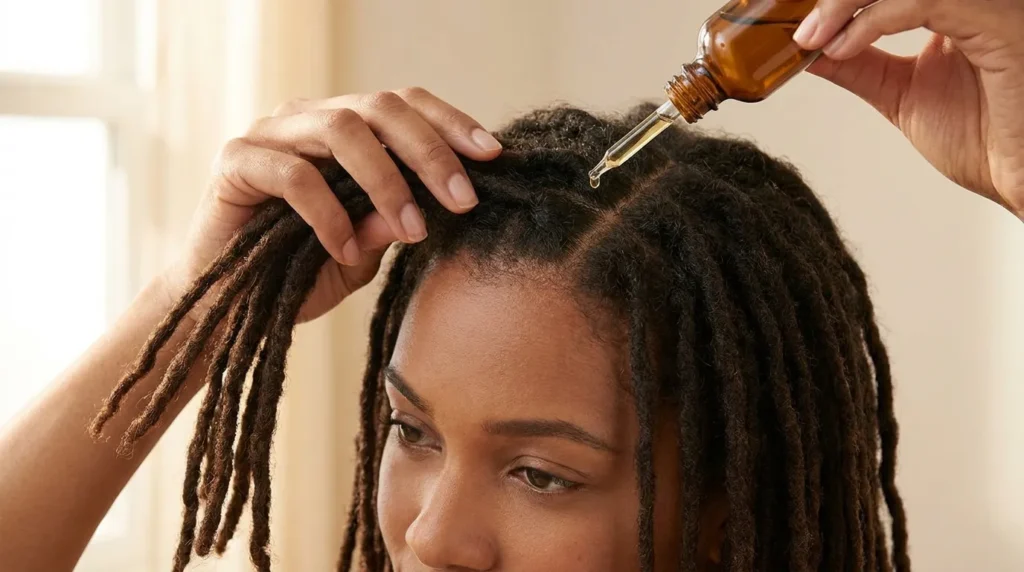
For the vast majority of loc wearers, oil should be applied directly to the scalp — not smoothed along the length of the locs. Here is why this works and how to do it correctly:
Why scalp-only oiling is correct:
- Your scalp produces its own natural oil (sebum) that travels down loose hair strands to condition them. With locs, this sebum cannot travel along the interlocked strands — so the scalp needs topical oil support while the locs themselves need very little additional oil.
- Oil applied to the scalp penetrates into the follicle environment, nourishing the root and stimulating blood circulation for better growth.
- Oil absorbed by the scalp does not create buildup inside or on the surface of the locs.
The one exception — loc body oiling: Very short starter locs (under 6 months old) where the hair is not yet fully locked can sometimes benefit from a tiny amount of lightweight oil applied along the length of the loc — this period the hair still behaves partially like loose hair. Once locs are fully matured (12+ months), loc body oiling provides almost no benefit and creates buildup risk.
Oils That CAUSE Buildup in Dreadlocks — Avoid These
These oils should not be applied to the body of locs — and should be used sparingly even on the scalp because their heavy molecular weight means they accumulate rather than absorb:
- Petroleum jelly and mineral oil: The absolute worst offenders. Both are petroleum-based, have no molecular ability to absorb into the scalp, and create a layer of buildup that is nearly impossible to remove from inside locs without a very strong clarifying shampoo. Many loc waxes contain petroleum as a base — this is why wax is one of the most damaging products for locs.
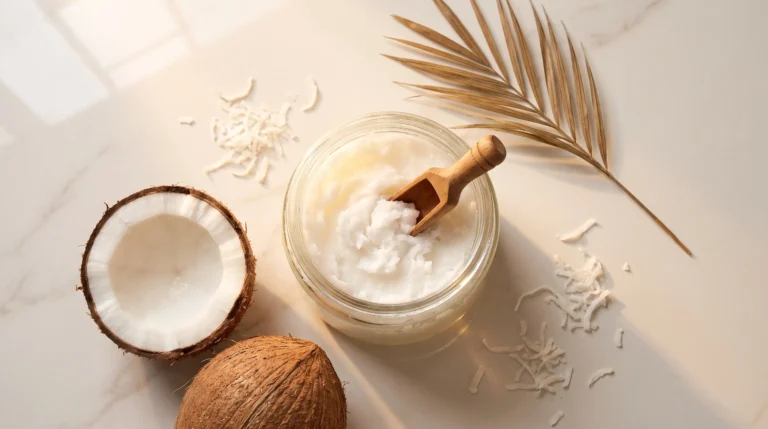
- Coconut oil (applied to loc body): Despite being popular in natural hair care, coconut oil’s large lauric acid molecules sit on the surface of the loc and solidify at room temperature, creating a white, film-like residue inside the loc structure. When applied to the scalp only in small amounts and washed regularly, coconut oil is acceptable — but it should never be applied along the loc length.
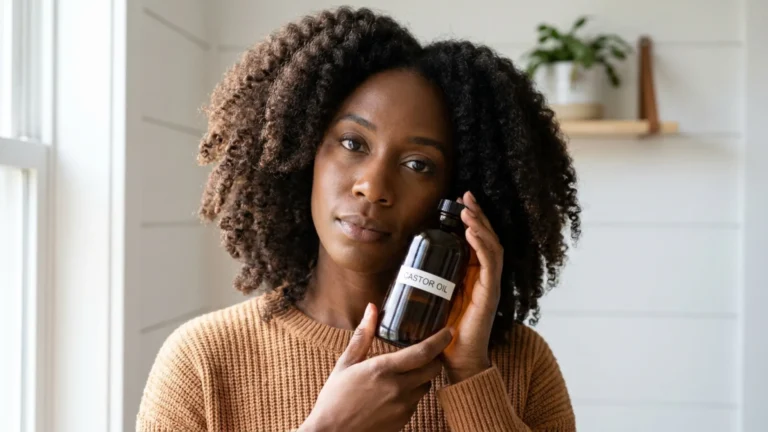
- Castor oil (heavy use): Castor oil is extremely thick and takes a long time to absorb even into scalp skin. Applied in excess, it accumulates on the scalp and at the base of locs, eventually causing a heavy buildup layer that traps dirt and promotes bacterial growth. Small amounts diluted with a lighter carrier oil on the scalp only is acceptable — undiluted castor oil applied generously is not.
- Heavy shea butter and other solid butters: Like castor oil, these do not dissolve easily and create a sticky film around the base of locs that collects lint and debris over time.
- Loc waxes and pomades: Not oils, but worth noting — any wax-based product is one of the most damaging things you can apply to dreadlocks regardless of the stage. Wax accumulates in the core of locs and cannot be fully removed. Avoid entirely.
The 7 Best Carrier Oils for Dreadlocks
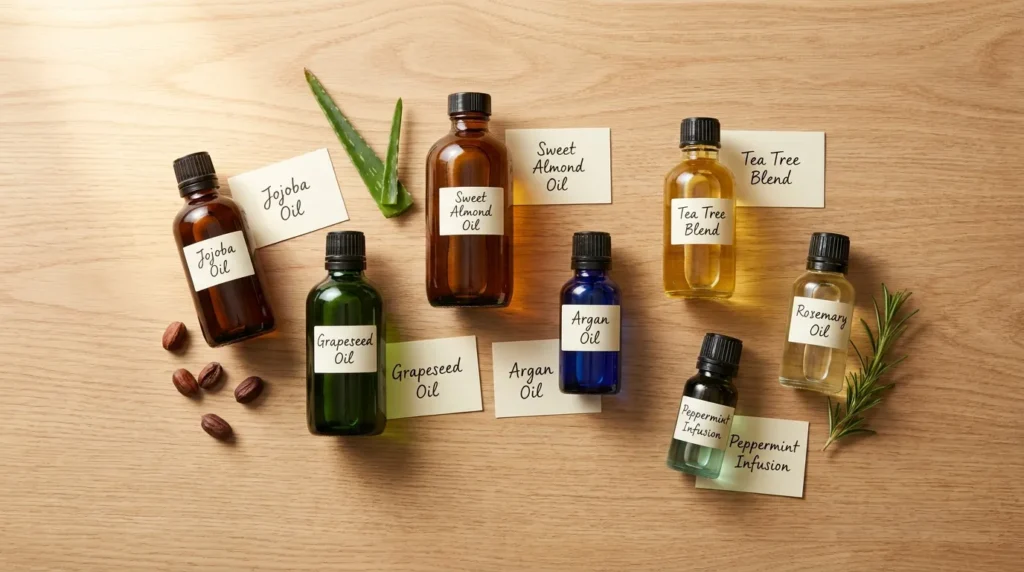
| Oil | Weight | Best Use for Locs | Buildup Risk | Key Benefit |
|---|---|---|---|---|
| Jojoba Oil | Light | Daily scalp oil — primary carrier base | Very Low | Mimics scalp sebum, balances oil production, absorbs without residue |
| Grapeseed Oil | Very Light | Daily scalp oil or carrier base for essential oils | Very Low | Lightest carrier available, no scent, anti-inflammatory, great for oily scalp |
| Sweet Almond Oil | Light–Medium | Scalp treatment, 2–3x weekly | Low | Rich in vitamins E and B, softens scalp, reduces dryness and flaking |
| Argan Oil | Light–Medium | Scalp treatment, finishing on new locs only | Low | Vitamin E, UV protection, excellent for scalp health and new loc sheen |
| Coconut Oil | Medium | Scalp pre-wash only, diluted, NOT on loc body | Medium (on locs) | Antimicrobial, good pre-wash penetration, reduces scalp fungal overgrowth |
| Castor Oil (diluted) | Heavy | Scalp only, diluted 1:4 with jojoba or grapeseed | Medium if overused | Stimulates scalp circulation, promotes thickness at the root |
| Rosehip Oil | Light | Scalp treatment for dry or sensitive scalps | Very Low | High linoleic acid, anti-inflammatory, excellent for sensitive or reactive scalp |
Best everyday choice for oils for dreadlocks: Jojoba oil or grapeseed oil as the carrier base, with essential oils added for specific scalp benefits. These are the lightest, least buildup-prone, and most effective oils for dreadlocks scalp care.
Best Essential Oils for the Dreadlocks Scalp
Essential oils should always be diluted in a carrier oil before scalp application — never applied undiluted. Use 5 to 7 drops of essential oil per tablespoon of carrier oil.
| Essential Oil | Scalp Benefit | Recommended Dilution | Best Combined With |
|---|---|---|---|
| Rosemary | Clinically shown to stimulate hair growth comparable to minoxidil in some studies; increases scalp circulation | 5 drops per tbsp carrier | Jojoba or grapeseed oil |
| Peppermint | Creates mild tingling vasodilation at the scalp, increases blood flow to follicles, refreshing scalp sensation | 3–4 drops per tbsp carrier | Grapeseed or jojoba oil |
| Tea Tree | Powerful antifungal and antibacterial — addresses dandruff, scalp itchiness, and prevents mildew-supporting bacterial environment | 4–5 drops per tbsp carrier | Jojoba or sweet almond oil |
| Lavender | Soothing, anti-inflammatory, reduces scalp stress response, mild antimicrobial properties, pleasant calming scent | 5–6 drops per tbsp carrier | Jojoba or rosehip oil |
| Eucalyptus | Deep scalp cleansing, antimicrobial, helps combat the scalp environment that promotes mildew in locs | 3–4 drops per tbsp carrier | Grapeseed oil |
| Cedarwood | Stimulates follicles, has shown promise for alopecia areata in research, balances oily scalp conditions | 5 drops per tbsp carrier | Sweet almond oil |
New Locs vs Mature Locs — Different Oiling Needs
| Stage | Timeframe | Scalp Oiling | Loc Body Oiling | Frequency | Best Oils |
|---|---|---|---|---|---|
| Starter Locs | 0–3 months | Essential — scalp dries quickly | Very light application acceptable on strands | 2–3x per week | Jojoba, grapeseed, argan (tiny amounts on locs) |
| Budding / Teenage Locs | 3–12 months | Regular scalp oil essential | Avoid loc body — buildup risk increases as locs tighten | 1–2x per week | Jojoba + rosemary/tea tree on scalp only |
| Mature Locs | 12+ months | Primary focus — scalp only | Avoid completely — full buildup risk | 1–2x per week | Any lightweight carrier + essential oils, scalp only |
| Established Long Locs | 3+ years | Scalp remains the sole focus | Never — locs are fully sealed and compacted | Once per week or as needed | Jojoba or grapeseed, minimal amounts, clarify monthly |
How to Apply Oils for Dreadlocks Correctly
What you need:
- A dropper bottle or applicator bottle with a pointed nozzle tip (makes scalp-only application precise)
- Your prepared loc oil blend
- Clean, dry or lightly damp locs
Step-by-step application:
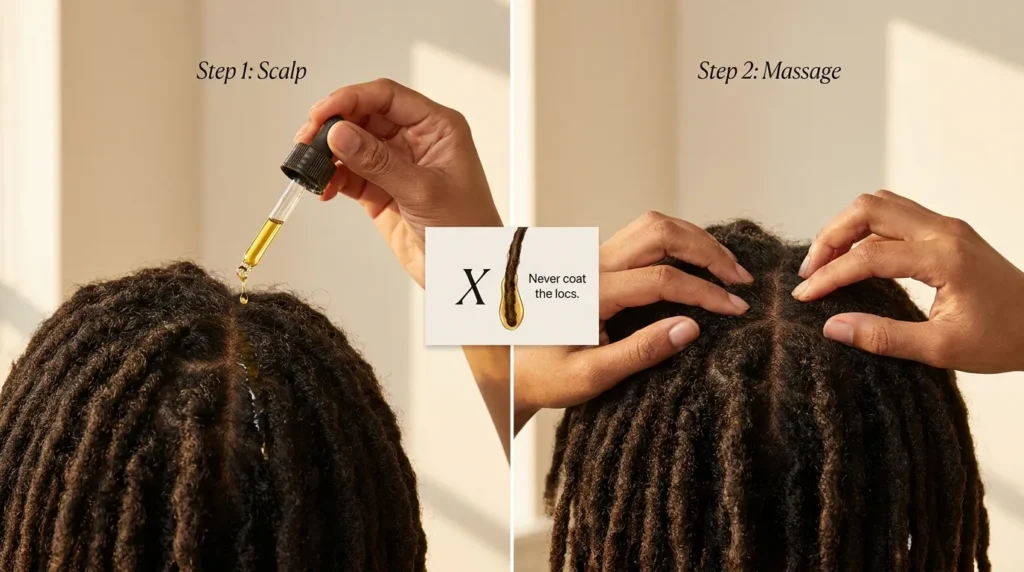
- Part and separate: Use the pointed tip of your applicator bottle to part the locs at the scalp, exposing the scalp skin directly.
- Apply at the root: Squeeze two to three drops directly onto the exposed scalp — not onto the loc base, but on the actual scalp skin between the locs.
- Massage the scalp: Use your fingertip pads (not nails) to massage the oil into the scalp in small circular motions for 30 to 60 seconds per section. This activates circulation and ensures the oil absorbs into the scalp rather than sitting on the surface.
- Work in sections: Move through your entire scalp in a systematic parting pattern — front to back, or in a grid pattern — ensuring all scalp areas are covered.
- Do not touch the loc body: Resist the urge to smooth oil down the length of the locs during or after this process.
- Leave in: No rinsing needed. The oil absorbs into the scalp over the next few hours.
Applicator bottle tip: A scalp applicator bottle with a long, narrow nozzle is the single best tool for precision loc scalp oiling. It allows you to apply oil directly to the scalp between locs without any product landing on the loc surface. Available at beauty supply stores and online for under five dollars — one of the most useful tools for loc care.
How Often Should You Oil Dreadlocks
Oiling frequency depends on your scalp type — not a universal rule. Here is how to determine the right frequency for yours:
- Dry scalp: Every 2 to 3 days. A dry, flaky scalp that feels tight and itchy between wash days benefits from more frequent oil application. Use a lightweight jojoba and tea tree blend to address both dryness and any fungal component contributing to the flaking.
- Normal scalp: Twice per week. Apply between wash days when scalp begins to feel dry, usually every 3 to 4 days.
- Oily scalp: Once per week or less. An oily scalp already produces enough sebum — adding more oil can cause buildup at the scalp level and clog follicles. Use grapeseed oil (which is astringent and less likely to increase oiliness) and focus essential oils on balancing rather than heavy moisturizing.
- After washing: Always apply a light scalp oil within an hour of washing locs to replace the natural oils that shampoo removed. This is the single most important oiling session — a clean scalp that is left without moisture rebalancing becomes dry and itchy faster.
Mildew Prevention — The Problem No One Talks About Enough
Mildew is one of the most distressing problems for loc wearers — and over-oiling is one of the primary contributing factors. An oil-coated loc surface traps moisture inside the loc and slows down drying time. If locs are not fully dry before sleeping or covering them, the residual moisture inside creates the perfect warm, damp, dark environment for mildew to grow.
Prevention steps:
- Never apply oil to the loc body — especially before bed or after washing. This is the fastest way to create mildew conditions.
- Always allow locs to dry completely after washing — under a hooded dryer if needed — before tying them up, covering them, or sleeping. Mature, thick locs can take 6 to 12 hours to dry completely.
- Add 3 to 4 drops of tea tree essential oil or eucalyptus essential oil to your scalp oil blend — both have antimicrobial properties that reduce the microbial environment that supports mildew growth.
- Clarify locs once a month with an apple cider vinegar rinse (1 part ACV to 3 parts water) to remove any oil, product, or mineral buildup that could contribute to mildew odor.
- If mildew odor is already present, wash locs with a clarifying shampoo containing tea tree oil and follow with an ACV rinse, then dry thoroughly under a hooded dryer. This process may need to be repeated over two to three wash sessions to fully address the problem.
DIY Loc Scalp Oil Blend
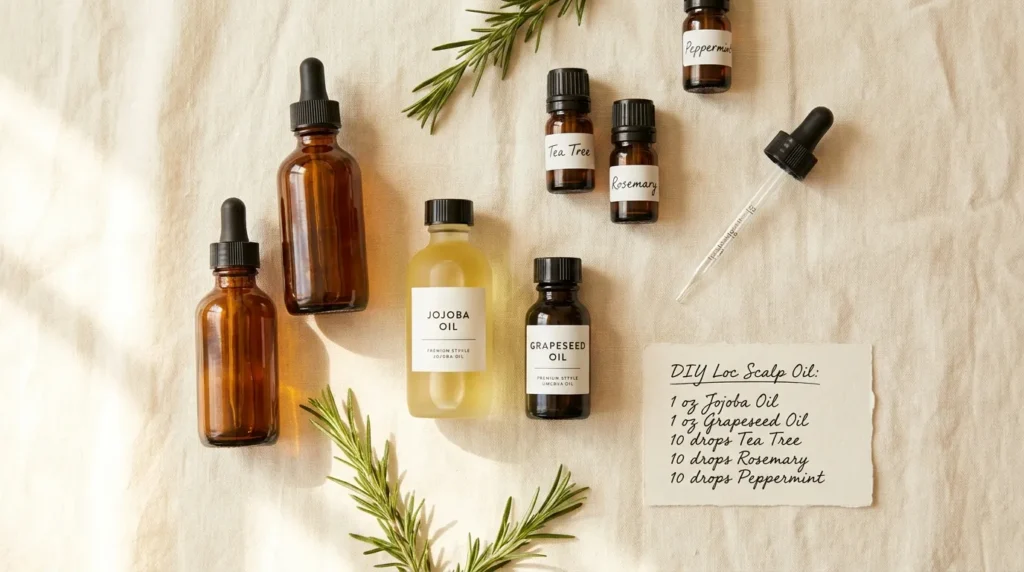
This blend is specifically formulated for dreadlocks scalp care — lightweight enough not to cause buildup, and packed with the essential oil actives that address the most common loc scalp concerns: dryness, flaking, itchiness, and growth stimulation.
Everyday Loc Scalp Oil:
- 3 tablespoons jojoba oil (primary carrier — sebum-mimicking, zero buildup)
- 1 tablespoon grapeseed oil (secondary carrier — additional lightness and astringency)
- 7 drops rosemary essential oil (growth stimulation)
- 5 drops tea tree essential oil (antifungal, anti-itch, mildew prevention)
- 4 drops peppermint essential oil (circulation, refreshing scalp sensation)
- 3 drops lavender essential oil (soothing, balancing)
- Combine all ingredients in a clean 2oz scalp applicator bottle with a pointed nozzle.
- Shake thoroughly before each use — essential oils settle and need to be redistributed.
- Apply directly to the scalp in sections using the nozzle tip, massaging in for 30 to 60 seconds per section.
- Store at room temperature away from direct sunlight. Shelf life approximately 3 to 4 months.
For oily scalp variation: Replace jojoba with all grapeseed oil and reduce total oil volume to 3 tablespoons. Add 3 drops of cedarwood essential oil to balance sebum production. Reduce application to once weekly.
Frequently Asked Questions
Can I use oils for dreadlocks every day?
Daily oiling is too frequent for most scalp types and risks accumulating oil residue at the scalp level even with lightweight oils. The exception is a very dry scalp that shows flaking and tightness on a daily basis — in that case, a minimal application of two to three drops of jojoba oil daily to the driest areas is acceptable. For most people, two to three times per week provides adequate scalp moisture without the accumulation risk of daily application.
What is the best oil for dreadlocks that are new?
Jojoba oil is the best starting oil for new starter locs because its sebum-like structure absorbs cleanly without residue and does not create the buildup that heavier oils deposit in the early forming stages of a loc. During the first three months, a very light application of jojoba or argan oil along the length of the locs is acceptable — the locs are not yet fully matured and the hair still behaves partially like loose strands. Once locs begin to bud and tighten (around months 3 to 6), move to scalp-only application exclusively.
Why do my locs smell even though I oil them regularly?
Regular oiling — particularly of the loc body rather than scalp only — is often a contributing cause of loc odor, not a solution. Oil applied to the loc exterior slows moisture evaporation after washing, promoting the internal dampness that mildew needs to grow. If your locs have an odor, stop applying oil to the loc body entirely. Clarify with an apple cider vinegar rinse, wash with a tea tree shampoo, dry completely under a hooded dryer, and switch to scalp-only oiling with a blend that includes tea tree and eucalyptus essential oils.
Is castor oil good for dreadlocks growth?
Castor oil can support scalp health and potentially root thickness when applied directly to the scalp in diluted form — but it must always be diluted (at least 1 part castor to 4 parts lighter carrier like jojoba) and applied only to the scalp. Undiluted castor oil applied to dreadlocks is one of the most common causes of severe loc buildup because its extremely heavy consistency does not absorb — it coats and accumulates. For growth stimulation, rosemary essential oil in a jojoba carrier is a better-researched, lower-risk alternative for dreadlocks.
How do I remove oil buildup from locs?
Oil buildup removal requires a clarifying shampoo with a surfactant strong enough to break down the oil — look for shampoos with sodium lauryl sulfate or sodium laureth sulfate specifically for clarifying sessions (once monthly). Soak locs thoroughly before applying the shampoo, work it through the entire loc from roots to tips with gentle squeezing motions, rinse completely, and follow with an apple cider vinegar rinse (1 part ACV to 3 parts water) to restore pH balance and remove any remaining residue. If buildup is severe, a baking soda soak (2 tablespoons baking soda in a basin of warm water, soak locs for 10 minutes) before clarifying shampoo can help break down heavy product accumulation.
The Right Oils Used the Right Way Make All the Difference
The best oils for dreadlocks are not the heaviest or the most popular — they are the lightest, cleanest oils applied precisely to the scalp where they can actually do something useful. Jojoba and grapeseed oil as your carrier base, rosemary and tea tree as your essential oil workhorses, applied two to three times per week to the scalp only with a pointed applicator bottle — this is the complete oils for dreadlocks routine that keeps locs healthy, scalps balanced, and buildup and mildew firmly out of the picture.
Start with the DIY loc scalp oil recipe this week. Make the switch to scalp-only application. Notice the difference in how clean, light, and odor-free your locs feel within just one or two wash cycles — and how much easier clarifying becomes when there is no product buildup to fight through.
Also Visit : Best Mango Butter for Natural Hair and How to Use It