Home Remedies for Natural Hair Growth That Actually Work
You have probably heard it a hundred times — “just be patient and your hair will grow.” But if you have been waiting months and your length is not budging, patience alone is clearly not enough. The good news is that your kitchen already has most of what your scalp actually needs.
These home remedies for natural hair growth are not internet myths. Each one has a real reason behind why it works — backed by the ingredients it contains and the way your hair follicles respond to them. What sets this guide apart is that we are not just going to list ingredients and call it a day. We are going to tell you exactly how to use each remedy, how often, and what to realistically expect.
Let us get into it.
Why Your Hair Stops Growing (And What These Remedies Fix)
Before diving into the remedies, it helps to understand what is actually holding your hair back. Hair growth does not stop because your follicles are broken — it slows down or stalls because something is disrupting the growth cycle. The most common causes are:
- Poor scalp circulation — Follicles need a strong blood supply to receive nutrients and oxygen. A sluggish scalp means slower growth and more shedding.
- Scalp buildup and clogged follicles — Product residue, excess sebum, and dead skin cells can block follicles, preventing new hair from emerging freely.
- Protein and nutrient deficiency — Hair is made of keratin, a protein. Without enough protein, iron, zinc, and biotin in your diet and on your scalp, strands grow in thin and weak.
- Inflammation and scalp conditions — Dandruff, dry scalp, and low-grade inflammation can significantly disrupt the hair growth cycle.
- High breakage rate — Many women think their hair is not growing when it is actually breaking just as fast as it grows. Strengthening the strand is just as important as stimulating the follicle.
Every remedy in this guide targets at least one of these root causes directly. That is what makes them effective — not magic, but science applied from your kitchen shelf.
1. Onion Juice — The Most Powerful Scalp Stimulator
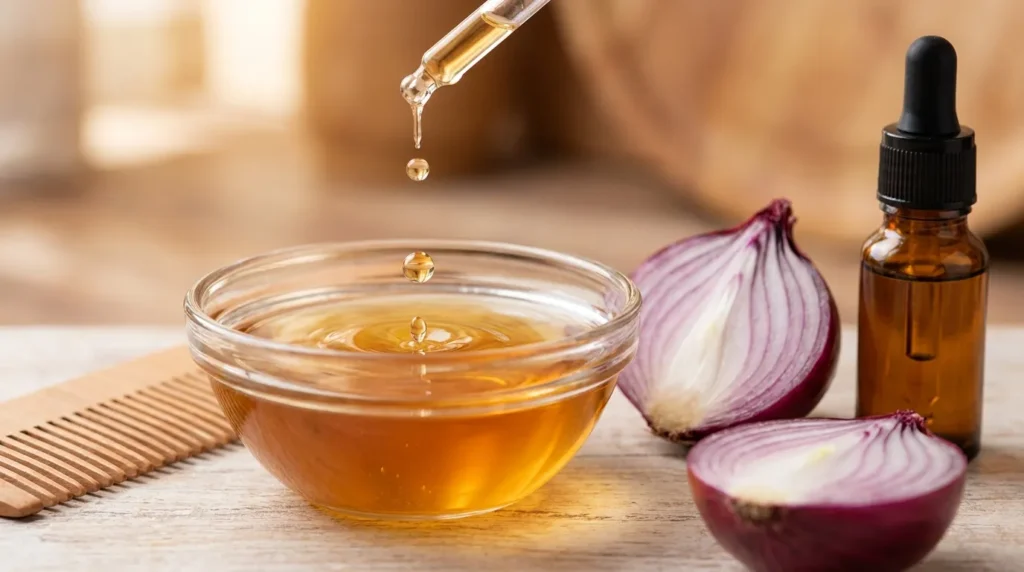
If there is one home remedy for natural hair growth that consistently shows up in clinical research, it is onion juice. A study published in the Journal of Dermatology found that participants who applied onion juice to their scalp twice weekly experienced significantly more hair regrowth than those who used plain water.
Here is why onion juice works so well:
- High sulfur content — Sulfur is one of the most important minerals for hair growth. It supports keratin production, strengthens the hair shaft, and improves scalp circulation. Onions are one of the richest natural sources of dietary and topical sulfur.
- Catalase enzyme — Onions contain catalase, an enzyme that breaks down hydrogen peroxide in scalp tissue. Hydrogen peroxide accumulates naturally with age and is one of the primary causes of hair graying and follicle weakening.
- Antibacterial and antifungal properties — Onion juice helps keep scalp infections in check, which is a common underlying cause of excess hair shedding.
- Improved blood circulation — The quercetin in onions has vasodilating properties, meaning it helps widen blood vessels and increase blood flow to the follicles.
How to Use Onion Juice for Hair Growth
What you need: 2 medium onions, a blender or grater, a cheesecloth or fine strainer, a cotton ball or dropper
- Peel two medium-sized onions and chop them into rough pieces.
- Blend or grate them thoroughly to extract as much juice as possible.
- Strain the pulp through a cheesecloth or fine strainer into a clean bowl. Squeeze out every drop of juice.
- Using a cotton ball, dropper, or applicator bottle, apply the onion juice directly to your scalp in sections.
- Massage gently in circular motions for 5–10 minutes to stimulate blood flow.
- Leave on for 30–45 minutes. For stronger results, leave on for up to one hour.
- Wash out thoroughly with a gentle shampoo. You may need two rounds to remove the smell completely.
Frequency: 2–3 times per week for a minimum of 4–6 weeks to see visible results.
Pro tip: Add a few drops of peppermint or lavender essential oil to the onion juice to reduce the strong smell while adding additional scalp stimulation benefits.
2. Rosemary Oil — Nature’s Answer to Minoxidil

Rosemary oil has recently earned serious attention in the scientific community. A 2023 clinical study compared rosemary oil directly to 2% minoxidil — one of the only FDA-approved hair loss treatments — and found that both produced comparable results in hair density improvement after six months. What rosemary oil does not produce, unlike minoxidil, is scalp itching and irritation as a side effect.
This makes rosemary oil one of the most compelling home remedies for natural hair growth available today.
Here is what makes it work:
- Carnosic acid — The key active compound in rosemary that heals nerve tissue damage and improves cellular communication in the follicle, directly stimulating new hair growth.
- Improved scalp circulation — Rosemary oil significantly increases blood flow to the scalp when massaged in, ensuring each follicle receives the nutrients it needs to produce thick, healthy strands.
- DHT blocker — Rosemary may help reduce the effect of dihydrotestosterone (DHT), the hormone responsible for follicle miniaturization and androgenic alopecia.
- Anti-inflammatory and antifungal properties — It keeps the scalp environment clean and balanced, reducing the inflammation that slows the hair growth cycle.
How to Use Rosemary Oil for Hair Growth
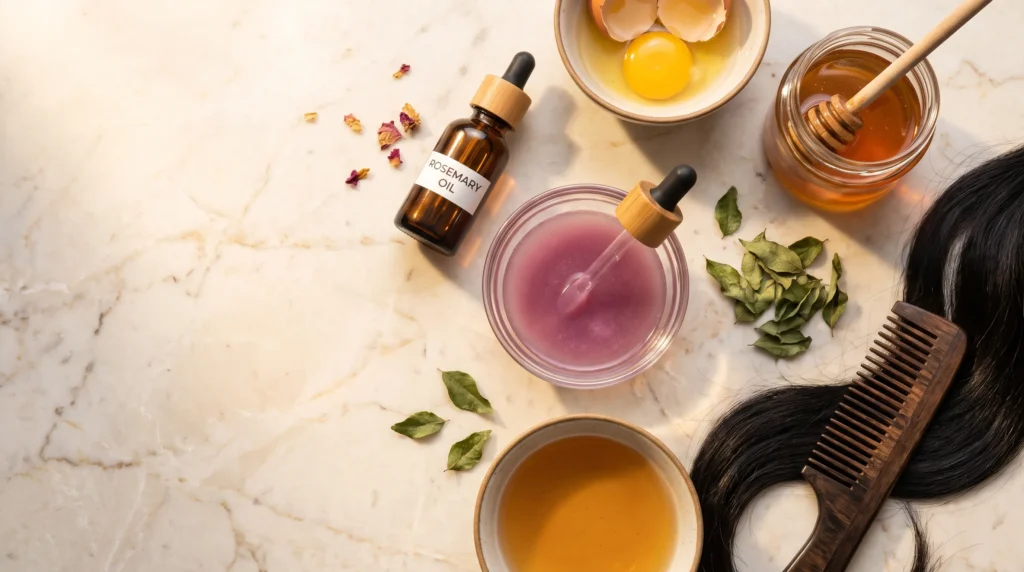
What you need: Rosemary essential oil, a carrier oil (jojoba, sweet almond, or coconut oil)
- Mix 5–6 drops of rosemary essential oil with 2 tablespoons of your chosen carrier oil. Never apply undiluted essential oil directly to the scalp — it must always be diluted.
- Section your hair and apply the mixture directly onto your scalp using a dropper or your fingertips.
- Massage using firm circular motions for at least 5–7 minutes, working across your entire scalp. Do not rush this step — the massage itself is a significant part of the treatment.
- Leave on for a minimum of 1 hour. For best results, leave overnight and cover with a satin bonnet.
- Wash out with a gentle shampoo the following morning.
Frequency: 3–4 times per week. Consistency over at least 3 months is key to seeing the kind of results shown in clinical studies.
3. Egg and Honey Hair Mask — Deep Protein Treatment for Stronger Strands

If your hair is breaking faster than it is growing, the problem is not your follicles — it is the structural weakness of your existing strands. Eggs are one of the highest quality natural sources of complete protein, and your hair is made almost entirely of keratin, which is a protein. A single egg contains biotin, B vitamins, zinc, and lutein, all of which directly support hair strength and elasticity.
Honey adds a powerful moisture-locking and antimicrobial component to this mask. As a natural humectant, it draws moisture from the environment into the hair shaft and keeps it there. This combination creates one of the most effective home remedies for natural hair growth and strength you can make in five minutes.
How to Make and Use the Egg Honey Hair Mask
What you need: 2 eggs, 2 tablespoons raw honey, 1 tablespoon olive oil, a bowl, a shower cap
- Crack two whole eggs into a bowl and beat them thoroughly until the yolks and whites are fully combined.
- Add 2 tablespoons of raw honey and 1 tablespoon of olive oil to the beaten eggs.
- Mix everything together until you have a smooth, uniform mixture.
- Apply generously to your scalp first, then work the mask down through the lengths and ends of your hair.
- Make sure every strand is coated. Put on a shower cap to create warmth and help the mask penetrate.
- Leave on for 20–30 minutes. Do not leave longer than 30 minutes, as the egg proteins can start to harden.
- Rinse thoroughly with cool water first — never hot water, as heat will cook the egg and make it impossible to remove without leaving residue.
- Follow with a light shampoo and your regular conditioner.
Frequency: Once a week as a pre-poo treatment or standalone protein mask.
Important: If your hair already feels stiff, dry, or overly hard (signs of protein overload), reduce this to once every two weeks and pair it with a moisture-rich deep conditioner.
4. Coconut Milk — Intense Moisture and Scalp Nutrition
Coconut milk is different from coconut oil, and for hair growth purposes, the milk is significantly more nutrient-dense. It is rich in iron, potassium, B vitamins, and medium-chain fatty acids, particularly lauric acid, which has a unique ability to penetrate the hair shaft and bind with hair proteins from the inside — reducing protein loss during washing and styling.
For women with natural hair who deal with dryness, brittleness, and shrinkage, coconut milk is one of the most nourishing home remedies for natural hair growth and length retention available.
How to Use Coconut Milk for Hair Growth
What you need: Fresh or canned full-fat coconut milk, shower cap
- Pour about half a cup of full-fat coconut milk into a bowl. Fresh coconut milk is ideal, but high-quality canned coconut milk with no additives works just as well.
- Optional: Warm the coconut milk slightly by placing the bowl in a larger bowl of warm water for a few minutes. Warm milk penetrates more effectively.
- Apply generously to your scalp and hair in sections, making sure to saturate from root to tip.
- Gently massage your scalp for 5 minutes in circular motions.
- Put on a shower cap and leave for 30–45 minutes.
- Rinse thoroughly and follow with a light shampoo.
Frequency: Once or twice a week as a pre-wash treatment.
Variation: For a more powerful treatment, blend fresh coconut milk with 10–12 curry leaves and allow the mixture to sit overnight before straining and applying. Curry leaves are rich in beta-carotene and proteins that additionally support follicle health.
5. Apple Cider Vinegar Rinse — Scalp Detox and pH Reset
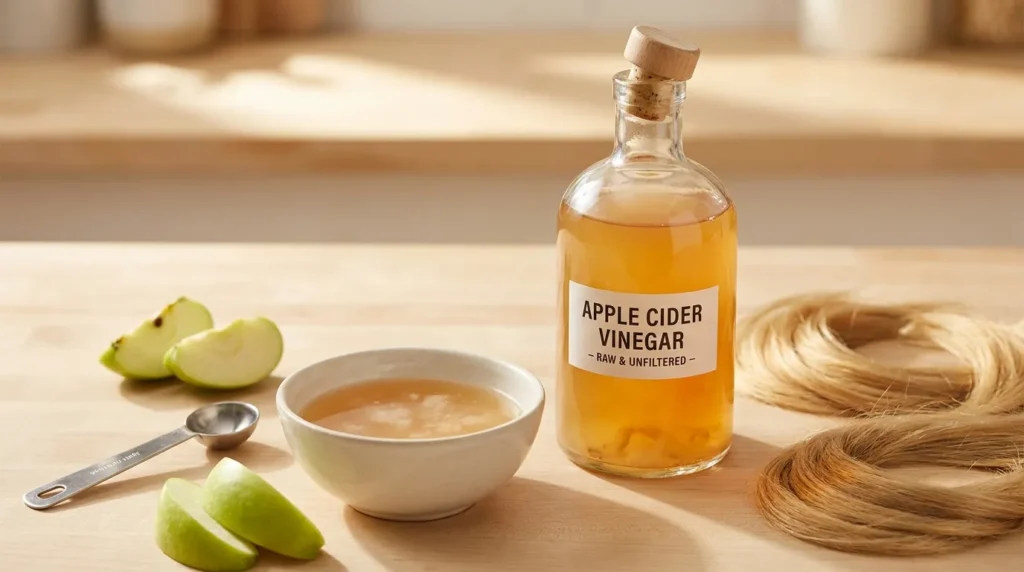
Apple cider vinegar (ACV) works differently from the other remedies on this list. Rather than directly stimulating follicles, it addresses one of the most overlooked causes of slow hair growth: an imbalanced scalp pH and product buildup on follicles.
Your scalp has a naturally acidic pH between 4.5 and 5.5. Many shampoos, conditioners, and styling products are alkaline, which disrupts this balance over time. An alkaline scalp environment leads to open cuticles (causing frizz and breakage), weakened strands, and clogged follicles that cannot support proper hair growth. ACV, with its pH of approximately 3.1, rebalances the scalp environment.
Additionally, ACV helps dissolve mineral buildup from hard water, remove product residue from follicles, and improve overall scalp circulation — making it an excellent supporting home remedy for natural hair growth when used as a rinse.
How to Use Apple Cider Vinegar for Hair Growth
What you need: Raw, unfiltered apple cider vinegar with “the mother,” water, a spray bottle or bowl
- Mix 2–3 tablespoons of raw apple cider vinegar with 1 cup (240ml) of water in a spray bottle or bowl. For a stronger clarifying rinse, use up to 4 tablespoons per cup of water. Always dilute — never apply undiluted ACV directly to your scalp, as the acidity can cause irritation.
- Wash your hair with your regular shampoo first.
- After rinsing out the shampoo, pour or spray the diluted ACV mixture over your scalp and hair, making sure to distribute it evenly.
- Gently massage your scalp with your fingertips for 2–3 minutes.
- Leave on for 3–5 minutes, then rinse thoroughly with cool water.
- Follow with your regular conditioner — the ACV rinse will have already smoothed the cuticle, so your conditioner will absorb even better.
Frequency: Once every 1–2 weeks. More frequent use can lead to excessive dryness, especially for low porosity or fine hair types.
6. Scalp Massage with Warm Oil — The Underrated Growth Tool
Scalp massage may be the simplest and most consistently overlooked home remedy for natural hair growth in this entire guide. A 2016 study from Japan found that a standardized scalp massage performed daily for 24 weeks resulted in significantly thicker hair strands. The mechanism is straightforward — consistent mechanical stimulation increases blood flow to follicles, encourages dermal papilla cells to stretch and produce more growth signals, and may even upregulate genes associated with hair growth.
How to Do an Effective Scalp Massage for Hair Growth
- Apply 1–2 tablespoons of warm oil to your scalp. Excellent choices include jojoba oil, castor oil, peppermint oil diluted in a carrier, or rosemary oil in a carrier.
- Using the pads of your fingers — not your nails — apply firm but gentle circular pressure to your scalp. Do not scratch or drag the skin.
- Work methodically from the front hairline, across the crown, to the nape of the neck, and then the sides. Spend 1–2 minutes on each section.
- The total massage should last at least 10–15 minutes to be effective.
- You can leave the oil in as a treatment, or do this as part of your wash day routine and shampoo it out afterward.
Frequency: Daily or at least 4–5 times per week. Consistency is what produces results here — a single scalp massage occasionally will not move the needle.
How Long Before You See Results?
This is the question everyone wants answered, and it deserves an honest answer rather than vague promises. Here is a realistic timeline:
| Remedy | When to Expect First Signs | Visible Results by |
|---|---|---|
| Onion Juice | 3–4 weeks (less shedding) | 8–12 weeks |
| Rosemary Oil | 4–6 weeks (fuller feel) | 3–6 months |
| Egg & Honey Mask | After first use (strength, shine) | 4–6 weeks |
| Coconut Milk | After first use (softness) | 6–8 weeks |
| Apple Cider Vinegar | After first use (shine, detox) | 4 weeks |
| Scalp Massage | 2–3 weeks (less shedding) | 4–6 months |
The most important thing to remember is that hair grows on average half an inch per month. No home remedy changes that biological baseline. What these remedies do is help you retain the length you grow and create the optimal scalp environment for that growth to happen consistently.
Tips to Make These Remedies Work Even Better
Getting the most out of these home remedies for natural hair growth comes down to how you support them day-to-day:
- Stay consistent. The biggest reason these remedies fail is inconsistency. A remedy used twice and then forgotten will not show results. Build them into your weekly hair care routine and stick to it for at least 8 weeks before judging.
- Protect your hair at night. Sleeping on cotton pillowcases creates friction that breaks hair. Switch to a satin or silk pillowcase, or wear a satin bonnet to protect your length while you sleep.
- Minimize heat styling. Heat directly damages the protein bonds in your hair. If you use heat regularly, every other remedy on this list has to work twice as hard to undo that damage. Limit heat tools to once a week maximum.
- Eat for hair growth. No topical remedy can compensate for a diet deficient in protein, iron, zinc, biotin, or omega-3 fatty acids. Include eggs, leafy greens, nuts, fish, and legumes regularly in your meals.
- Detangle gently. Aggressive detangling causes mechanical breakage that mimics “not growing.” Always detangle from the ends up using a wide-tooth comb on well-moisturized, conditioned hair.
- Avoid tight styles. Protective styles are excellent for length retention, but styles that pull too tightly at the hairline — particularly braids, weaves, and tight ponytails — cause traction alopecia, which can permanently damage follicles over time.
Frequently Asked Questions
Can I combine multiple remedies in the same week?
Yes, and this is actually recommended for best results. You can do a scalp massage with rosemary oil several times a week, an onion juice treatment twice a week, and a monthly egg and honey mask without any conflict. The key is not to overload your scalp with too many products or treatments at the exact same time. Space them out across your wash routine throughout the week.
Is onion juice really effective despite the smell?
Yes — the smell is the main reason people give up on it too quickly, but the results are genuinely worth the inconvenience. The sulfurous compounds that create the smell are exactly what make onion juice effective for the scalp. To manage the odor, mix your onion juice with a few drops of peppermint or lavender essential oil before applying. After washing with shampoo twice, the smell dissipates completely.
Do these home remedies work for alopecia?
It depends on the type. For alopecia caused by breakage, nutritional deficiency, or poor scalp health, these remedies can be quite effective. For androgenic alopecia (hormonal hair loss) or autoimmune alopecia areata, home remedies can support overall scalp health but should not replace a consultation with a dermatologist. Rosemary oil specifically has shown clinical promise for androgenic alopecia and is a reasonable complement to medical treatment.
How do I know if my hair is not growing or just breaking?
The easiest way to check is to look at your drain or your comb after a wash. If you are seeing mostly short, broken pieces rather than full-length strands with a white bulb at the root, breakage is your primary issue — not growth rate. In that case, focus on strengthening remedies like the egg mask and reduce manipulation and heat first.
Can men use these remedies too?
Absolutely. All of these home remedies work equally well for men and women. Scalp biology is fundamentally the same regardless of gender. The onion juice and rosemary oil treatments are particularly useful for men experiencing early-stage male pattern hair thinning, as both have shown evidence for supporting hair density in androgenic alopecia.
Should I follow any particular order when using multiple remedies?
There is no strict order required, but here is a practical weekly framework that works well: scalp massage with rosemary oil on Monday and Thursday, onion juice treatment on Tuesday, and egg or coconut milk mask on your wash day on Saturday. The ACV rinse is used as your final rinse on wash day, after shampooing and before conditioning.
Final Thoughts
Your hair absolutely has the ability to grow longer, thicker, and healthier — and you do not need expensive salon treatments or products with ingredient lists you cannot pronounce to make it happen. These home remedies for natural hair growth have stood the test of time for a reason: they work with your hair’s biology rather than against it.
Start with one or two of the remedies that feel most manageable for your current routine. Commit to them consistently for a minimum of eight weeks. Track your progress with monthly photos. Then layer in additional remedies as they become habit.
The most powerful thing you can do for your hair growth journey is to stop searching for a quick fix and start building a consistent routine that your scalp can respond to over time. Your kitchen already has what you need — the rest is simply showing up for your hair, week after week.
Also Visit : Palm Oil for Hair: Benefits, How to Use It, and What to Expect