Hair Growth for Black Women: What Actually Works

Black hair grows. That’s the short answer to a question that shows up in natural hair communities on repeat, and it’s worth stating clearly before anything else. Follicles in tightly coiled hair produce new strand at roughly the same rate as any other hair type — around half an inch a month on average.
The reason hair growth for Black women so often feels stuck isn’t a growth problem. It’s a retention problem. Coiled hair is structurally more prone to breakage than straighter textures, and when strands snap off at roughly the same speed they emerge, visible length stays fixed even while the follicle keeps working. This article covers what actually determines whether that growth becomes length you can see and use.
Most advice on this topic treats hair growth and retention as the same question. They’re not, and that mix-up sends a lot of people toward routines and products that can’t address what’s actually happening.
The Black Hair Growth Myth
The idea that Black hair grows more slowly than other textures gets repeated often enough to feel like settled biology. It isn’t. Growth rate is controlled by the anagen phase of the hair cycle — the active window where the follicle produces new cells and pushes strand outward from the scalp. That process is influenced by nutrition, hormones, and overall health. Curl pattern doesn’t play a meaningful role in it.
What does differ across hair types is strand shape, cuticle structure, and how moisture behaves once it’s inside the shaft. Tightly coiled hair typically has a flatter, more oval cross-section, and every turn in the curl creates a mechanical stress point. The cuticle — the protective outer layer — tends to be thinner and more lifted at those bends than along the rest of the shaft. That’s where breakage begins. Not at the root, but mid-shaft or closer to the ends.
Research comparing hair growth rates across different textures suggests that, where differences in follicle output have been found at all, they’re modest — far smaller than the length differences most Black women actually experience. That gap is a retention story, not a growth one.
Why Coiled Hair Breaks Before It Can Grow
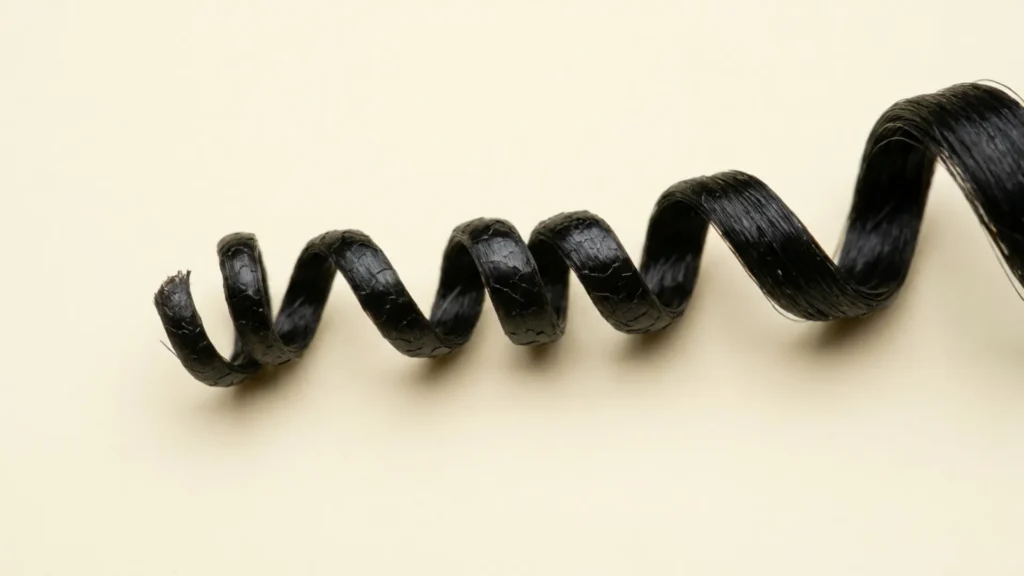
To understand why retention is harder for tightly coiled hair, it helps to think about what a curl actually is, structurally. A type 4 coil isn’t simply hair that bends. It’s a strand that winds back on itself many times along its length, with each turn concentrating mechanical stress at that point. Apply tension from combing, stretching, or rough styling and that force lands hardest at every curve.
Two structural features make those stress points worse. First, the cuticle layers are thinner at the bends than along the rest of the shaft. The cuticle’s job is to seal the inner cortex and hold moisture in, and when those layers wear down, moisture escapes faster and the strand becomes brittle. Second, moisture doesn’t travel along a tightly coiled strand the way it does along a straight one. Sebum, the scalp’s natural oil, follows the hair shaft outward from the root. On a straight strand it slides down readily. On a tight coil, it moves slowly through the spirals, often not reaching the mid-shaft and ends at all.
The result is chronically dry ends. Not because the scalp isn’t producing oil, but because the geometry makes distribution genuinely difficult. Dry ends break. Broken ends don’t become length. That sequence, playing out week after week, is why someone can have actively working follicles and still measure the same length they had three months ago.
None of this means coiled hair is so delicate that handling it becomes a risk at every step. It means it needs a different set of habits from the routines designed for straighter textures, most of which were developed around entirely different structural properties.
Also Visit : The Hair Growth Secrets Behind a Healthier Scalp
The Breakage Triggers That Cancel Out Growth
Breakage isn’t random. It follows consistent patterns, and knowing which trigger is at work makes it possible to address the right problem rather than guessing. The most common culprits:
| Trigger | What it does to the strand | How to address it |
|---|---|---|
| Heat damage | Collapses the cuticle, weakens internal protein bonds, can permanently alter curl pattern in severe cases | Use a heat protectant every time; limit direct heat tools to once a week or less; keep temperature at or below 400°F (204°C) |
| Chronic dryness | Makes the strand brittle and prone to snapping at the natural stress points along the curl | Apply water-based moisture followed by an oil or butter to seal; re-moisturise on dry days between wash days, not only on wash day |
| Rough handling on dry hair | Combing or brushing shrunken dry coils forces the tool through stress points and snaps strands at the curves | Detangle only on wet, conditioner-saturated hair; use a wide-tooth comb or fingers; always work from the ends toward the root |
| Prolonged tension at the root | Constant pull at the hairline or temples gradually stresses follicles, which can lead to permanent thinning in those areas over time | Install braids, weaves, and updos without tension pain; take them down before six to eight weeks; vary where tension falls across different styles |
| Single-strand knots at the ends | These tiny knots snag adjacent strands and start breakage chains that travel up the shaft | Regular light trimming removes knots before they can travel; keeping ends consistently moisturised reduces how often they form |
The tension trigger is worth examining carefully. Traction alopecia is one of the most common causes of hairline thinning in Black women, and it develops gradually, often without obvious pain in the early stages. Many people don’t notice it until the hairline has already shifted. It’s preventable — but it requires the same protective styles so often recommended for growth to be genuinely low-tension and taken down on time, not simply assumed to be safe because they’re called protective.
Your Scalp and What It’s Actually Doing

Hair grows from follicles, and follicle health matters even when it’s invisible from outside. The hair growth cycle moves through three phases: anagen (active growth, lasting two to seven years depending on the individual), catagen (a brief transition of a few weeks), and telogen (resting, where the old strand sheds while the follicle prepares to produce a new one). The proportion of follicles sitting in anagen at any given time determines how much active growth is happening across the scalp.
Several things push follicles out of anagen prematurely or slow how quickly they restart. Chronic stress — physical and emotional — is among the more well-supported of them. Significant nutritional gaps in iron, zinc, or protein can shift more follicles into the resting phase, producing the kind of diffuse shedding that shows up across the whole scalp rather than in one area. Tight styling puts direct physical stress on the follicle opening itself.
Scalp massage comes up often in natural hair discussions. The evidence behind it is limited but not empty: small studies suggest it may support hair thickness over time, likely by improving blood flow to the follicle. Whether it meaningfully changes growth rate is a harder case to make. What it does reliably is help distribute product and gives you regular, close contact with your scalp — enough to catch early thinning, persistent flaking, or tenderness before those things get harder to reverse.
Also Visit : Biotin Hair Growth: What It Actually Does to Your Hair
What Actually Works for Hair Growth and Retention

No single product grows Black hair faster. What builds length is a consistent set of habits that protect the strand from the damage that cancels out growth. The brand names matter far less than the principles.
Moisture applied consistently and sealed in. Coiled hair needs water-based moisture applied regularly, followed by something that slows how quickly it evaporates. The LOC method (liquid, oil, cream) and LCO (liquid, cream, oil) both work on that principle: water penetrates and hydrates the inner cortex, while the oil or butter layer slows evaporation from the cuticle surface. Which order works better tends to depend on porosity — high-porosity hair often benefits from cream before oil, since its cuticle is more open and needs sealing faster. What matters most isn’t the order. It’s applying moisture on dry days between wash days, not only on wash day itself.
Low-manipulation handling. Every time you detangle, stretch, re-twist, or restyle coiled hair, there’s friction and tension. Reducing how often and how forcefully you handle it is high-impact and costs nothing. Finger-detangling on wet, conditioner-heavy hair, wearing a loose braid or twist for a few days after wash day, and avoiding the pull of daily restyling all reduce cumulative damage without requiring any product changes.
Protective styling, done right. Braids, twists, and extensions protect ends from daily friction and keep hair in a low-manipulation state. That’s genuinely useful for retention. But “protective” only holds if the style is installed without tension, the ends are sealed before going in, and the style comes down before the hair has been in long enough to begin matting at the roots. Four to six weeks is a more realistic ceiling for most styles. Twelve weeks isn’t protective — it’s breakage at takedown plus compounding traction risk across the full wear period.
Regular light trimming. Split ends don’t stay at the tip. They travel up the shaft, and a strand that splits mid-length breaks there — losing more length than a small trim would have removed. Dusting (taking off just the very tip rather than a full cut) every eight to twelve weeks keeps ends intact long enough to become real retained length. It sounds counterproductive. The math says otherwise.
Two things that matter less than commonly claimed: oils applied without water-based moisture underneath sit on top of the cuticle rather than penetrating it — they can reduce moisture loss but can’t fix existing dryness on their own. And hair growth supplements don’t speed up the hair cycle in people who aren’t deficient in what those supplements contain. If a blood panel shows low iron or zinc, addressing that can genuinely help. Otherwise, supplements won’t change your growth rate.
A Realistic Year of Growth: What to Expect
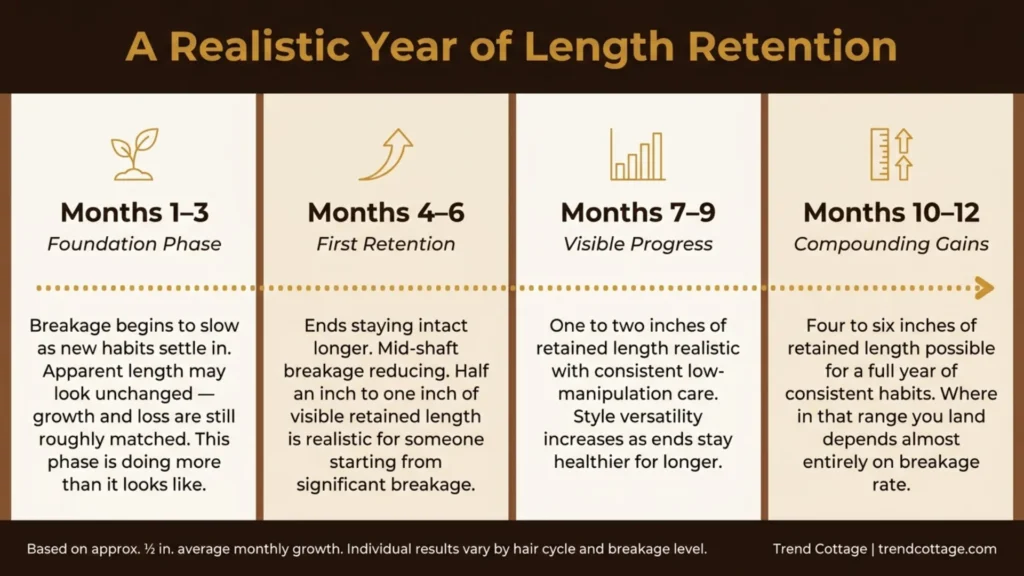
At half an inch a month, twelve months of uninterrupted growth adds up to around six inches of new strand. In practice, almost nobody retains all of it — some breakage will always happen regardless of how careful the routine. A realistic first-year target for someone making meaningful changes is somewhere in the four to six inch range. Where in that range you land depends on how much breakage is currently happening and how significantly new habits reduce it.
The early months tend to feel discouraging. Breakage can match growth so closely that apparent length looks exactly the same, even while the habits are working. What’s actually happening in that window is that the rate of new growth is starting to edge past the rate of loss — but the gap isn’t wide enough yet to show up in the mirror. For most people making genuine changes, visible progress tends to appear around months four or five, not at the end of week two.
If length genuinely hasn’t moved after six to eight months of consistent care, or if you’re noticing patchy thinning, a receding hairline, or tenderness at the scalp, those are worth taking to a dermatologist rather than troubleshooting with more products. Central centrifugal cicatricial alopecia (CCCA) and traction alopecia both disproportionately affect Black women and can look like general slow growth early on. A dermatologist can diagnose or rule both out before permanent follicle damage occurs — which is exactly why catching them early matters.
Also Visit : Which Hair Growth Methods Are Worth Your Time?
Frequently Asked Questions
Does Black hair actually grow more slowly than other hair types?
The research is mixed, but any growth rate differences found across hair types are modest — far smaller than the length gap most Black women experience. The gap is primarily about retention: coiled hair is more structurally prone to breakage, so length is lost before it can accumulate as visible inches.
How long before I see noticeable length from better habits?
Most people making real changes to their moisture routine and handling habits see visible difference around months four or five. The first couple of months often look unchanged because growth and breakage are still roughly matched. Length compounds after that as the balance tips toward retention.
Can protective styles cause hair loss?
Yes, if they’re installed too tightly or left in too long. Tight braids, weaves, and ponytails put consistent tension on the hairline and temples, causing traction alopecia over time. It’s preventable: install without tension pain, take styles down within six to eight weeks, and vary where tension is applied across different styles.
Do hair growth vitamins actually do anything?
Only if you’re deficient in what they contain. Biotin, iron, zinc, and protein all support normal hair growth — but adding more when your levels are already adequate doesn’t accelerate the growth cycle. A blood test is the only way to know whether a supplement would help. For most people eating a reasonably complete diet, it won’t.
Why does my hair stay the same length no matter what I do?
Almost always because breakage is matching growth exactly. The follicle is working, but strands are snapping before they can accumulate. Reducing the main triggers — chronic dryness, rough handling on dry hair, and prolonged tension — is the only thing that shifts the balance.
If you’re working through a retention routine for the first time, save this for reference — it’s easier to troubleshoot one variable at a time than to overhaul everything at once. Drop a comment below with the habit you’re starting with.
Key Takeaways
- Black hair grows at roughly half an inch a month — the same general rate as other hair types. Growth rate is not the problem.
- Coiled hair is structurally prone to breakage at every bend in the curl. When breakage matches growth, visible length stays fixed even while the follicle keeps producing new strand.
- Moisture applied consistently and sealed in is the foundation of length retention — not oils used alone, and not supplements without a confirmed deficiency.
- Protective styling only protects when it’s genuinely low-tension and taken down within six to eight weeks. Tight or overlong styles are a breakage and traction risk, not a growth strategy.
- Patchy thinning, a shifting hairline, or no length change after six to eight months of consistent care are signals worth taking to a dermatologist — not a sign to buy more products.
This article is for general information only and isn’t medical advice. For persistent hair loss, scalp pain, or sudden shedding, see a dermatologist or trichologist.
Written by Anna Anderson for Trend Cottage.