Hair Growth Hacks That Actually Work (And What Doesn’t)

Most hair growth advice lumps two completely different problems together. Products that stop breakage get packaged alongside techniques that affect the follicle itself, and everything gets labelled a “hack” as if it all works the same way.
It doesn’t. Knowing the difference is most of the work.
Quick answer: Hair grows roughly half an inch a month for most adults, and that rate is set by genetics, hormones, and nutrition. No topical product changes that ceiling in any meaningful way. What most hair growth hacks actually address is breakage — how much of that growth you retain before it snaps off. A smaller number of approaches do genuinely influence the growth cycle itself, but that list is shorter than the internet suggests. This article sorts them out.
Hair Growth Has a Speed Limit
The average human scalp grows hair at roughly 0.35 to 0.45 mm per day. That works out to around six inches a year, though the figure varies by age, hair type, and where each individual follicle sits in its cycle at any given moment.
Each follicle moves through three stages. Anagen is the active growth phase. For scalp hair, it can last anywhere from two to seven years. Catagen is a brief transitional phase where growth stops. Telogen is the resting phase, when the follicle pauses before eventually shedding the strand and restarting. Between 90 and 95 percent of scalp hair is in anagen at any one time, which is why most people shed between 50 and 100 strands a day without noticeable thinning. [EXTERNAL SOURCE NEEDED: specific AAD, Cleveland Clinic, or NHS page citing these hair cycle statistics — replace this placeholder before publishing]
Anything that disrupts or shortens the anagen phase slows growth in a measurable way. Anything that supports the conditions for a full, healthy anagen phase is a genuine growth hack. Everything else is breakage management — still valuable, but a different problem requiring different solutions.
Also Visit : Hair Growth Challenge: How to Build One That Works
Growth vs. Breakage: Why It Matters Which Problem You Have
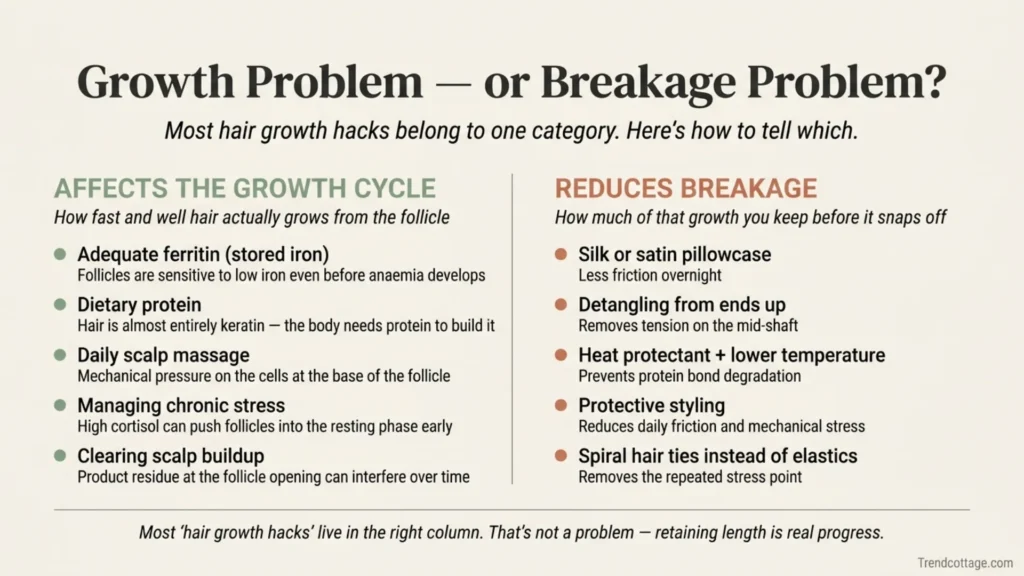
This is the distinction that most content in this space glosses over, and it changes everything about which approach is actually worth trying.
A strand that grows six inches but snaps off at three inches looks, from the outside, like hair that only grew three inches. Products and routines that stop that mid-shaft snapping get credited with making hair grow faster. They didn’t. They prevented growth from being erased before it became visible length.
That’s still genuinely worth doing. But it’s a different problem with different solutions. If hair grows slowly for biological reasons (low ferritin, caloric restriction, a shortened anagen phase), conditioning treatments and gentle detangling won’t fix it. If hair grows fine but breaks constantly, a scalp supplement won’t address that either.
Most people are dealing with some version of both at once, which is why a mixed approach tends to produce results, as long as you’re applying the right fix to the right issue. The graphic above sorts the two categories clearly. It’s worth reading before spending money on any hair growth hack in this space.
What Can Actually Influence the Growth Cycle
Three things have real mechanisms behind them for affecting actual growth — not just how hair looks or feels day to day.
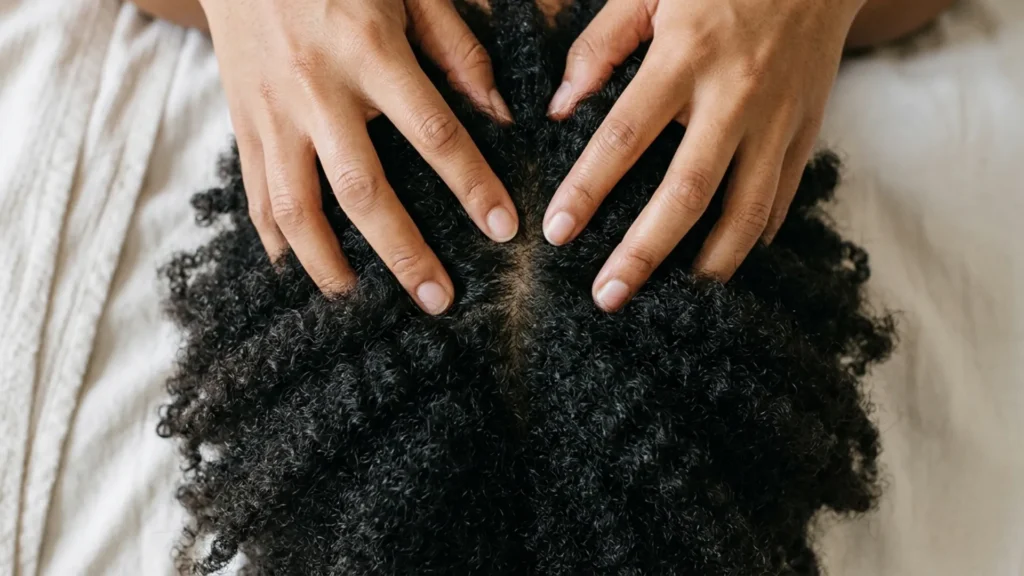
Scalp massage. a study tracking 24 weeks of standardised daily scalp massage found measurable increases in hair shaft thickness. The mechanism the researchers identified wasn’t simply increased blood flow, which is the explanation most often given. Physical pressure from the massage was found to stretch dermal papilla cells (the cells at the base of each follicle that regulate growth activity). The study was small and hasn’t been replicated at scale, so it isn’t conclusive proof. But it’s a specific, testable finding, and it puts scalp massage in a different category from most topical treatments. The protocol used: four minutes of firm, circular fingertip pressure across the whole scalp, daily.
Iron and ferritin. Low ferritin — the stored form of iron, distinct from the basic red-blood-cell markers on a standard panel — is one of the more commonly missed reasons hair growth stalls. research into ferritin levels and hair shedding suggests the follicle is particularly sensitive to low iron stores even before full anaemia develops. Hair is metabolically non-essential: when the body needs to triage its iron supply, follicles lose out early.
Ferritin shortfalls are more common than most people expect. the NIH’s consumer guidance on iron requirements shows how much the recommended daily intake varies by age and sex, which is partly why shortfalls go undetected on routine panels. If hair growth has slowed with no other obvious explanation, a serum ferritin test is worth asking a GP about before buying any supplement.
Protein intake. Hair is almost entirely keratin, which is a protein. The follicle needs adequate dietary protein to construct each strand. Severe caloric restriction, or a diet very low in protein, can push more follicles into the resting phase and slow growth noticeably within weeks. This isn’t about eating more protein than you need — it’s about not eating less than your follicles require to function.
One thing that doesn’t belong on this list: most oils applied to the scalp don’t reach the follicle at any meaningful concentration. Some, like peppermint oil, have a single promising small study behind them; none have the replication needed to be reliably recommended. Oils applied to the lengths and mid-shaft do have a place, but that place is on the breakage side of the equation, not the growth side.
Also Visit : Black Hair Growth: Why Retention Is the Real Work
Reducing Breakage: The Other Half of Length Retention
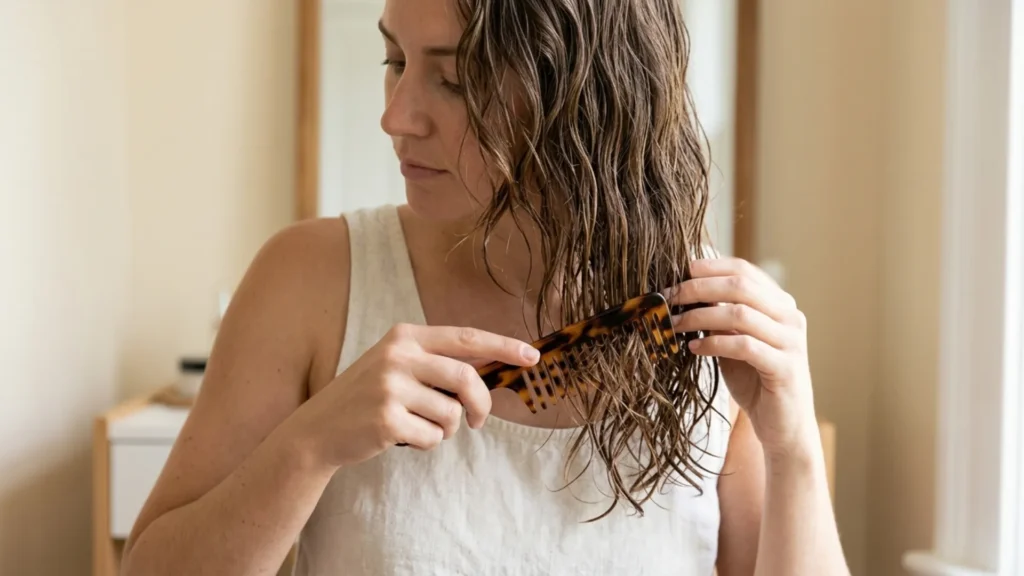
Most of the hair growth hacks that actually change results over time work on the breakage side, not the follicle side. This is where most people lose centimetres they’d otherwise be counting. The fixes aren’t complicated, but they compound.
Detangling order matters more than most people think. Working a comb through dry, tangled hair from root to tip pulls against knots and snaps mid-shaft strands as it goes. Hair is weakest under tension. Starting from the ends and working gradually upward, on damp hair with a leave-in or slip product in it, removes that tension entirely. It takes a little longer; it preserves considerably more length.
Heat damages hair in a specific way. High heat without a protectant, or heat layered repeatedly over the same section, degrades protein bonds in the shaft and creates a brittle, porous strand that breaks more easily afterwards. A proper heat protectant applied before styling, and the lowest temperature that gets the job done, prevents most of that. The problem isn’t heat itself. It’s heat applied without preparation.
Overnight friction is a quieter factor, particularly for longer hair or curlier textures. Cotton pillowcases create more surface resistance than silk or satin, and that friction causes tangling and mid-shaft breakage throughout the night without you noticing. Switching the pillowcase (or loosely wrapping hair before bed) removes a breakage event that otherwise happens every single night.
Hair ties create stress points. An elastic band worn in the same spot repeatedly builds a structural weakness in the shaft that eventually snaps. Spiral ties, scrunchies, or simply rotating where you place a ponytail from day to day distributes that stress rather than concentrating it in one place.
None of this accelerates growth. All of it means more of what grew actually stays.
What Quietly Stalls Growth
Some factors interfere with the growth cycle in ways people rarely connect to their hair, often because the effect shows up weeks or months after the cause.
Chronic stress is the most common example. Sustained high cortisol has been linked to more follicles shifting prematurely into the telogen (resting) phase — a condition called telogen effluvium. The shed typically appears two to three months after the stressful period, not during it, which makes the cause hard to identify. Hair that starts falling heavily after a difficult few months isn’t unhealthy or permanently damaged. It’s catching up with a cycle disruption that already happened. It usually reverses once the stressor resolves, though density can take six to twelve months to visibly recover.
Scalp buildup does more damage than most people credit. Product residue, excess sebum, and mineral deposits from hard water accumulate at the follicle opening over time. A clarifying shampoo used every two to four weeks, or a gentle exfoliating scalp scrub, keeps it cleared without stripping the scalp’s natural balance.
Under-eating is more common than most people acknowledge, particularly on weight-loss plans. Follicles are metabolically expensive. When the body runs a significant caloric deficit, it deprioritises non-essential functions, and hair growth is among the first to feel it. A moderate, sustainable deficit is unlikely to cause this. Aggressive restriction reliably does, usually within six to twelve weeks of starting.
Certain medications list increased shedding as a side effect, including some blood pressure drugs, cholesterol medications, and hormonal treatments. If hair growth slowed noticeably after starting a new prescription, that connection is worth raising with the prescribing doctor — not to stop the medication, but to understand whether an alternative without that effect exists.
Also Visit : Hair Growth Massage: Technique, Timing and Results
How to Apply These Hair Growth Hacks
The framework breaks into three layers, and none of them require spending money first.
Support the growth cycle: eat enough protein, check ferritin if growth has stalled without an obvious cause, and add four minutes of scalp massage to a daily routine. Reduce what might be slowing it down: manage chronic stress where possible, use a clarifying shampoo regularly, and don’t restrict calories aggressively if hair health is a priority right now.
Reduce breakage: change how you detangle, use heat protection consistently, update the pillowcase, and rethink the hair tie situation.
That’s the whole list. It won’t change a genetic growth rate — nothing available without a prescription reliably does that. What it does is remove the obstacles that stop natural growth from becoming visible length. For most people, that’s the actual gap between where their hair is and where they want it to be.
Frequently Asked Questions
Does hair grow faster in summer?
There’s some evidence suggesting scalp hair grows slightly faster in warmer months, possibly linked to UV exposure and seasonal changes in follicle activity. The difference is small — fractions of a millimetre — and won’t translate into meaningful length change over a single season. It’s not something to plan a routine around.
How long before scalp massage shows any result?
The study that found measurable increases in hair thickness ran for 24 weeks. That’s the honest benchmark. Changes to the growth cycle take months to appear as visible difference — four weeks isn’t a fair test of anything working at the follicle level.
Is biotin worth taking for hair growth?
Only if you’re genuinely deficient in it. For people whose biotin levels are already sufficient, supplementing doesn’t improve growth in any documented way. High-dose biotin can also interfere with certain thyroid and cardiac blood tests, so it’s worth flagging to a GP before a panel. Deficiency is uncommon in people eating a varied diet.
Does trimming make hair grow faster?
No — cutting the ends has no effect on the follicle. What trims prevent is split ends travelling up the shaft. Once a split progresses far enough, the strand snaps higher than the original split, losing more length than a timely trim would have taken. Regular trims are breakage prevention, not growth acceleration.
What’s a realistic monthly growth rate?
Somewhere between 0.5 and 1.5 cm per month for most adults, with the average closer to 1 cm. Genetics sets most of that ceiling. Optimising nutrition, reducing scalp disruption, and retaining length through less breakage is how the upper end of a personal range becomes the norm rather than the exception.
Key Takeaways
- Hair grows roughly half an inch a month — genetics, hormones, and nutrition set that ceiling, not topical products
- Most hair growth hacks reduce breakage, not the growth rate itself. Both matter, but they need different approaches
- Scalp massage, adequate ferritin, and sufficient protein have real (if modest) mechanisms for the growth cycle itself
- Chronic stress, under-eating, scalp buildup, and certain medications are among the most commonly missed growth-slowing factors
- The goal for most people isn’t faster growth — it’s removing the obstacles that stop existing growth from becoming visible length
If this changes how you’re approaching your routine, save this article for later — and if you’ve found something that genuinely helped you retain length, leave it in the comments below.
This article is for general information only and isn’t medical advice. For persistent hair loss, scalp pain, or sudden shedding, see a dermatologist or trichologist.
Written by Anna Anderson for Trend Cottage.