How to Follow an Urutan Hair Care Routine Properly
Most people build their wash day routine by feel — shampoo first, then something conditioning, then whatever’s supposed to go on after. The sequence feels intuitive enough. But “after” covers a lot of ground, and where products land within that window is exactly where most routines quietly fall apart.
Quick answer: The correct urutan hair care routine runs from cleansing to sealing: pre-treatment (optional) → shampoo → conditioner or deep mask → leave-in conditioner → serum or treatment → hair oil → heat protectant if styling. The logic isn’t arbitrary. Lighter, water-based products need to sit on the strand before heavier, oil-based ones — oil repels water, so once it’s on the strand, water-based products applied afterwards can’t get through. Get the order right and every product works as it’s supposed to. Get it wrong and even good products underperform.
Here’s the full sequence, the reasoning behind each position, and where most routines quietly go sideways.
Why the Order Changes What Your Products Can Do
The hair cuticle is the outermost layer of each strand, made of overlapping scales. Shampoo and warm water lift those scales open. That’s not a flaw — it’s the mechanism. Conditioning ingredients enter the strand while the cuticle is open, then cooler water or slightly acidic rinses push the scales back down. The correct urutan hair care routine is built entirely around this two-stage process.
Oil sits on the surface of the strand and slows moisture from escaping — useful as a final sealing step. But apply oil before a water-based leave-in and you’ve created a barrier the leave-in can’t cross. Apply oil before shampooing and the shampoo has to fight against that same barrier, leading either to under-cleansed roots or a second wash that strips more than necessary. The American Academy of Dermatology’s guidance on washing hair properly recommends focusing shampoo at the scalp rather than running it through the full length — in part because over-lathering already-conditioned strands causes dryness that has nothing to do with the product itself.
Most routine problems don’t come from bad products. They come from good products applied in the wrong order.
Also Visit : What’s the Best Hair Care Routine for Wavy Hair?
The Full Wash Day Sequence
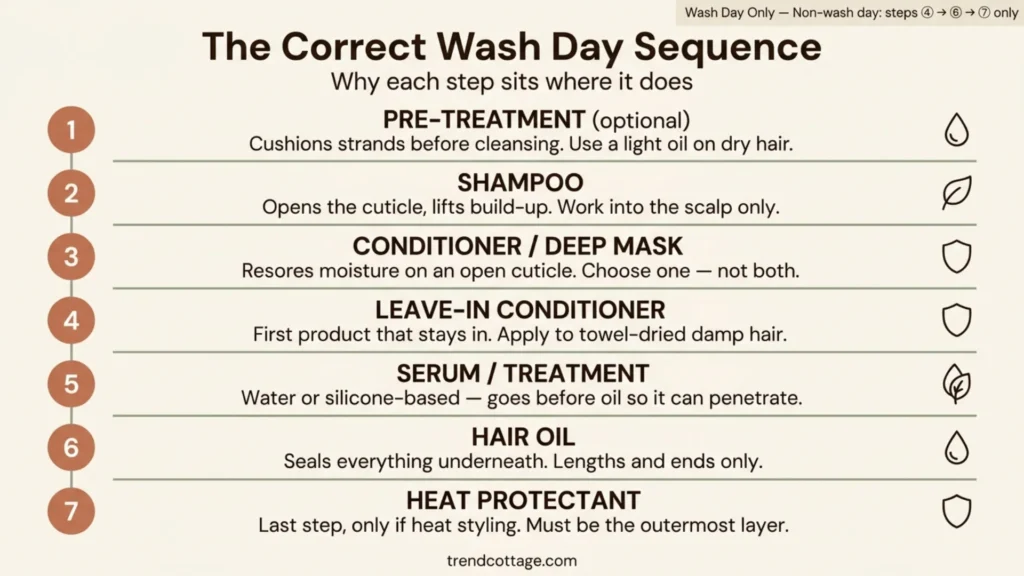
This is the complete urutan for wash day — every step in the position it belongs, and why it sits there. The table below gives the overview; the sections after explain the reasoning for the steps people most often get wrong.
| Step | Product Type | Purpose | Key Note |
|---|---|---|---|
| 1 | Pre-treatment (optional) | Cushions strands before cleansing | Light oil or detangling conditioner on dry hair |
| 2 | Shampoo | Cleanses scalp; opens cuticle | Focus on roots — let the rinse carry it through |
| 3 | Conditioner or deep mask | Restores moisture on an open cuticle | Choose one — don’t layer both on the same day |
| 4 | Leave-in conditioner | Moisture base that stays in | Applied to damp, towel-dried hair — not soaking wet |
| 5 | Serum or lightweight treatment | Targeted treatment before sealing | Water or silicone-based; must go on before oil |
| 6 | Hair oil | Seals in moisture; slows loss | Lengths and ends only — not the scalp |
| 7 | Heat protectant | Shields hair from heat tool damage | Only if heat styling; goes on last, over the oil |
Before You Shampoo
The pre-treatment step is optional, but it’s worth understanding what it actually does. A pre-poo — a light oil or a detangling conditioner applied to dry hair before you wet it — reduces the friction and moisture loss that shampooing causes. It doesn’t prevent cleansing from working. It cushions the process. If your hair consistently comes out of the shower feeling tight and rough, even after a gentle shampoo, a pre-poo step often resolves it before you need to reconsider the shampoo itself.
Shampoo, Then Condition
Shampoo works on the scalp. The surfactants in it lift sebum and product build-up from the roots — running thick lather down the full length of the hair is usually unnecessary and contributes to dryness over time. Massage the scalp well and let the rinse water carry the foam through the rest on its way out.
A rinse-out conditioner then closes the cuticle and replaces some of the moisture the shampoo removed. A deep conditioning mask does the same job with a longer contact time — usually 5 to 30 minutes, sometimes with a heat cap or warm towel to help the ingredients penetrate further. The point worth repeating: choose one or the other for any given wash. They serve the same function in the same position, and they don’t need to be stacked.
The Leave-In, Serum, and Oil Trio
This is the stretch of the routine where most people unknowingly reorder things, and where product performance drops most sharply as a result.
Leave-in conditioner goes on first — applied to towel-dried, damp hair, not hair that’s still dripping. It’s the first product in the sequence that stays in, which makes its placement critical. Anything heavier sitting on the strand before it will block it from making contact.
Serums and lightweight treatments go next. Heat protection serums, bond-building treatments, and smoothing serums are almost always water or silicone-based. They need direct contact with the hair before oil goes over them. If your serum includes heat protection, the placement matters even more — those protective agents need to sit on the outermost layer of the strand, not be covered by a sealant.
Hair oil is the last moisturising step. It sits on the surface of the strand and slows moisture from escaping — genuinely useful, but only once there’s something worth locking in underneath. AAD guidance on minimising hair styling damage consistently notes that lighter products applied before heavier ones penetrate more effectively — a principle that runs straight through the leave-in, serum, and oil sequence. Apply oil to lengths and ends; applying it to the scalp adds build-up without benefit unless a specific scalp oil treatment calls for it.
Heat Protectant Comes Last
If you’re heat styling, heat protectant goes on after the oil — just before the tool makes contact. The polymers in most heat protectants form a shield on the very outer surface of the strand. That shield has to be the top layer to work. Apply oil over it and the oil, not the protectant, is what the hot tool meets first.
Two Steps Most People Put in the Wrong Place
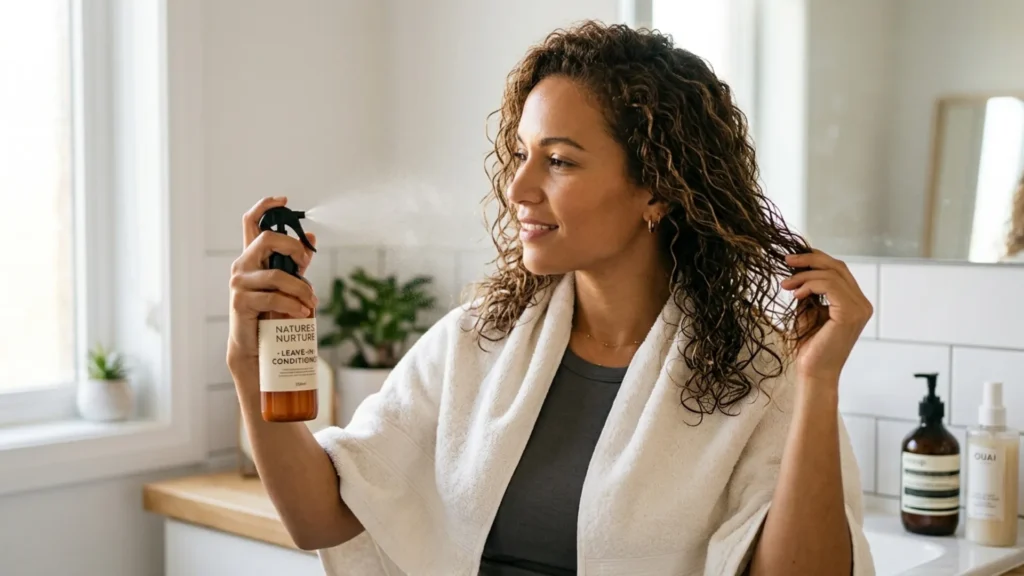
Following a correct urutan hair care routine is mostly intuitive once the sealing logic makes sense. Two specific steps still catch people out.
Oil before leave-in. This is the most common reversal. People reach for a hair oil right out of the shower, while the hair is still very damp, before any leave-in has been applied. The oil seals the strand immediately. The leave-in applied afterwards sits on a surface that won’t absorb it — hair feels coated and heavy for a few hours, then dry and dull by the next day. Research on how oils interact with the hair shaft has shown that even lighter, penetrating oils like coconut oil form some degree of surface coating, supporting the case for applying them after water-based conditioning products rather than before. [EXTERNAL SOURCE NEEDED: Rele AS and Mohile RB, “Effect of mineral oil, sunflower oil, and coconut oil on prevention of hair damage,” Journal of Cosmetic Science, 2003, vol. 54 — verify exact PMID and add live PubMed link before publishing]
Deep mask before shampoo. Some hair care traditions — particularly those from South Asian and Indonesian backgrounds — do apply oil-based treatments to dry hair before shampooing as a deliberate pre-wash step. That’s a valid technique with its own purpose. But a deep conditioning mask isn’t a pre-wash treatment. A mask is formulated to work on a clean, open cuticle after shampoo, when the strand is ready to receive it. Using a mask before shampooing means the ingredients are competing with scalp oil and existing build-up, and most of the conditioning effect is lost.
Also Visit : Simple Hair Care Routine That Actually Fits Your Week
Non-Wash Day: A Shorter Sequence
On days you’re not shampooing, the urutan shrinks. The scalp is already clean, the cuticle hasn’t been lifted by shampoo, and the hair still carries some conditioning from the last wash day. A full product stack isn’t necessary — and on most hair types, it actively works against you.
A practical non-wash day order:
- A light mist of water or a curl refresher spray to rehydrate the surface
- A small amount of leave-in if the hair feels dry — this isn’t always needed
- A drop or two of hair oil on the ends to reseal
- Heat protectant only if you’re using heat that day
The mistake most people make on non-wash days is over-layering. Applying a full wash-day product stack on top of hair that’s already moisturised and sealed builds up fast. That build-up is often why roots get greasy sooner than expected — not because the scalp is naturally oilier, but because heavy daily layering is adding to the problem.
Adjusting Your Urutan Hair Care Routine by Hair Type

The step order in an urutan hair care routine doesn’t change based on hair type. The products chosen within it do.
Fine hair gets weighed down quickly. A spray-formula leave-in works better than a cream, and the oil step should be minimal — a few drops on the very ends, or skipped on wash days when the hair already has plenty of conditioning from the mask. Heat protectant remains non-negotiable if any heat tool is involved, regardless of how light the rest of the routine runs.
For thick or coarse hair, the challenge is holding on to moisture. A richer cream leave-in and a more generous oil application both help, but the sequence still runs the same way: leave-in first, oil second, every time.
Low-porosity hair has a cuticle that lies tightly closed and resists product absorption. The conditioning step responds well to added heat — a heat cap, a hooded dryer, or even a warm towel during the 10 to 30 minutes a mask sits on the hair helps conditioning ingredients get past a cuticle that doesn’t lift easily. The sequence itself doesn’t change. What changes is what you do at step 3 to help it work.
When hair is high-porosity — usually from chemical processing or repeated heat damage — it absorbs products fast but loses moisture just as quickly. A slightly richer oil as the final sealant helps lock in what the leave-in and serum established. Protein treatments, where they’re needed, sit in the serum position: after the leave-in, before the oil, not tacked on at the end.
The temptation with hair typing is to overhaul the sequence. It rarely helps. The variables are product weight and conditioning time — not the order the steps run in.
Also Visit : Hair Care Routine for Coloured Hair: Keep Colour Longer
Frequently Asked Questions
Does conditioner go before or after a hair mask?
A hair mask replaces the conditioner step — it doesn’t add to it. Both sit in the same position in the urutan hair care routine: directly after shampoo, on damp hair, before any leave-in. Use one or the other on any given wash day.
Can I apply hair oil to completely dry hair?
Yes, but only when the hair was already moisturised while it was damp. Applying oil to hair that dried without a leave-in underneath seals dryness into the strand rather than locking moisture in. If your hair dried without a leave-in, a light mist of water first — then oil — is a more effective fix than oil alone.
What if I co-wash instead of shampooing?
Co-washing replaces the first two steps. After rinsing the co-wash conditioner out, the rest of the routine continues normally: leave-in, then serum if you use one, then oil, then heat protectant if styling. The rest of the urutan doesn’t change.
Does heat protectant go before or after hair oil?
After. Heat protectant needs to sit on the outermost layer of the strand to form its protective barrier. Apply oil over it and you’ve covered the very layer that was supposed to shield the hair from the heat tool.
How often should I run the full routine?
The complete wash-day sequence runs whenever you shampoo — once or twice a week for most hair types. The shorter non-wash day version covers the days in between. Running the full cleansing and conditioning cycle daily is unnecessary for most people and usually causes more dryness than it prevents.
If you’re building a routine from scratch, start with just steps 2 through 4 — shampoo, conditioner, and a basic leave-in — and add one product at a time. It’s much easier to know what’s actually working when you’re not adding five things at once.
Key Takeaways
- The correct urutan hair care routine runs: pre-treatment (optional) → shampoo → conditioner or mask → leave-in → serum → oil → heat protectant.
- Oil is a sealant, not a moisturiser. It belongs after the leave-in — applied first, it blocks every water-based product that follows.
- A deep conditioning mask and a rinse-out conditioner serve the same function in the same position. Use one, not both, on any given wash day.
- Non-wash day routines are shorter: a mist, light leave-in if needed, oil on the ends, heat protectant only if styling with heat.
- Hair type changes which products you choose at each step. It doesn’t change the order those steps run in.
Written by Anna Anderson for Trend Cottage.