Build a Hair Care Routine for Thick Hair Step by Step

Most hair advice for thick hair starts with products — a better conditioner, a heavier oil, a different shampoo. What it rarely starts with is an explanation of why the usual approach doesn’t work in the first place. That gap is why so many people with thick hair spend months adjusting products without actually fixing anything.
The short answer: a good hair care routine for thick hair accounts for three things most generic guides skip — slower moisture uptake at the strand level, faster scalp buildup than it looks from the outside, and drying times long enough to cause their own damage when they’re not accounted for. Get those three realities right and the routine starts to make sense.
This guide works through each step in order, starting with what thick hair actually does, then building the routine from wash day through to the weekly extras worth adding.
What Thick Hair Actually Does
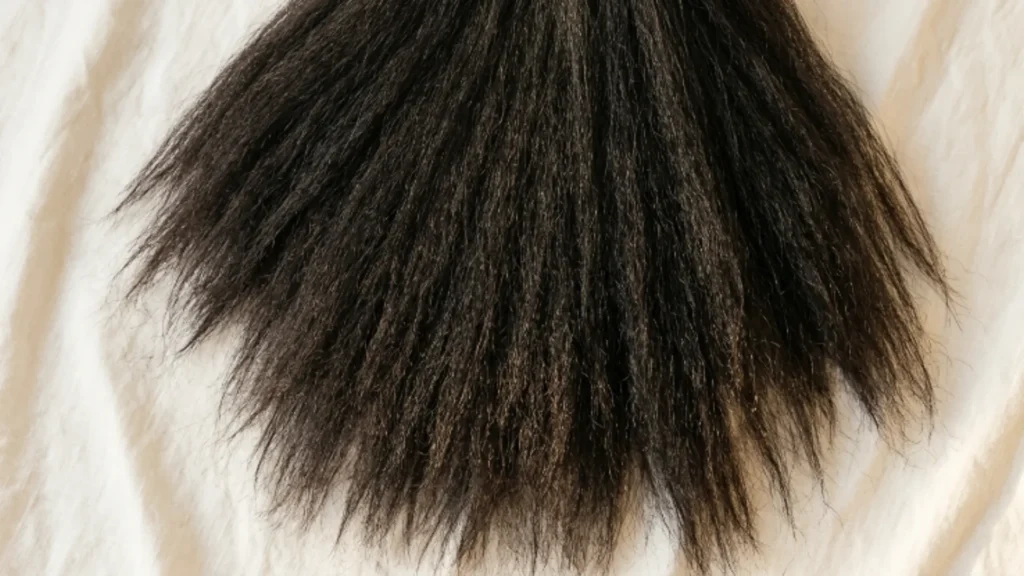
“Thick” covers two different realities. The first is strand width — some people have individual hairs with a wide diameter, often called coarse hair, where each strand is stiffer and harder to saturate. The second is density — a high number of strands per square inch, even when each individual strand is medium-width. A lot of people have both. The care principles overlap enough to handle together.
What both types share is that water, conditioner, and treatments take longer to reach the inner structure of the strand. The cuticle on a wide or dense strand is more tightly laid, and penetration is slower. That’s why conditioning for 60 seconds — the way most people do it — doesn’t do much for thick hair. It’s not that the conditioner is wrong. It’s that it hasn’t had time to work yet.
Scalp behaviour is also different. Dense hair traps heat and slows how quickly natural oils travel down each strand. The result is an oily root and dry ends — not a product problem, but a structural one. Treating it as a product problem is usually why thick-hair routines stall without an obvious reason.
Understanding this changes which steps matter most in a hair care routine for thick hair, and how those steps are ordered below.
Also Visit : The Hair Care Routine for Long Hair Growth That Works
How Often Should You Actually Wash Thick Hair
The “2–3 times a week” rule works as a rough guideline for medium hair. For thick hair, it’s too imprecise. Scalp type matters here, and it interacts with strand density in ways most general guides skip over.
| Scalp type | Suggested wash frequency |
|---|---|
| Oily scalp, thick hair | Every 2–3 days |
| Normal scalp, thick hair | Twice a week |
| Dry or sensitive scalp, thick hair | Once a week |
| Active lifestyle (daily exercise) | Every 2 days; co-wash in between |
| Dense, fine-strand hair | Twice a week minimum — buildup shows quickly |
Stretching the time between washes isn’t automatically protective for thick hair. Product residue, shed skin cells, and natural scalp oil build up between dense strands before any of it becomes visible — by the time an oily scalp shows on thick hair, the buildup has usually been sitting there for a day already. That layer can block moisture from reaching the strands you’re trying to hydrate. The American Academy of Dermatology’s guidance on keeping hair and scalp healthy long term supports washing as often as needed rather than following a fixed universal schedule.
On the other side: washing too often strips the scalp’s natural oil, and thick hair already struggles to distribute that oil toward the ends. Twice a week is the right starting point for most people. Adjust up or down using the table above.
Wash Day, Step by Step

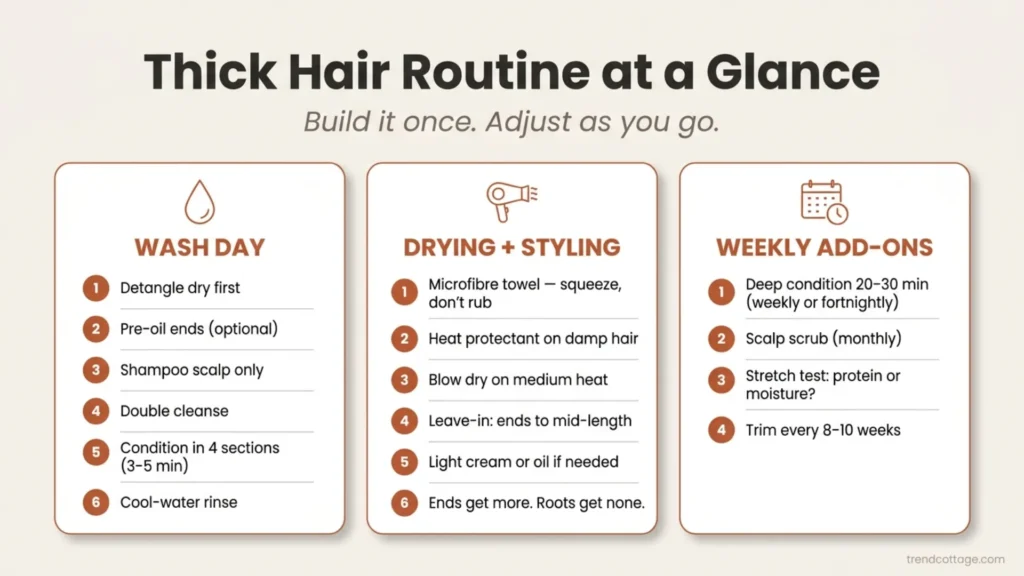
Detangle before water touches it
Wet thick hair tangles more aggressively than dry thick hair. Run a wide-tooth comb or detangling brush through dry hair in sections before getting in the shower. It takes around five minutes and saves considerably more than that in post-wash breakage.
Pre-wash oil
A small amount of oil applied to dry ends before shampooing acts as a buffer against the shampoo. Shampoo lifts some of the hair’s natural lipids along with dirt and buildup; coating the ends first reduces how much gets removed from the parts that are already driest. Argan oil, sweet almond oil, or any oil with a low molecular weight works here. Apply from mid-length to ends only — never on the scalp, and never so much that the shampoo can’t cut through it.
Shampoo the scalp, not the length
Work shampoo into the scalp with your fingertips — the pads, not the nails — and let the suds travel down the length during rinsing. Scrubbing shampoo through thick mid-lengths creates unnecessary friction over time.
Thick hair benefits from a double cleanse. The first round breaks down buildup; the second cleans the scalp properly. The second round lathers noticeably better than the first — that’s the sign the first pass did its job.
Condition in sections
This is the step most people rush, and for thick hair it’s where the routine either works or doesn’t.
Divide hair into four sections — two at the front, two at the back — and clip each one up. Work conditioner through one section at a time, squeezing it from mid-length to ends rather than spreading it over the surface. Once all four sections are coated, leave the conditioner on for 3–5 minutes before rinsing. Wide or dense strands can take that long to begin absorbing it, regardless of the formula.
Rinse with water a few degrees cooler than your shower temperature. It helps flatten the cuticle and reduces frizz before styling even starts.
Also Visit : Hair Care Routine Step by Step: Why the Order Matters
Drying Thick Hair Without Damage

Cotton towels create more friction against the cuticle than most people realise — and thick, dense hair has more surface area for that friction to work on. A microfibre towel or a clean cotton t-shirt reduces it. Squeeze sections rather than rubbing: press the cloth around a section of hair, hold for a few seconds, move on.
Air drying is fine, but thick hair can take 3–5 hours or more to dry fully depending on density. Hair that stays wet for that long is at higher risk of hygral fatigue — a repeated swelling and contracting of the strand as it absorbs and releases moisture. It weakens the shaft gradually, and you can’t see it happening. For thick, high-porosity hair that’s air dried every wash day, it’s worth at least partially blow-drying to cut the wet time down.
Blow drying is a practical choice for thick hair, not a harmful shortcut, as long as the technique is right:
- Apply heat protectant to damp hair before it starts drying on its own
- Use a concentrator nozzle to direct airflow down the strand, not across it
- Keep the dryer moving — holding it on one section overheats it
- Dry on medium heat for most of the process, not maximum
- Finish each section with a cool shot to set it
The AAD’s guidance on hair and scalp care notes how heat styling contributes to breakage across all hair types. For thick hair, the extra volume can mask that damage for weeks before it becomes obvious — which is exactly why consistent technique habits matter from the start.
Styling Thick Hair Without Weighing It Down

Heavy creams applied root to tip are usually why thick hair ends up flat and coated by the second day. The issue isn’t the product. Placement is the problem — applying weight where the hair is already oiliest makes things worse, not better.
The working principle is simple: more product at the ends, almost nothing at the roots. A light leave-in conditioner works as the base. Apply it to damp hair from mid-length to ends, working through sections, and let it absorb before layering anything else on top.
For extra definition or smoothness, a small amount of styling cream goes on next — ends first, then mid-length if needed. A coin-sized amount per section is usually enough. More than that tends to coat the outside of each section rather than working through it.
Oil goes on last and goes on sparingly. Two or three drops of a lightweight oil — squalane, argan, or rosehip — pressed between the palms and smoothed over each section gives a clean finish without the heaviness that thicker oils can leave on dense hair. The order matters: leave-in first, cream second if needed, finishing oil last. Reversing it stops heavier products from reaching the strand.
Also Visit : Hair Care Routine: Build One That Actually Sticks
The Add-Ons That Complete a Thick Hair Care Routine
Wash day handles the basics. These additions are what change how thick hair holds up over weeks and months — the difference between a routine that maintains and one that actually improves things.
Deep conditioning: Once a week or every two weeks, swap your regular conditioner for a deep treatment and leave it on for 20–30 minutes under a shower cap. Body warmth under the cap softens the cuticle slightly and helps the product penetrate past the surface. Look for shea butter, panthenol, or hydrolysed proteins in the ingredient list. These hold moisture in a way standard conditioners don’t, and the difference shows on thick hair over time.
Scalp care: Dense hair masks scalp buildup. A monthly scalp scrub or a leave-on scalp serum used a few times a week keeps the follicle environment clean without stripping it. If flaking, persistent itching, or scalp discomfort doesn’t settle with routine changes, a dermatologist is the right next step rather than more products.
Protein versus moisture: This is where thick-hair routines most often go wrong. Protein and moisture treat different problems, and applying the wrong one makes hair worse. Thick hair that feels stretchy when wet — or that breaks easily after chemical or heat exposure — may benefit from a protein treatment. Thick hair that feels dry but snaps cleanly and doesn’t feel weak probably needs moisture. Adding protein to hair that already has enough makes it stiff and brittle. The quickest way to tell the difference: pull one wet strand gently. Lots of stretch before it breaks suggests a protein need. An immediate snap with no give suggests a moisture need.
Trims: The weight of thick hair puts constant tension on the ends. A trim every 8–10 weeks is a reasonable baseline. Waiting longer usually means the next trim has to take more off.
Frequently Asked Questions
Can thick hair be low porosity?
Yes. Porosity and thickness are entirely separate properties. Low-porosity thick hair is one of the harder combinations to manage because products sit on the surface for longer than usual. Conditioning under warmth — a heated shower cap, or staying in the steam of a warm shower while the conditioner sits — helps open the cuticle enough to let moisture in.
Why does thick hair still feel dry after conditioning?
Usually one of three things: the conditioner isn’t reaching every strand (sectioning fixes this), it isn’t staying on long enough, or the formula is too light. Products designed for fine or normal hair often don’t have enough slip or weight to coat a wide, dense strand properly. Switching to a formula labelled for thick, coarse, or curly hair tends to help more than switching brands within the same product category.
Is it okay to skip heat protectant on thick hair?
No. Thick hair can withstand higher styling temperatures before it visibly burns, but it’s not heat-proof. Heat damage on thick hair builds gradually and tends to show up weeks after the sessions that caused it, not during. Apply heat protectant every time you use a blow dryer, flat iron, or curling tool — even when the hair appears fine without one.
How long before a new routine shows results?
Texture changes often appear within 4–6 weeks of consistent changes. Assessing the length takes longer — three months of a consistent hair care routine for thick hair gives enough new growth to see how the approach is affecting the strand from root to end, rather than just the surface condition.
Does thick hair need a different routine in winter?
Often yes. Cold air and dry indoor heating both pull moisture from hair faster than in warmer months. Many people with thick hair find they need to deep condition more frequently between late autumn and early spring, and may benefit from a slightly heavier leave-in to hold the same moisture level they achieve in summer.
Key Takeaways
- Thick hair needs conditioner worked through in sections, not spread across the surface — products need to reach every strand, not just the outer layer
- Scalp type should drive wash frequency; twice a week suits most thick hair, but the table above is a more reliable guide than any blanket rule
- Apply styling products from ends upward, not root to tip — weight at the root is almost always product placement, not a sign that roots need more moisture
- Protein and moisture treat different problems; the wet-strand stretch test is the quickest way to tell which one thick hair actually needs
- Deep conditioning once a week or fortnightly is the single add-on most likely to change how thick hair holds up over time
Written by Anna Anderson for Trend Cottage.