Best Mango Butter for Natural Hair and How to Use It
If you have been searching for the best mango butter for natural hair, chances are you already know that not all butters perform equally — and that using the wrong one for your hair type, or applying any butter the wrong way, produces buildup and disappointment rather than the moisture and softness you are looking for. This guide covers everything: what mango butter actually is at the ingredient level, why it works scientifically, how it compares to shea butter and coconut oil, and exactly how to use it to get real results on natural hair.
By the end, you will know whether mango butter is right for your specific hair type, how to choose a pure, quality product, and how to incorporate it into three different DIY recipes for your routine.
What Is Mango Butter and Where Does It Come From
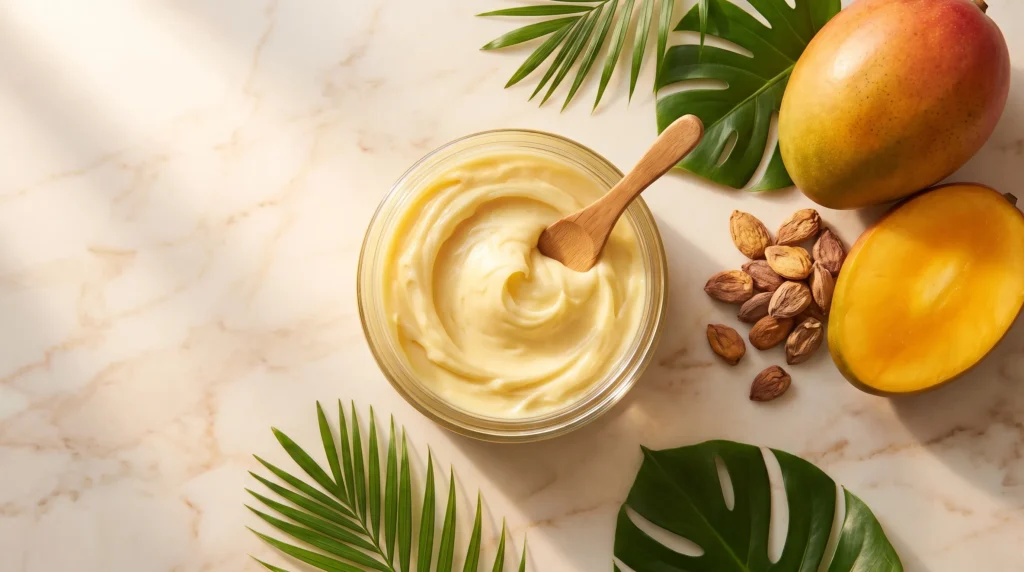
Mango butter is extracted from the seed kernel inside the large pit of the mango fruit. After the mango fruit is removed, the pit is cracked open and the pale ivory seed kernel inside is cold-pressed to extract its rich, solid fat. The result is a smooth, creamy butter that is solid at room temperature and melts quickly on contact with skin or warm hands.
Pure, unrefined mango butter is ivory to pale yellow in color, has a very mild, faintly nutty scent, and a soft, velvety texture that absorbs into the hair and skin more smoothly than shea butter. Refined mango butter is white and odorless, with some of its beneficial natural compounds removed in the refining process. For hair care, unrefined is always preferred — it retains its full nutrient profile.
Mango butter has been used in South Asian and West African beauty traditions for centuries as a hair and skin moisturizer. Its rise in the natural hair community is a rediscovery of something that has worked for generations.
Mango Butter Nutrients and Hair Benefits at a Glance
| Nutrient / Compound | Amount in Mango Butter | Specific Hair Benefit |
|---|---|---|
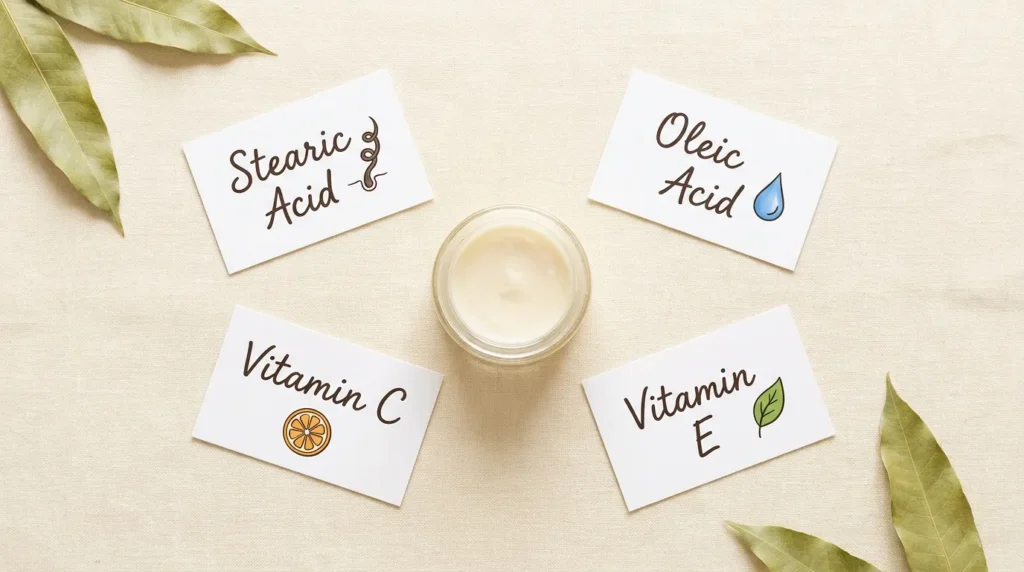
| Stearic Acid | High (35–57%) | Conditions and softens hair cuticle, seals moisture, reduces frizz, improves manageability |
| Oleic Acid (Omega-9) | High (38–52%) | Penetrates hair shaft, adds shine, strengthens the cortex from inside |
| Palmitic Acid | Moderate (3–18%) | Emollient that softens and smooths the cuticle surface |
| Linoleic Acid (Omega-6) | Low–Moderate (1–8%) | Reduces scalp inflammation, supports follicle health, improves scalp barrier |
| Vitamin C | Present | Antioxidant protection, supports collagen for scalp integrity, brightens scalp |
| Vitamin E (Tocopherols) | Present | Protects cuticle from UV and oxidative damage, adds shine, scalp health |
| Vitamin A (Beta-carotene) | Present | Promotes healthy scalp cell turnover, reduces dry scalp flaking |
| Phytosterols | Present | Anti-inflammatory at the scalp level, helps soothe irritation and itchiness |
| Natural Antioxidants | High | Protects hair from environmental damage, extends color vibrancy in treated hair |
8 Proven Benefits of Mango Butter for Natural Hair
1. Deep moisture without greasiness: Mango butter’s high stearic and oleic acid content delivers rich moisture to the hair shaft while absorbing cleanly — unlike shea butter, it rarely leaves a heavy, greasy film. This makes it one of the best butters for everyday moisture sealing, particularly for medium to high porosity natural hair.
2. Reduces frizz and improves definition: The stearic acid in mango butter acts as a natural emollient that coats each hair strand with a smooth, even layer, causing the cuticle to lie flat. Flat cuticles mean significantly less frizz and more defined curl patterns. Applied to damp hair after leave-in conditioner, the difference in definition and frizz control is noticeable from the first use.
3. Protects hair from UV damage: Mango butter contains natural UV-absorbing antioxidants — particularly vitamin E tocopherols and phytosterols — that create a mild barrier against UV radiation on the hair shaft. UV exposure causes color fading in treated hair and progressive dryness and brittleness in all hair types. Regular mango butter application provides a measurable protective layer against this damage.
4. Strengthens hair from inside out: The oleic acid in mango butter has a small enough molecular structure to partially penetrate the hair cuticle and reach the cortex — the inner layer that gives hair its strength and elasticity. Regular use improves the structural integrity of the hair shaft, reducing breakage and split end formation over time.
5. Scalp soothing and anti-inflammatory: The phytosterols and linoleic acid in mango butter have documented anti-inflammatory properties that soothe scalp irritation, reduce redness and itchiness, and help calm the chronic low-grade scalp inflammation that contributes to hair thinning and follicle miniaturization. For those with sensitive or reactive scalps, mango butter is one of the gentlest butters available.
6. Conditions and detangles: Mango butter’s smooth, velvety texture reduces friction between hair strands, making detangling significantly easier and less damaging. Applied to damp hair before finger detangling or wide-tooth combing, it reduces the tension required to work through tangles and knots — and therefore reduces the breakage that detangling causes in natural hair.
7. Extends moisture between wash days: As a sealing butter, mango butter creates a physical barrier over the hair cuticle that slows down transepidermal moisture loss — the evaporation of water from inside the hair shaft into the air. Applied after a water-based leave-in conditioner, it can extend the time that hair stays moisturized by one to three additional days compared to leaving the hair unsealed.
8. Conditions color-treated and chemically processed hair: Chemical processing and coloring open the hair cuticle permanently and damage the lipid layer that naturally seals the cuticle. Mango butter’s fatty acid profile closely mimics the ceramide-rich lipid layer of healthy hair, making it an excellent restorative treatment for chemically processed natural hair. It fills the gaps in damaged cuticles and gives processed hair a smoother, healthier-looking appearance.
Mango Butter vs Shea Butter vs Coconut Oil
| Feature | Mango Butter | Shea Butter | Coconut Oil |
|---|---|---|---|
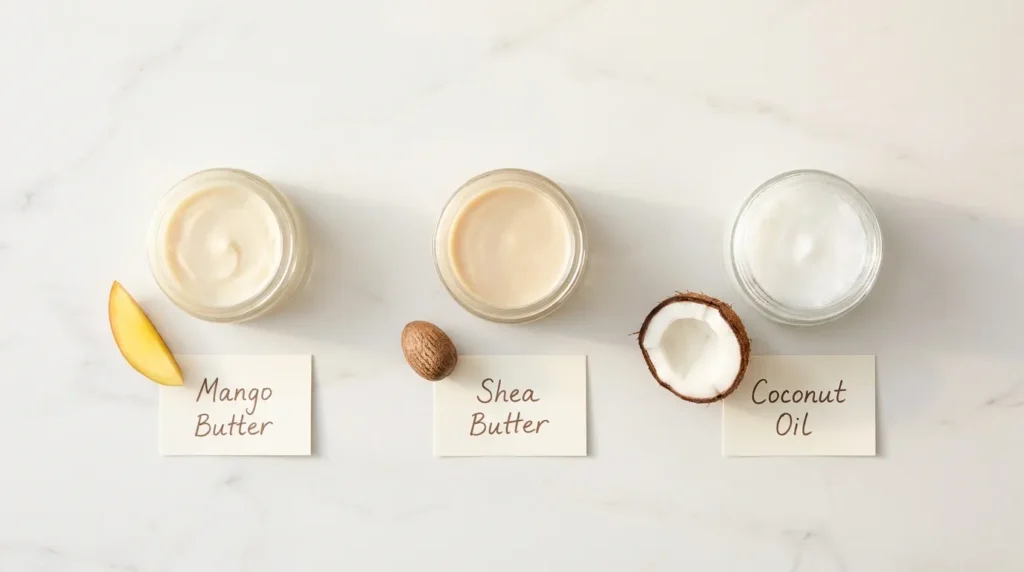
| Primary Fatty Acid | Stearic + Oleic (balanced) | Oleic + Stearic (higher oleic) | Lauric acid (large molecule) |
| Hair Penetration | Partial — penetrates and seals | Primarily seals surface | High penetration (pre-poo) |
| Texture on Hair | Light-medium, absorbs cleanly | Medium-heavy, can feel waxy | Can feel greasy if overused |
| Frizz Control | Excellent | Very good | Moderate |
| UV Protection | Good — natural antioxidants | Mild (SPF ~3–6) | Very mild |
| Buildup Risk | Low — lighter than shea | Moderate — can build up | High on low porosity hair |
| Scent | Mild, faintly nutty | Earthy, nutty (stronger) | Strong coconut |
| Best For | Daily sealing, frizz, medium-high porosity | Very dry/coarse hair, ends | Pre-poo, protein-deficient hair |
| Low Porosity Safe? | Use sparingly with heat | Avoid — too heavy | Avoid — causes buildup |
| DIY Versatility | Excellent — blends well with all oils | Excellent | Good |
| Availability | Specialty stores, online | Very widely available | Universally available |
Bottom line: Mango butter is the better daily sealant for natural hair that needs frizz control and moisture retention without the heaviness of shea. Shea butter is better for very coarse or severely dry hair that needs a heavier moisture barrier. Coconut oil is in a different category — it works best as a penetrating pre-wash treatment rather than a sealant.
Hair Type and Porosity Suitability Guide
| Hair Type / Concern | Suitability | Best Application Method |
|---|---|---|
| 4c Coily Hair | ✅ Excellent | LOC method sealant, overnight treatment |
| 4a / 4b Coily Hair | ✅ Excellent | Daily sealing after leave-in, twist-out definition |
| 3b / 3c Curly Hair | ✅ Good — use moderate amounts | Finishing butter for curl definition |
| High Porosity Hair | ✅ Excellent — seals cuticle gaps | Daily sealing step, overnight mask |
| Medium Porosity Hair | ✅ Excellent — ideal match | Post-wash sealing, LOC method |
| Low Porosity Hair | ⚠️ Use sparingly | Apply warm to damp hair, avoid scalp |
| Fine / Thin Hair | ⚠️ Use very small amounts | Ends only, fingertip application |
| Dry / Brittle Hair | ✅ Excellent | Deep conditioning mask weekly |
| Color-Treated Hair | ✅ Very good — protective | Post-wash sealant, UV protection |
| Sensitive / Itchy Scalp | ✅ Good — anti-inflammatory | Light scalp massage, avoid buildup |
How to Choose Pure Quality Mango Butter
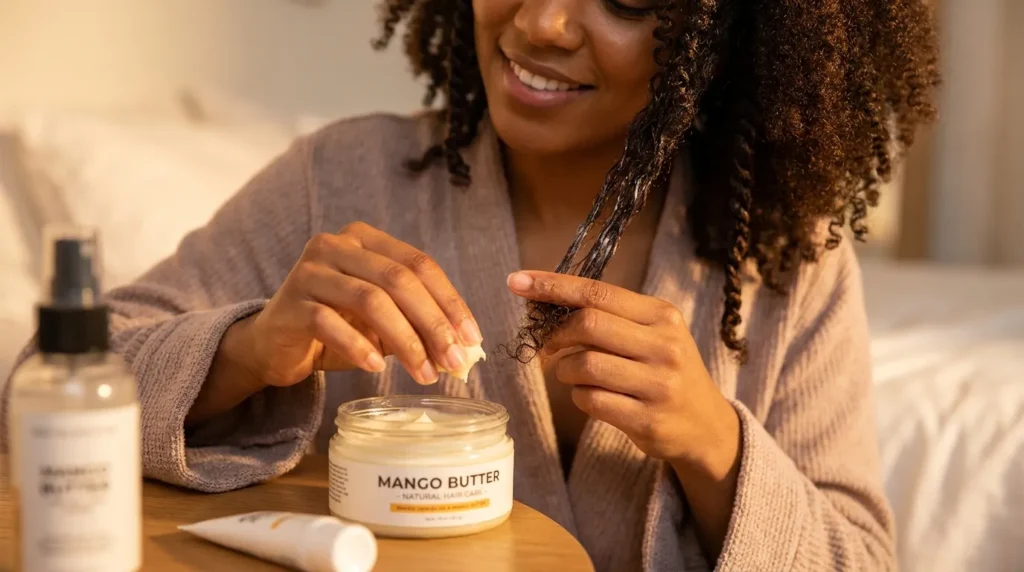
Not all mango butter products on the market contain meaningful amounts of actual mango butter — many are blended products with a small percentage of mango butter listed on the label for marketing purposes. Here is how to identify quality:
- Check the ingredient list: The INCI (scientific) name for mango butter is Mangifera Indica (Mango) Seed Butter. This should appear within the first three ingredients on the label. If it appears near the bottom of a long ingredient list, the product contains very little actual mango butter.
- Unrefined vs refined: Unrefined mango butter is pale ivory or pale yellow with a mild scent. Refined mango butter is pure white and odorless. For hair care, unrefined retains more vitamins, antioxidants, and phytosterols. Choose unrefined when available.
- Texture test: Pure mango butter is solid at room temperature but melts immediately and completely between the fingers with gentle pressure. If it feels waxy, gritty, or does not melt easily on contact with warm skin, it may be adulterated or very refined.
- No unnecessary additives: Pure mango butter should list only one ingredient: Mangifera Indica Seed Butter. Any additional preservatives, fragrance, or mineral oil in a “pure” mango butter product indicate it is not 100% pure.
- Color consistency: Unrefined mango butter should be uniformly pale ivory. Significant yellowing or browning can indicate oxidation from improper storage before purchase.
4 Ways to Use Mango Butter on Natural Hair
Method 1 — LOC Method Daily Sealant (Most Common):
This is the most effective everyday use of mango butter for natural hair moisture retention.
- Apply water or a water-based leave-in conditioner to damp or dampened hair as your Liquid step.
- Scoop a pea-sized amount of mango butter, warm it between your palms until fully melted, and apply through the hair as your Oil/Butter step.
- Follow with a light styling cream or gel as your Cream step if needed.
- Style as desired. The mango butter seals the moisture from the leave-in against evaporation.
Method 2 — Pre-Wash Treatment:
- Apply softened mango butter to dry hair from scalp to ends before washing.
- Work through thoroughly, ensuring the ends — the most vulnerable part — are well coated.
- Cover with a plastic shower cap and leave for 30 minutes to 2 hours.
- Shampoo directly over the butter without rinsing it first — this method conditions hair during washing and significantly reduces the protein loss that water and shampoo can cause.
Method 3 — Overnight Deep Moisture Treatment:
- Mist hair lightly with water or aloe vera spray to dampen slightly.
- Apply a generous amount of mango butter throughout hair from roots to ends.
- Braid or twist into large sections to protect the hair while sleeping.
- Cover with a satin bonnet and sleep normally.
- In the morning, either restyle as is or wash out if the hair feels too heavy.
Method 4 — Twist-Out and Braid-Out Finishing Butter:
- After applying leave-in conditioner to washed, damp hair, apply a small amount of melted mango butter to each section before twisting or braiding.
- The butter adds slip for easier twisting, defines the curl pattern as it dries, and creates a shiny, smooth finish when the style is taken down.
- When taking down the twist-out or braid-out, rub a tiny amount of mango butter between your palms and use your fingertips to separate the sections gently without disrupting the curl pattern.
3 DIY Mango Butter Recipes for Natural Hair
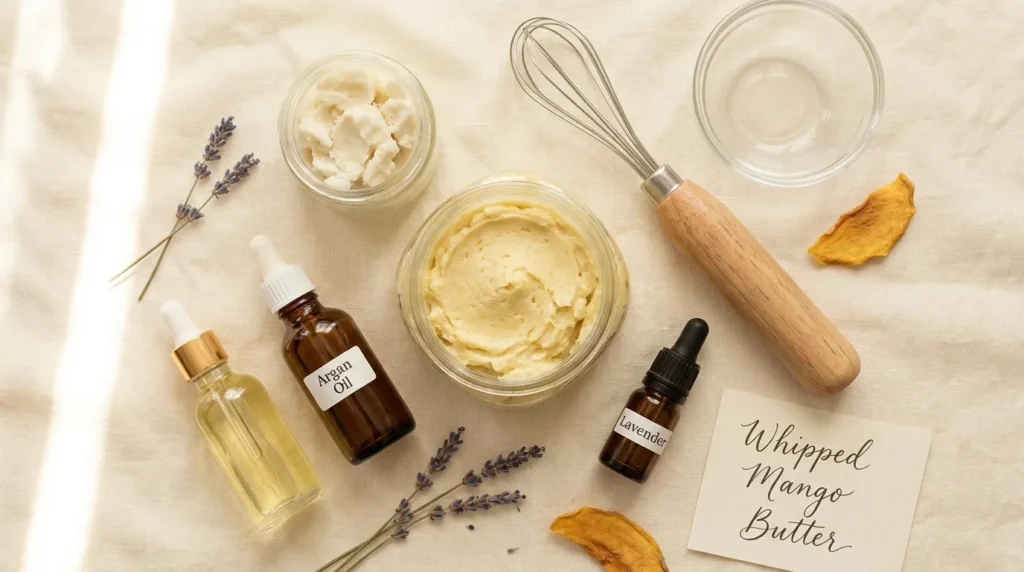
Recipe 1 — Classic Whipped Mango Butter (Daily Moisturizer):
- 4 tablespoons pure mango butter
- 2 tablespoons shea butter
- 1 tablespoon jojoba oil
- 1 tablespoon argan oil
- 10 drops lavender essential oil (optional)
- 5 drops rosemary essential oil (optional — for growth)
- Melt the mango butter and shea butter together in a double boiler or microwave in 30-second intervals until just liquid.
- Add the jojoba and argan oil and stir to combine.
- Allow to cool at room temperature for 30 minutes, then place in the refrigerator for 20 to 30 minutes until the mixture is semi-solid but not fully set.
- Add essential oils and whip with a hand mixer for 3 to 5 minutes until light and fluffy.
- Transfer to a clean glass jar and store at room temperature.
Recipe 2 — Mango Butter Deep Conditioning Mask:
- 3 tablespoons pure mango butter, melted
- 2 tablespoons raw honey
- 1 tablespoon pure aloe vera gel
- 1 tablespoon coconut oil (pre-poo penetration)
- 1 egg yolk (protein boost)
- Mix all ingredients until smooth and consistent — a blender helps ensure the egg yolk is fully incorporated.
- Apply to clean, damp hair after shampooing, from scalp to ends.
- Cover with a plastic shower cap and sit under a hooded dryer for 25 to 30 minutes.
- Rinse with cool water only — never warm or hot, which will cook the egg in your hair.
- Follow with your regular leave-in and sealing routine.
Recipe 3 — Lightweight Mango Butter Scalp Butter (for sensitive scalps):
- 2 tablespoons pure mango butter
- 2 tablespoons grapeseed oil (lightweight, anti-inflammatory)
- 1 tablespoon sweet almond oil
- 7 drops tea tree essential oil (antifungal, scalp cleansing)
- 5 drops peppermint essential oil (circulation stimulation)
- Melt mango butter gently and mix with the carrier oils until liquid and combined.
- Allow to cool slightly then add essential oils and stir well.
- Pour into a dropper bottle for easy scalp application.
- Apply directly to scalp in sections, massage for 3 to 5 minutes, and leave overnight or for 2 hours before washing.
Best Ingredients to Pair with Mango Butter
Mango butter works even better when combined with complementary ingredients:
- Aloe vera gel: Adds water-based moisture that mango butter can seal in. Mix fresh aloe with melted mango butter for a lightweight whipped cream that suits even medium-porosity hair without heaviness.
- Jojoba oil: Mimics scalp sebum and helps the mango butter absorb more evenly. Together they create a balanced sealant that is less likely to sit on top of the hair.
- Rosemary essential oil: Adds growth-stimulating benefits that mango butter alone does not provide. Mix 7 drops per tablespoon of carrier oil before blending into mango butter for a scalp-treatment blend.
- Raw honey: A humectant that draws atmospheric moisture into the hair while mango butter seals it. Together they create one of the most effective moisture-locking combinations for dry natural hair.
- Glycerin: Another powerful humectant. In humid climates, 1 teaspoon of glycerin in a mango butter blend dramatically improves moisture retention for 4c hair that struggles to stay moisturized between wash days.
Storage and Shelf Life
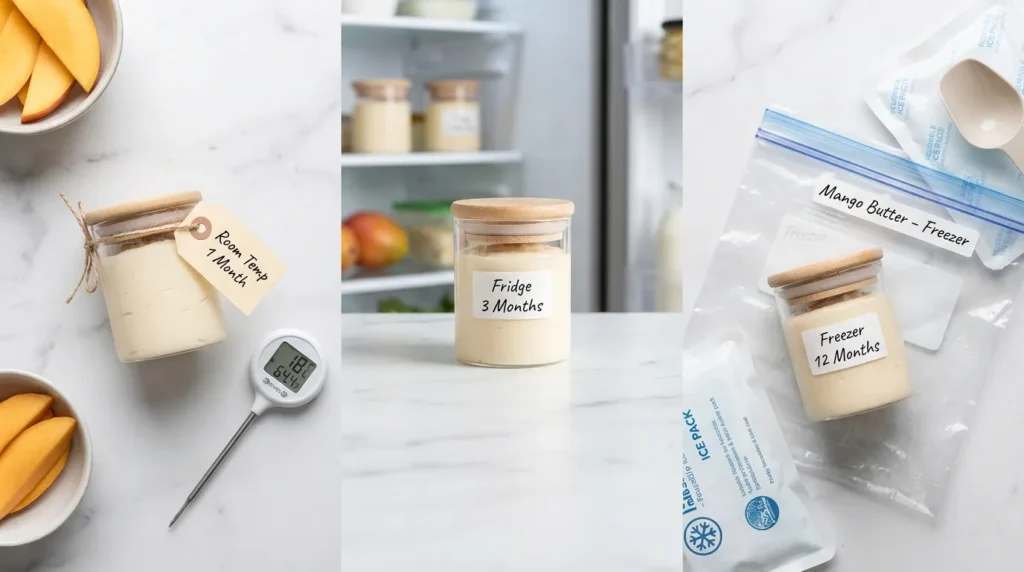
- Room temperature: Pure mango butter stored in a clean sealed glass jar away from direct sunlight and heat lasts one to two months at room temperature. In warm climates it may partially melt — this does not affect quality. Stir and allow to re-solidify.
- Refrigerator: Extends shelf life to three to four months. Remove from the fridge before use and allow to come to room temperature, or warm between your palms before application.
- Freezer: Store in ice cube tray portions and freeze for up to twelve months. Thaw only what you need each week to maximize freshness and minimize the number of times the butter is exposed to air.
- Signs of rancidity: Pure mango butter that has gone rancid develops a sharp, unpleasant sour-to-sour smell very different from its naturally mild nutty scent. Visible mold, significant darkening, or an off smell are all signs to discard and replace.
Frequently Asked Questions
Is mango butter better than shea butter for natural hair?
For most natural hair types, mango butter is a better daily sealant because it is lighter, absorbs more cleanly, and leaves less residue than shea butter. Shea butter is better for very coarse, high-porosity hair that needs an extremely rich, heavy moisture barrier. For everyday use, mango butter is the more versatile and manageable choice, particularly for type 3 to 4b hair. For 4c hair with severe dryness, a blend of both often provides the ideal moisture-to-seal balance.
Can I use mango butter on my scalp?
Yes, but in small amounts and with proper clarifying. Mango butter is lighter than shea butter and less likely to clog follicles, making it safe for scalp use in moderate amounts. Apply directly to the scalp only as part of a pre-wash scalp treatment that you wash out — leaving thick butter on the scalp between wash days accumulates buildup that can slow follicle activity over time. The lightweight scalp butter recipe above is specifically formulated for safe scalp use.
How often should I use mango butter on natural hair?
For most natural hair types, using mango butter as the sealing step in your LOC method on every wash day (once to twice weekly) plus a light re-application mid-week is ideal. Using it more frequently than daily risks buildup, particularly on medium and low porosity hair. Clarify with a clarifying shampoo once a month to reset the hair and prevent accumulated butter from blocking moisture absorption.
Does mango butter cause breakouts or scalp acne?
Mango butter has a comedogenic rating of 2 out of 5 — lower than coconut oil (4) and shea butter (0–2 depending on processing). This means it is unlikely to clog pores or cause scalp acne in most people. Those with already oily scalps or acne-prone skin should use mango butter only on the hair strands and avoid applying to the scalp directly. If you notice increased scalp breakouts after starting mango butter use, discontinue scalp application and use it on strands only.
Can I use mango butter on low porosity natural hair?
Yes, but with modifications. Low porosity hair’s tightly closed cuticle makes absorbing thick butters difficult — applied incorrectly, mango butter will sit on the surface and create buildup rather than moisturize. Use it in very small amounts (pea-sized or less), always apply to warm, damp hair after washing when the cuticle is slightly open, and use the steam or hooded dryer method to improve absorption. Warm the butter between your palms until fully liquid before applying. Clarify monthly.
The Right Butter Makes All the Difference
Finding the best mango butter for natural hair is about matching quality ingredients to the right application method for your specific hair type. Pure, unrefined mango butter applied correctly — to damp, warm hair as part of the LOC method — provides a level of frizz control, moisture retention, and cuticle conditioning that is difficult to achieve with other butters of similar price and accessibility.
Start with the whipped mango butter recipe this weekend. Use it as your sealing step on your next wash day. Pay attention to how long your hair stays moisturized afterward compared to your current routine. That difference is the practical proof of whether mango butter belongs in your rotation — and for most natural hair types, the answer becomes very clear very quickly.
Also Visit : Ethiopian Butter for Hair Benefits Uses and How to Make It