Daily Weekly Monthly Natural Hair Care Routine for Black Women

A consistent natural hair care routine is the single most important factor in achieving healthy, long, moisturized natural hair — more important than any single product, treatment, or technique. This complete daily weekly monthly natural hair care routine for black women breaks down exactly what to do every morning, every evening, on wash day, and once a month, with specific guidance for different hair types and porosity levels so you can adapt the routine to what your hair actually needs rather than following a one-size-fits-all approach.
Whether you have 4a ringlets, 4b coils, or 4c kinks — whether you are newly natural, transitioning, or have been on your natural hair journey for years — this routine gives you a clear, manageable framework that protects your hair from damage, retains length, and keeps your scalp healthy every single day.
Understanding Your Hair Before Starting
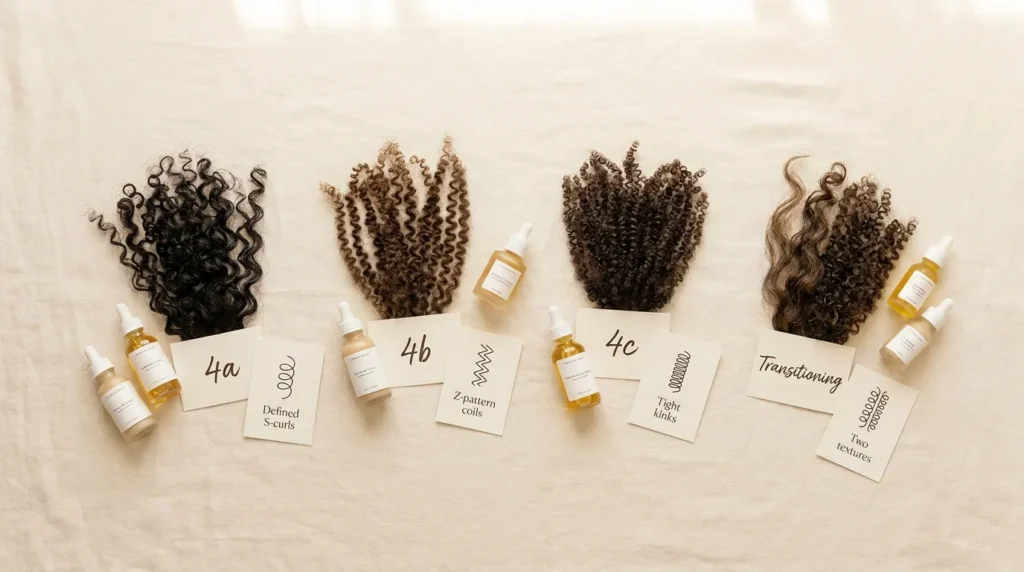
Before building any natural hair routine, you need to understand two things about your hair: your curl type and your porosity. These two characteristics determine which products work best, how often your hair needs moisture, and how much manipulation it can handle without breakage.
Curl types for black women’s natural hair:
- Type 4a: Defined S-shaped coils with visible curl pattern. More moisture-retentive than 4b/4c but still prone to dryness. Responds well to wash-and-go styles.
- Type 4b: Z-shaped pattern with less defined coils, bends at sharp angles. More fragile than 4a — requires more moisture and gentle handling. Twist-outs and braid-outs define the pattern better than wash-and-gos.
- Type 4c: Tightest coil pattern, shrinks up to 75% of actual length. Most fragile of all curl types — requires the most moisture, the most gentle handling, and consistent protective styling for length retention.
- Transitioning hair: Contains two textures simultaneously — relaxed ends and natural new growth. The point where the two textures meet (the line of demarcation) is the most fragile point in the hair shaft and is where most breakage happens during transitioning.
Porosity — the factor most people overlook:
- Low porosity: Tightly closed cuticle. Products sit on top rather than absorbing. Needs heat during conditioning, lightweight products, and regular clarifying.
- Medium porosity: The ideal state. Accepts and retains moisture well. Most products work effectively.
- High porosity: Open cuticle gaps (often from damage). Absorbs moisture quickly but loses it just as fast. Needs heavier sealants, protein treatments, and frequent moisturizing.
The Daily Natural Hair Care Routine
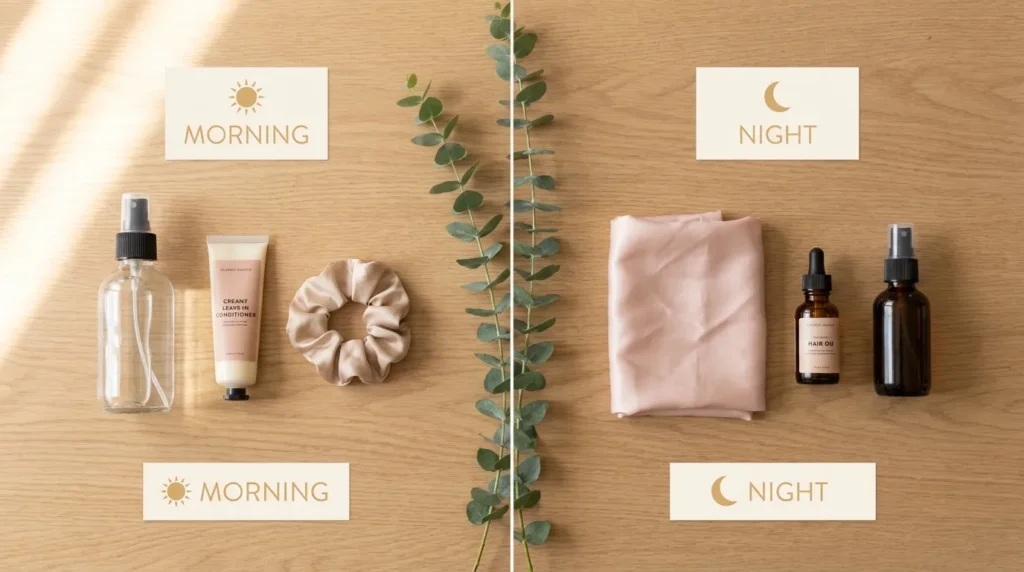
The daily routine is not about washing or heavy product application — it is about protecting what you already have and refreshing moisture without disturbing or over-manipulating your style.
Morning Routine (10 to 15 minutes):
- Remove your satin bonnet or unwrap your satin scarf (1 minute): Gently remove your nighttime protective covering. Do not pull or tug — unwrap carefully to preserve the style underneath.
- Assess moisture level (1 minute): Touch your hair to feel whether it is dry and stiff, or still soft and pliable from last night’s moisture. This assessment determines whether you need a full refresh or just light finger-combing.
- Refresh if needed (5 to 8 minutes): If hair feels dry, lightly mist with a spray bottle filled with water or a water + aloe vera juice mixture (50/50). Scrunch gently with your hands or smooth with your palms — never with a comb on dry natural hair. Add 1 to 2 drops of lightweight oil to seal if needed.
- Style (3 to 5 minutes): Shape your style with your hands — fluff an Afro, separate twist-out sections, or smooth edges with an edge brush and a small amount of edge control. Keep manipulation minimal on non-wash days.
- Protect your edges (1 minute): Apply a small amount of edge control or light gel with your fingers or edge brush. Avoid tight manipulation that causes traction alopecia over time.
Nighttime Routine (5 to 10 minutes):
- Lightly mist hair (1 minute): Spray hair lightly with water to add a small amount of moisture back before protective styling for the night.
- Add scalp oil if needed (2 to 3 minutes): If your scalp feels dry or itchy, apply 2 to 3 drops of your scalp oil blend to dry areas. Massage in with fingertip pads.
- Protective night styling (3 to 5 minutes): Choose one of the following depending on your hair length and style:
- Pineapple: Gather all hair loosely at the very top of the head and secure with a satin scrunchie (not elastic). This preserves volume and curl definition for shorter to medium hair.
- Large twists or braids: For longer hair or those wanting a twist-out for the next day, twist or braid into 4 to 8 large sections.
- Flat twist-down: For fine or fragile hair, flat twist hair flat to the head to minimize tension overnight.
- Cover with satin bonnet or scarf (1 minute): Cover completely with a satin bonnet or satin-lined cap. Alternatively, sleep on a 100% silk or satin pillowcase if a bonnet is uncomfortable. Cotton absorbs moisture from hair and creates friction that causes breakage and frizz overnight.
Daily Routine Quick Reference:
| Time | Step | Products | Time Required |
|---|---|---|---|
| Morning | Remove bonnet, assess moisture | None | 1–2 min |
| Morning | Refresh dry hair with water mist | Spray bottle (water or water + aloe) | 2–5 min |
| Morning | Seal if needed | Lightweight oil (jojoba or argan) | 1–2 min |
| Morning | Style and edge care | Edge control or light gel, edge brush | 3–5 min |
| Evening | Light mist + scalp oil if dry | Spray bottle, scalp oil | 2–3 min |
| Evening | Protective night styling | Satin scrunchie, clips | 3–5 min |
| Evening | Cover with satin bonnet or sleep on satin pillowcase | Satin bonnet or pillowcase | 1 min |
The Weekly Natural Hair Care Routine

The weekly routine centers on wash day — the most important session in the entire natural hair care schedule. For most natural hair types, washing once a week or once every two weeks is ideal. Washing too frequently strips natural oils; washing too infrequently allows product buildup and scalp issues to develop.
Wash Day Routine — Step by Step (2 to 3 hours):
- Pre-poo treatment (30 to 60 minutes before washing): Apply a lightweight oil or your pre-poo treatment to dry hair before washing. Coat the hair from roots to ends. This step protects the hair from the hygral fatigue (repeated swelling from water absorption) that causes natural hair to weaken over time. Cover with a plastic shower cap while the pre-poo works. Good pre-poo options: jojoba oil, avocado oil, or a conditioner + oil mix.
- Shampoo (10 to 15 minutes): Use a sulfate-free shampoo applied directly to the scalp. Dilute your shampoo with water in a squirt bottle for easier application if needed. Massage the scalp with your fingertip pads in circular motions — do not scrub the hair strands themselves. Allow the lather to run down the hair as you rinse. For very dry or low porosity hair, use a co-wash (cleansing conditioner) on most weeks, reserving shampoo for every 2 to 4 weeks. Clarify with a stronger clarifying shampoo once a month to remove all buildup.
- Deep condition (20 to 45 minutes): Apply a moisturizing deep conditioner generously to freshly washed, damp hair in sections. Cover with a plastic shower cap and apply heat — hooded dryer, heated cap, or warm towel wrap — for 20 to 30 minutes. Heat opens the cuticle slightly and dramatically improves conditioner penetration, especially important for low porosity hair. On alternate weeks, use a protein treatment instead of (not in addition to) a moisturizing deep conditioner to maintain the protein-moisture balance your hair needs for strength and elasticity.
- Rinse with cool water: Always rinse your deep conditioner with cool or cold water, never warm. Cool water closes the cuticle after conditioning, sealing in the treatment and leaving hair smoother and shinier.
- Detangle (15 to 30 minutes): Detangle only while hair is still wet and saturated with conditioner or a leave-in conditioner. Work in sections — 4 to 6 sections minimum for most lengths. Start at the ends and work toward the roots, using a wide-tooth comb or your fingers. Never detangle dry natural hair. For 4c hair specifically, finger detangling first before any tool is strongly recommended to minimize breakage.
- Apply leave-in conditioner (5 to 10 minutes): While hair is still damp, apply a water-based leave-in conditioner to each section. This is your primary moisture source — everything else seals it in.
- LOC or LCO method (5 to 10 minutes): Seal your leave-in with a lightweight oil (LOC: Liquid, Oil, Cream) or a cream first then oil (LCO: Liquid, Cream, Oil). LCO tends to work better for high porosity hair; LOC is more effective for medium and low porosity. Finish with a styling cream or butter as your cream step.
- Style (15 to 30 minutes): Apply your styling product (gel, custard, curl cream) and set your style — twist-out, braid-out, wash-and-go, or protective style. Allow hair to dry fully before manipulating.
Full Weekly Schedule:
| Day | Routine | Products Needed | Time |
|---|---|---|---|
| Sunday (Wash Day) | Pre-poo → Shampoo → Deep Condition → Detangle → LOC → Style | Pre-poo oil, shampoo, deep conditioner, leave-in, oil, cream, styling product | 2–3 hours |
| Monday | Morning refresh + nighttime protection | Spray bottle, edge control, satin bonnet | 15 min total |
| Tuesday | Assess style — refresh lightly if needed | Spray bottle, light oil if needed | 5–10 min |
| Wednesday | Mid-week moisture refresh + scalp oil | Spray bottle (water + aloe), leave-in, scalp oil | 10–15 min |
| Thursday | Style refresh or re-twist ends | Styling cream or curl refresher spray | 10–15 min |
| Friday | Refresh or transition to protective style for weekend | Spray bottle, leave-in, edge control | 15–20 min |
| Saturday | Low manipulation — rest day or light style maintenance | Satin bonnet/scarf | 5 min |
Mid-week moisture refresh (Wednesday — 10 to 15 minutes): Natural hair loses moisture steadily between wash days. A mid-week refresh prevents the dryness that leads to breakage. Lightly mist hair with a 50/50 water and aloe vera spray, apply a very small amount of leave-in conditioner or curl refresher to any sections that feel dry, seal with 1 to 2 drops of lightweight oil. This should take no more than 10 to 15 minutes and extends the life of your wash-day style significantly.
The Monthly Natural Hair Care Routine
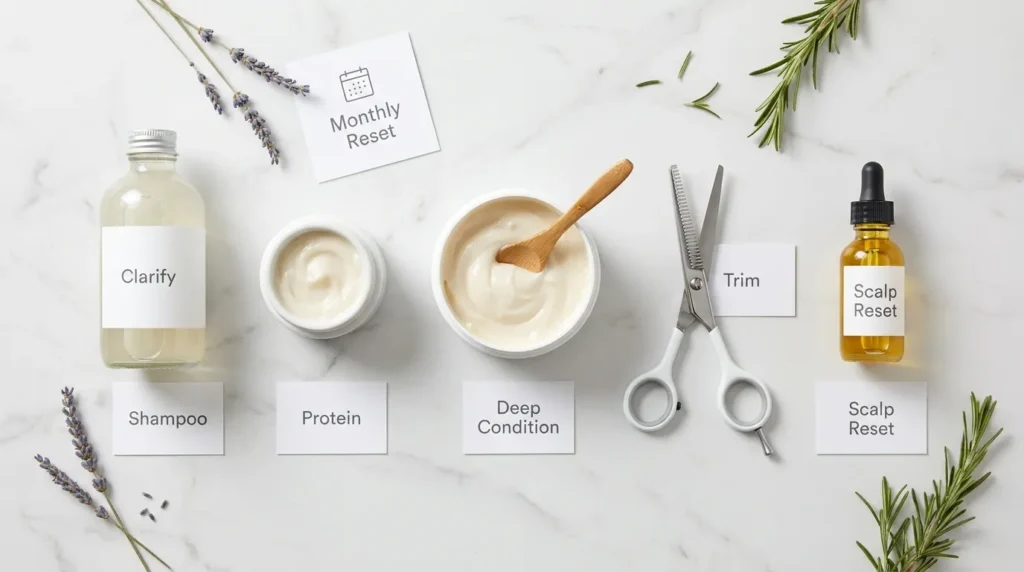
Monthly treatments address hair and scalp needs that go beyond what weekly washing and daily moisture can achieve. These are reset and maintenance steps that prevent long-term accumulation of damage, buildup, and neglect.
| Monthly Treatment | Purpose | How to Do It | Frequency |
|---|---|---|---|
| Clarifying Wash | Remove all product and mineral buildup that regular shampoo cannot break down | Replace your regular shampoo with a clarifying shampoo (contains stronger surfactants). Focus on scalp. Follow with deep conditioning immediately — clarifying opens the cuticle. | Once monthly (more if heavy product use) |
| Protein Treatment | Restore strength and elasticity to hair weakened by manipulation, heat, or environmental stress | Apply a protein treatment (not a deep conditioner) to clean, damp hair for 15 to 30 minutes under heat. Always follow with a moisturizing deep conditioner on the same day — protein without moisture causes brittleness. | Once monthly (adjust based on elasticity test results) |
| Hair Trim | Remove split ends and single-strand knots before they travel up the shaft and cause more breakage | Trim only on freshly washed, deep conditioned, dry hair in a stretched state. Use professional shears only — regular scissors cause additional splitting. Trim 1/4 to 1/2 inch of ends. | Every 2 to 3 months (not necessarily monthly) |
| Scalp Reset | Address any scalp buildup, flaking, or follicle-clogging that has accumulated over the month | Apply a salicylic acid scalp scrub or a diluted apple cider vinegar rinse (1 part ACV to 3 parts water) to the scalp before shampooing. Massage in and leave for 5 minutes before washing. | Once monthly |
| Hair Porosity Check | Reassess whether your current products are still working optimally for your hair’s current porosity state | Drop a clean hair strand in a glass of room-temperature water. Float = low porosity. Sinks slowly = medium. Sinks immediately = high. Adjust product weights accordingly if results have shifted. | Once monthly |
| Length Check | Track retention progress and motivation | Measure hair in a consistent state (always stretched, always the same location) and photograph against a measurement surface. Compare month-to-month for progress tracking. | Once monthly |
Customizing the Routine by Hair Type and Porosity

| Hair Type | Wash Frequency | Deep Condition Time | Detangling Method | Key Focus |
|---|---|---|---|---|
| 4a (defined coils) | Weekly | 20–30 min with heat | Wide-tooth comb on wet hair | Moisture + curl definition |
| 4b (Z-pattern) | Weekly or bi-weekly | 30–45 min with heat | Finger detangle first, then wide-tooth comb | Intense moisture + minimal manipulation |
| 4c (tight kinks) | Bi-weekly (or weekly for very dry) | 30–45 min with heat | Finger detangle only — avoid combs where possible | Maximum moisture + consistent protective styling |
| Transitioning | Weekly | 30–45 min with heat | Finger detangle very gently at line of demarcation | Strengthening protein treatments + protective styles |
| Low porosity (any type) | Bi-weekly typically | 45 min with heat (essential) | Normal — focus on keeping products lightweight | Clarify monthly + lightweight products + heat during DC |
| High porosity (any type) | Weekly or as needed | 20–30 min — add protein DC every other week | Normal — be extra gentle due to fragile cuticle | Heavier sealants + protein-moisture balance + cool water rinses |
Your Essential Product List — What You Actually Need
The natural hair industry sells thousands of products, but an effective routine only requires a focused selection. Here is the complete product list for this daily weekly monthly natural hair care routine for black women, organized by step:
- Daily: Spray bottle with water (or water + aloe vera), lightweight oil for sealing (jojoba or grapeseed), edge control or light gel, satin bonnet or pillowcase.
- Weekly (Wash Day): Sulfate-free shampoo, co-wash or cleansing conditioner (optional for between washes), moisturizing deep conditioner, protein deep conditioner (for alternating weeks), leave-in conditioner, lightweight sealing oil, styling cream or gel, wide-tooth comb or denman brush.
- Monthly: Clarifying shampoo, scalp scrub or ACV, professional trimming shears.
- Tools: Scalp applicator bottle, hooded dryer or heated conditioning cap, plastic shower cap, satin scrunchies and hair clips (not rubber bands).
What you do NOT need: Heavy waxes, petroleum-based products, alcohol-heavy sprays, relaxers or texturizers that alter curl pattern, silicone-heavy products that cause buildup over regular use.
Building Consistency — The Most Important Part of Any Routine
The most common reason natural hair routines fail is not product choice — it is inconsistency. Hair responds to consistent care over months and years. A simple routine done consistently produces better results than a complex routine done occasionally.
How to build the habit:
- Set a consistent wash day — the same day every week — and protect it in your schedule. Sunday is the most popular choice because it sets the hair up for the work week.
- Keep your products organized in one accessible location so the routine requires minimal effort to execute.
- Start with the simplest version of each routine and add steps only when the basics are consistent. A two-step nighttime routine done every night beats a six-step routine done twice a month.
- Track your progress with monthly length check photos. Seeing tangible length retention is the most powerful motivator for maintaining the routine through busy weeks and seasons.
Frequently Asked Questions
How long before I see results from a consistent natural hair routine?
Visible results from a consistent hair care routine typically appear within 4 to 8 weeks. Moisture levels improve within the first one to two wash day cycles. Reduced breakage becomes noticeable within a month of consistent protective nighttime care. Measurable length retention requires three to six months of consistent routine adherence, since hair grows approximately half an inch per month and the goal is retaining rather than growing new length.
How often should black women wash natural hair?
Most natural hair types benefit from washing once a week, with some very dry or coarse 4c hair types doing well on a bi-weekly schedule. The right frequency depends on your scalp type — an oily or active scalp may need weekly washing, while a drier scalp can extend to two weeks. The most important thing is to never go more than two weeks without cleansing, as product and sebum buildup blocks follicles and slows growth over time.
What is the most important step in the natural hair care routine?
If forced to choose one step, nighttime protective care is the most impactful for daily hair health. More breakage happens to natural hair at night from friction against cotton pillowcases and unsupported hair tangling on itself than from any styling activity during the day. Wearing a satin bonnet consistently costs almost nothing but has a compounding effect on length retention over months and years. Deep conditioning is the single most important wash-day step for maintaining the moisture levels that prevent breakage in natural hair.
Do I need to use different products for 4c hair than for 4a hair?
Not necessarily different brands, but different weights and quantities. Type 4c hair typically benefits from heavier creams and more generous product application than 4a hair because its tighter curl pattern means the hair’s natural oils have a harder time traveling down the coil — making it inherently drier. Type 4a hair often needs lighter products to avoid weighing down the more defined curl pattern. Both types benefit from the same routine structure — the adjustments are in product weight, application amount, and how often mid-week refreshing is needed.
Is protective styling necessary for length retention?
Protective styling — braids, twists, updos, buns, and other styles that tuck away the ends of the hair — is one of the most effective length retention tools because it minimizes daily friction, manipulation, and exposure to environmental factors that cause breakage. It is not strictly mandatory, but for women with 4b and 4c hair types who struggle with length retention, incorporating protective styles for two to four weeks per month while maintaining moisture access to the scalp is one of the most reliable ways to see measurable length gains over a six to twelve month period.
Start Today — One Day at a Time
This daily weekly monthly natural hair care routine for black women is designed to be built gradually — not implemented all at once. Start tonight with the nighttime routine: mist your hair lightly, put it in a pineapple or large twists, cover with a satin bonnet. Do that every night this week. Next Sunday, do the full wash day routine. By the end of the month, the habit is formed and the results — reduced breakage, longer moisture retention, and visible length — will reinforce it automatically.
Natural hair thrives on patience, consistency, and understanding. Give your routine enough time to work before changing it. The women with the healthiest, longest natural hair are almost always the ones who have been consistently doing simple things correctly for a long time — not those who have found the newest or most expensive product.
Also Visit : How to Protect Natural Hair From Heat Damage (2026 Guide)