
Hair Care Routine for Hair Growth: Build It Right

Your hair is almost certainly growing right now — roughly half an inch a month for most adults, about six inches a year. The scalp doesn’t usually stop working. What keeps length from showing is almost always something else: new growth breaks off at a similar rate to which it arrives, and months pass with nothing visibly changing. A hair care routine for hair growth has to solve both sides of that problem, not just one.
Quick answer: Growth needs two things from your routine: a scalp environment where follicles produce consistently, and enough strand protection that length doesn’t snap off before it accumulates. Most routines handle one of these adequately and ignore the other. That’s where progress stalls, and it’s what this guide addresses directly.
What a Hair Care Routine for Hair Growth Has to Do
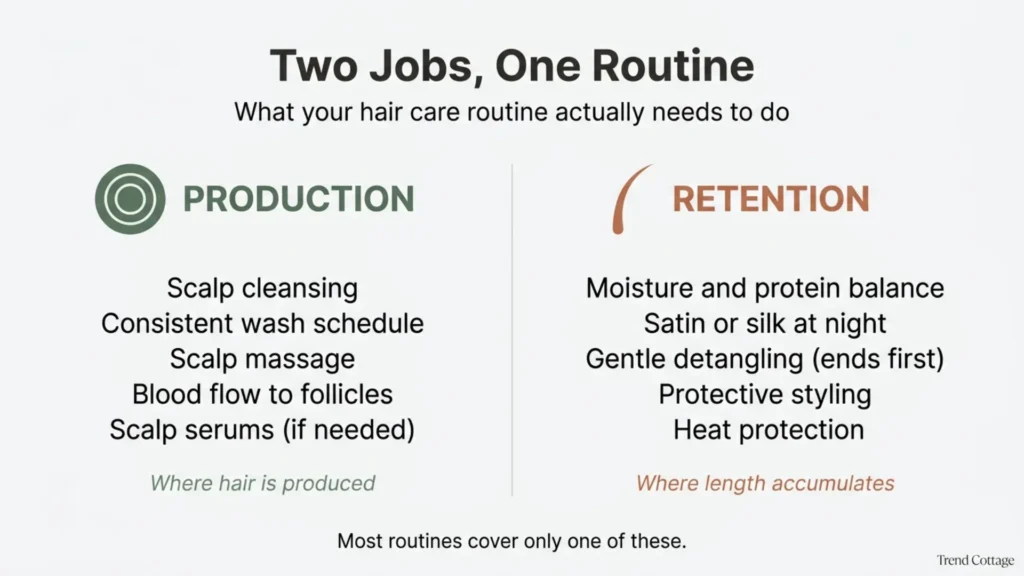
Think of the scalp as a factory and each strand as what comes off the line. The scalp works through a biological cycle: the active growth phase, called anagen, can last anywhere from two to seven years before the follicle rests and the strand eventually sheds. Conditions that disrupt this cycle — persistent buildup, poor circulation, chronic dryness or inflammation — can shorten that phase, meaning each strand grows for less time before it falls. The NHS explanation of hair loss and the growth cycle covers what this looks like in practice and when shedding crosses into something worth addressing. That’s the production side.
Retention is the other half. Once a strand leaves the follicle, it can’t repair itself. Dryness, friction, heat, and rough handling all break the shaft. That breakage is invisible until you notice your length hasn’t moved in six months. Every centimetre lost to breakage is a centimetre your scalp already produced that your routine didn’t protect.
Fixing one without the other produces a plateau. The cleanest, most stimulated scalp in the world won’t give you visible length if your ends snap off below your shoulders. Conditioning alone doesn’t help a follicle that’s cycling too fast due to buildup or inflammation. Both sides have to run together.
Also Visit : Hair Care Routine: Build One That Actually Sticks
How Often You Should Wash
Wash frequency matters more to growth than most people account for, and getting it wrong pushes back against both sides of the equation. Too-frequent washing strips the natural sebum that coats and protects the shaft. Too-infrequent washing lets product residue, excess oil, and dead skin accumulate at the follicle opening. That doesn’t block follicles in the dramatic way it’s sometimes described online, but a chronically congested scalp isn’t a good environment for steady production.
The right frequency depends mostly on hair texture, because texture determines how quickly sebum travels from the scalp down the strand:
| Hair Type / Texture | Suggested Wash Frequency | Notes |
|---|---|---|
| Fine or straight | Every 2–3 days | Sebum travels fast; buildup and oiliness happen quickly |
| Wavy or medium texture | Every 3–5 days | Watch for scalp dryness if washing more frequently than this |
| Curly or coily | Once a week to every 10 days | Sebum struggles to reach the shaft; over-washing drives breakage |
| Locs or heavy protective styles | Every 1–2 weeks | Focus on the scalp; avoid over-saturating the style itself |
If your scalp runs oily but your ends are dry and brittle, the issue usually isn’t frequency alone. Applying shampoo mid-shaft and below dries the hair out without doing any useful cleansing. Shampoo belongs on the scalp. The rinse-off takes care of the lengths.
The Wash Day Sequence
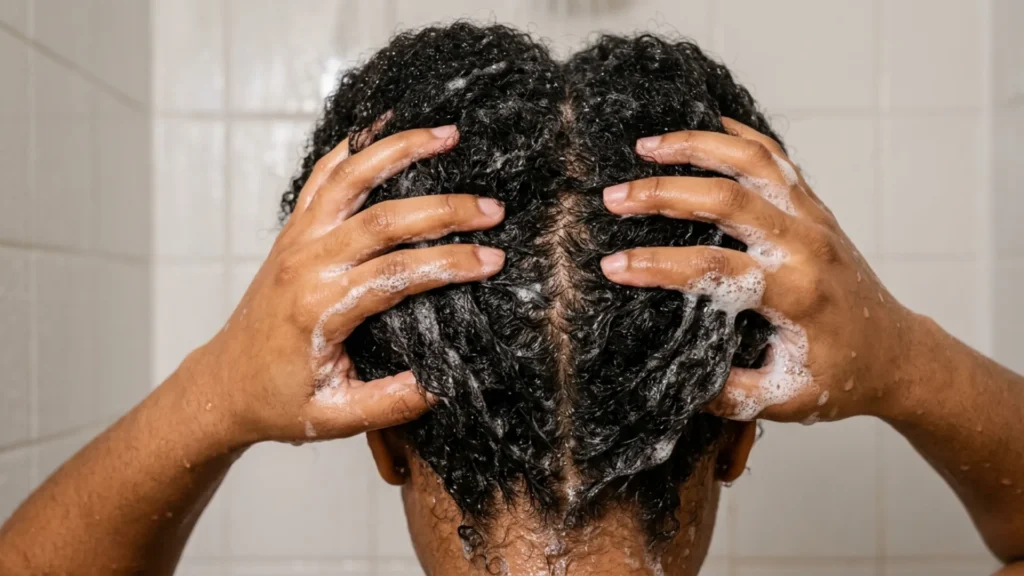
Wash day is where most of the production work happens. The scalp gets cleaned, stimulated, and reset. Getting the order right makes a real difference. It matters more than switching products does.
If your hair is prone to tangling or dryness, a pre-shampoo step is worth building in. Apply a light oil or conditioner to dry hair from mid-shaft to the ends before you get in the shower. It reduces the friction of the cleansing step and limits how much moisture the shaft loses when it comes into contact with water, a particular concern for high-porosity hair. Ten minutes is enough. Rinse lightly, then shampoo as normal.
When you shampoo, keep it on the scalp. Use your fingertips — not nails — and work in firm, slow, circular motions. Cover the crown, temples, nape, and hairline, not just the top section. Two minutes is the minimum; more is better. The technique is functional: that pressure temporarily increases blood flow to the follicle area, and follicle blood supply is directly connected to how well the growth phase runs. [EXTERNAL SOURCE NEEDED: peer-reviewed study on scalp massage and hair thickness or growth rate — e.g. Koyama et al. 2016; verify correct PubMed or PMC URL before publishing] Rinse the shampoo fully. Residue left on the scalp becomes part of the buildup you’re working against.
Apply conditioner from the ears down. The scalp produces its own sebum and doesn’t benefit from conditioning the way mid-lengths and ends do. Leave it on for three to five minutes, then rinse with cool water. The cool rinse flattens the hair cuticle, which reduces friction and tangling in the days that follow. A smoother cuticle catches less and breaks less — a retention benefit built directly into wash day.
Also Visit : Hair Growth Challenge: How to Build One That Works
Scalp Care Between Wash Days
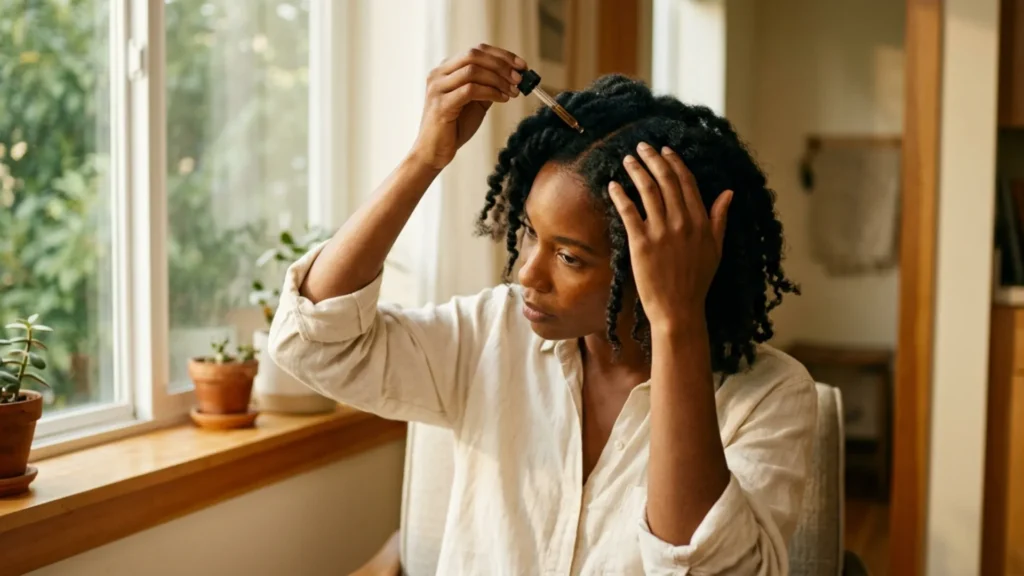
Between wash days, the scalp is still doing its job. A few targeted habits in that window can meaningfully support the production side without adding much time to the week.
Scalp massage doesn’t have to stay on wash day. Two to three minutes of firm circular pressure with your fingertips every other day or so keeps circulation more consistent than a once-a-week wash day session alone. Some people find this easier with a drop or two of lightweight oil on the fingertips first — it reduces drag and makes longer sessions more comfortable. Rosemary oil is the most frequently cited option for scalp use and has the most available research support behind it, though the evidence base is still developing. Apply it sparingly. A heavy coat on the scalp contributes to exactly the buildup a good wash schedule is managing.
Serums aimed at the scalp are worth considering if basic cleansing and massage haven’t resolved persistent dryness, flaking, or sluggish growth. Niacinamide supports the scalp’s barrier function. Salicylic acid gently clears dead skin and residue between washes. Caffeine has some evidence for stimulating follicle activity, though it’s among the less thoroughly studied ingredients available. The American Academy of Dermatology’s guidance on hair loss and scalp health is a useful reference before adding any active ingredient, since some overlap with medical treatments and it’s worth understanding the distinction.
The scalp produces sebum between washes, and that’s normal and useful. Resist the habit of layering dry shampoo heavily every few days to absorb it. Dry shampoo is a short-term fix, not a replacement for cleansing, and heavy regular use contributes to exactly the buildup you’re managing with your wash schedule.
Protecting Length the Rest of the Week
Production happens at the scalp. Retention happens everywhere else, all week long, in the choices that seem small until they’ve added up over six months.
A cotton pillowcase creates friction throughout the night. Over months, that friction causes breakage at the hairline and nape in particular, where the hair tends to be finer. Switching to a satin or silk pillowcase — or a satin sleep bonnet — is one of the cheapest and most consistent retention changes available. Either works. The choice comes down to how you sleep.
Detangling direction matters more than most people account for. Starting at the root drags knots downward through strands that would have detangled cleanly if you’d started from the end. Work from the ends upward, section by section, with a wide-tooth comb or fingers. A fine-tooth brush on dry hair is one of the most reliable ways to shorten your ends without realising it’s happening.
If heat tools are part of the routine, a heat protectant isn’t optional for someone focused on retention. Even moderate heat settings cause cumulative cuticle damage over repeated sessions, and that damage tends to show as splits and breakage at whatever point on the strand the tool sits longest.
Also Visit : Hair Growth Recipes That Actually Match Your Hair Problem
What to Expect, and When

Most people assess a new routine too early. At four weeks, what you’re actually measuring is how wash days feel and whether the scalp is less irritated. Real length retention takes three to six months to show up visibly, because hair grows roughly half an inch a month and most people can’t accurately judge a centimetre or two of change without a fixed reference point.
A practical habit: measure from a consistent point — the nape or the crown — at the start of a new routine, and photograph the same spot in the same lighting at 90 days. What the tape measure shows versus what your eye sees is often the retention gap: hair that grew but broke before it accumulated as visible length.
If shedding has increased rather than stabilised after six months of a consistent routine, that’s worth a conversation with a dermatologist. Increased shedding alongside good topical habits can point to a nutritional deficiency, a hormonal change, or a scalp condition that surface-level care won’t fix. The Mayo Clinic’s overview of hair loss causes and when to seek evaluation covers what the investigation typically looks like and which causes are treatable.
Consistency matters more than perfection here. Missing a wash day or skipping a massage session for a week doesn’t undo six months of good habits. Switching products every three weeks, or abandoning the routine before the 90-day mark, makes it impossible to know what’s working and resets the assessment clock each time.
If you’re not sure where your current habits are falling short, mapping them against the two-part framework — what’s the routine doing for production, what’s it doing for retention — is usually enough to spot the gap. Drop a comment below if you try the sequence above; it helps other readers know what’s actually making a difference in practice.
Frequently Asked Questions
How long does it take for a hair care routine to show results?
Visible length retention typically becomes measurable over three to six months. The scalp grows hair at a fixed biological rate; a routine can’t change that number, only protect the growth that’s already happening. Set a physical reference point at the start and measure at 90 days rather than going by appearance alone.
Does washing hair less often help it grow?
Not directly. Less-frequent washing can support retention by reducing the friction and moisture loss that comes with repeated wetting and heat-drying. But it doesn’t change the rate the follicle produces hair. The goal is the wash frequency that matches your texture, not the lowest possible number.
Can scalp massage actually affect hair growth?
Some research suggests it can influence hair thickness over time, with increased blood circulation to the follicle area as the likely mechanism. It won’t dramatically speed up the biological growth rate, but it’s one of the few low-cost scalp habits with any research behind it at all. Two to three minutes of firm circular pressure during shampooing, done consistently, is where any benefit sits.
Should I take supplements if my routine isn’t working?
Only if there’s a deficiency to address. Biotin, iron, vitamin D, and zinc all play roles in hair production, but supplementing above your actual need doesn’t add more output. If a consistent routine hasn’t produced measurable change after six months, blood work is a more useful next step than another supplement.
What’s the difference between hair growth and hair retention?
Growth is biological — the follicle producing new hair. Retention is mechanical — keeping that hair intact long enough to accumulate as visible length. Most people experiencing a stall have a normal growth rate and poor retention. Identifying which problem applies to you is the right starting point for building any routine.
Key Takeaways
- Hair grows at a fixed biological rate — a good hair care routine for hair growth protects that output and maintains the scalp that produces it, rather than generating growth independently.
- Every routine needs to address both production (scalp health) and retention (strand protection). Focusing on one and ignoring the other causes a plateau.
- Wash frequency should match your hair texture, not a general rule. Getting it wrong pushes back against both sides of the equation.
- Scalp massage during shampooing is functional, not decorative — two minutes of firm circular pressure affects blood flow to the follicle area.
- Give any routine 90 days before assessing it. Week four is too early to judge anything, and switching products before that point resets the clock.
This article is for general information only and isn’t medical advice. For persistent hair loss, scalp pain, or sudden shedding, see a dermatologist or trichologist.
Written by Anna Anderson for Trend Cottage.