Hair Care Routine for Healthy Hair: Build Yours in 3 Steps

Most people build a hair care routine for healthy hair by copying whatever a stranger posted online, then wonder why their results don’t match. It’s usually not because they did anything wrong. It’s because that routine was built for someone else’s scalp, someone else’s water, someone else’s hair.
Here’s the short version: a hair care routine for healthy hair isn’t a fixed list of steps everyone follows in order. It’s three quick checks that tell you how to wash, treat and style hair that’s actually yours – how thirsty it is, how much oil your scalp makes, and how much damage risk your current habits carry. Answer those three questions honestly, and the rest of the routine mostly writes itself.
Why Most Hair Care Routines Don’t Actually Work for You
Generic routines assume every head of hair behaves the same way. It doesn’t. Two people can use the identical shampoo, on the identical schedule, and end up with opposite results – one with soft, bouncy hair, the other with hair that feels coated and heavy.
That’s not bad luck. It’s because “healthy hair” isn’t a single destination with one path to it. It depends on how your hair takes in water, how your scalp behaves between washes, and how much wear your styling habits put on the strand itself. A routine that ignores those three things is really just a guess dressed up as advice.
The rest of this article walks through each of those three checks, then shows how to turn the answers into an actual routine – not a list you follow blindly, but one you can adjust as your hair changes with seasons, color treatments, or just time.
Step 1: Learn How Your Hair Actually Drinks Water
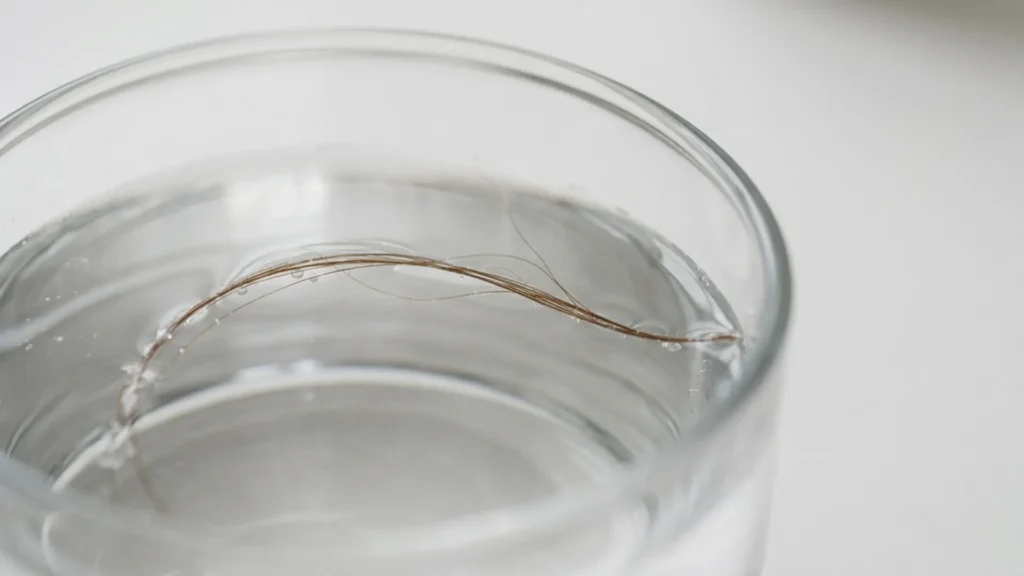
This first check is about porosity – a plain way of describing how easily water and moisture pass into and out of your hair strand. Think of the outer layer of each strand like tiny overlapping scales. When those scales sit tight and flat, water has a harder time getting in. When they’re lifted or roughened, water rushes in and just as easily escapes again.
You can get a rough read on this with a simple test. Drop a clean strand of shed hair into a glass of room-temperature water and leave it a few minutes. If it floats, your hair likely has low porosity – moisture resistant, often shiny, but slow to absorb anything you put on it. If it sinks fast, you’re probably dealing with high porosity – hair that soaks up product quickly but loses moisture just as fast, leaving it prone to frizz and dryness. Hair that sinks slowly, somewhere in between, is closer to average.
Why this matters for a hair care routine for healthy hair: low porosity hair usually needs lighter products applied to damp (not soaking) hair, sometimes with gentle heat to help things absorb. High porosity hair generally benefits from richer creams and an extra sealing step, since it loses moisture almost as quickly as it takes it in. Skip this check, and you’ll spend money on products that are fighting your hair’s actual behavior instead of working with it.
Also Visit : Hair Care Routine Tips Built Around Your Hair Type
Step 2: Read Your Scalp Before You Read Any Product Label

The second check has nothing to do with the strand itself and everything to do with what’s happening at the root. Your scalp produces a natural oil that keeps skin protected, and how quickly it builds up varies a lot from person to person. how much natural oil your scalp produces is largely genetic, though heat, humidity, and even stress can shift it.
A simple way to check: go a day or two without washing and pay attention to how your roots feel and look by the end of it. Flat, shiny-looking, or noticeably oily by day one or two points to a higher-oil scalp. Still feeling dry and a little rough by day three or four points to a lower-oil scalp. Neither is a problem to fix – it’s just information that decides how often you should actually be washing.
This is where a lot of routines quietly fail. Someone with a low-oil scalp washing daily strips away protection their scalp needed. Someone with a high-oil scalp stretching washes to “protect their color” ends up with a scalp that feels uncomfortable and hair that looks weighed down by day two. Matching wash frequency to your actual oil production, not a rule you read somewhere, is one of the fastest fixes available.
Step 3: Rank Your Damage Risk Before You Pick a Styling Habit
This last check looks at what your daily habits are actually doing to the hair shaft over time. Heat tools, chemical color or relaxing services, tight ponytails and braids, and even rough towel-drying all wear down the same protective outer layer that porosity depends on. Damage doesn’t announce itself right away – it builds quietly until one day your hair suddenly feels rougher or breaks more easily than it used to.
tightly pulled styles like weaves and extensions are a good example of a habit that feels harmless day to day but adds up. The same is true of high-heat blow-drying without protection, or leaving color treatments too close together.
Here’s a rough way to rank common habits by how much wear they put on hair over time, along with a lower-risk swap for each:
| Habit | Damage Risk | Lower-Risk Swap |
|---|---|---|
| Daily high-heat styling, no protectant | High | Medium heat + heat protectant, air-dry when possible |
| Tight braids, ponytails, or extensions worn for weeks | High | Looser styles, rotate part lines, give roots regular breaks |
| Color or chemical services back to back | High | Space services out, use bond-building treatments between |
| Rough towel-drying | Medium | Blot with a microfiber towel or soft t-shirt |
| Wet detangling with a fine-tooth comb | Medium | Wide-tooth comb or fingers, start from the ends |
| Occasional low-heat styling | Low | No change needed |
Also Visit : Hair Care Routine for Hair Fall That Actually Works
Building a Hair Care Routine for Healthy Hair From the Three Layers
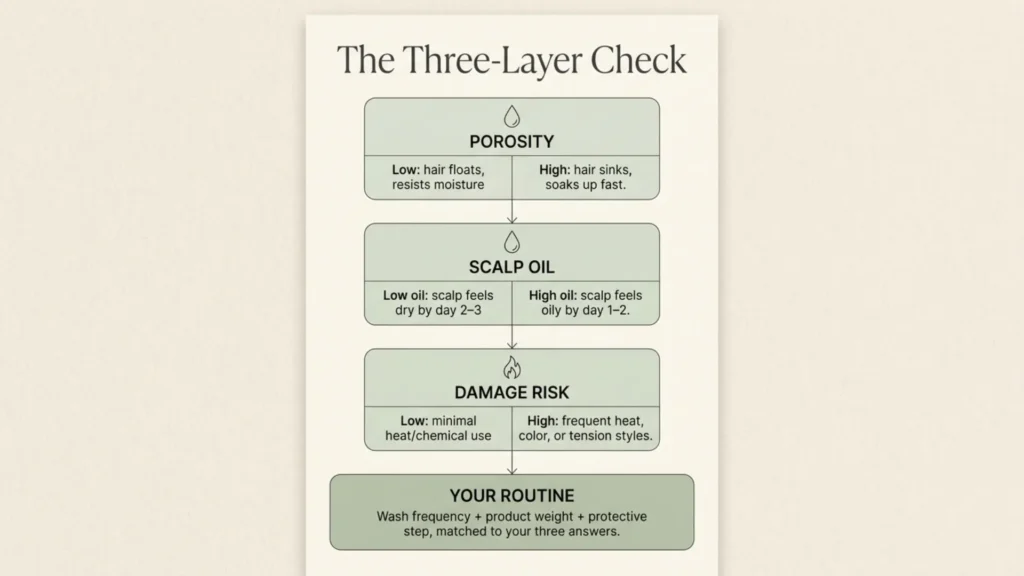
Once you know your porosity, your scalp’s oil pattern, and your damage risk, you’re not guessing anymore – you’re assembling. A routine really only has four jobs: cleanse, add moisture where it’s needed, protect the strand from further wear, and style with the least damage possible. The order rarely changes. What changes is how often and how much of each.
A few examples of how the three answers combine in practice:
- Low porosity, low-oil scalp, low damage risk: wash every 3-4 days, use lightweight leave-in products, apply on slightly damp hair, minimal extra steps needed.
- High porosity, high-oil scalp, high damage risk: wash every 1-2 days focusing on the scalp, follow with a rich leave-in and a sealing oil on the ends, add a weekly protein or bond treatment to offset styling wear.
- Average porosity, low-oil scalp, medium damage risk: wash every 3 days, moderate conditioner, add a heat protectant only on styling days, skip daily deep conditioning.
Notice none of these routines have the same number of steps or the same frequency. That’s the point. A hair care routine for healthy hair should look different from one head to the next, because the three inputs that shape it are different too.
A Sample Week, Not a Sample Routine
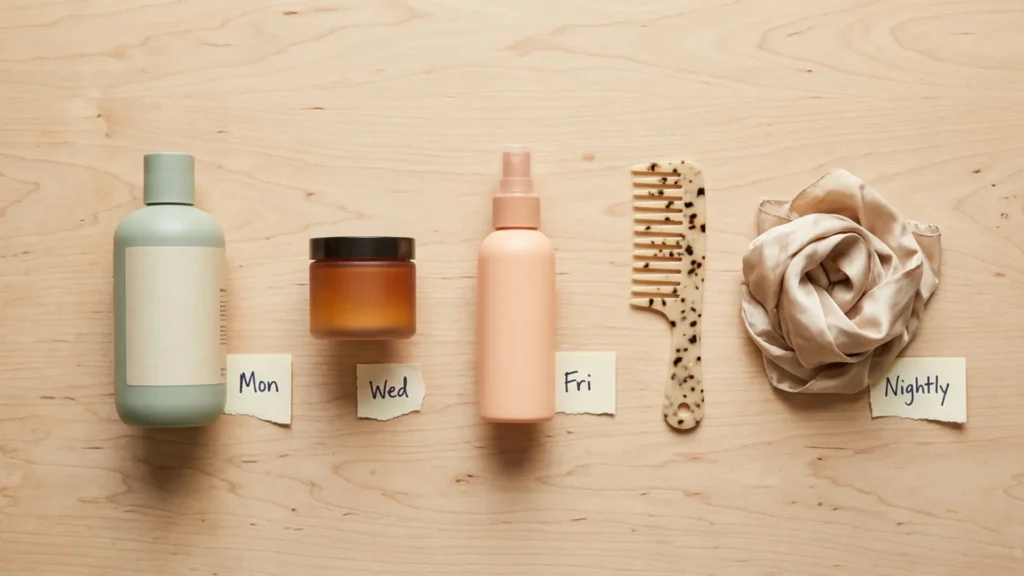
Instead of a rigid daily checklist, think in terms of a flexible week you adjust as you go. Say your hair leans toward higher porosity and a moderately oily scalp. Monday might be a full wash and deep condition day, since the weekend’s product buildup needs clearing. Wednesday could be a scalp-only rinse with conditioner just on the ends, skipping shampoo entirely. By the weekend, a protective, low-manipulation style gives your hair a break from daily brushing and heat.
Dermatologists generally frame washing frequency the same way – washing based on how oily or dirty your hair actually gets, rather than on a fixed calendar. That’s the same logic behind treating the week as flexible instead of scripted.
If your damage risk check came back high, build in one no-heat, no-tension day every week, even if it’s just a loose bun or braid-out. Recovery happens on the days you’re not actively stressing the hair, not just on the days you’re treating it.
Also Visit : How to Build a Natural Hair Care Routine That Actually Holds
What to Skip Entirely While Your Hair Recovers
A few habits do more harm than good no matter which porosity or oil type you land on. Double-shampooing every single wash strips more than it cleans for most people. Piling on rich, heavy creams onto low porosity hair usually just sits on top of the strand instead of absorbing, leaving hair looking greasy rather than moisturized. Skipping heat protectant “just this once” adds up faster than it feels like it should.
It’s also worth dropping any step you can’t explain the purpose of. If you’re using a product because a routine told you to, not because you know what job it’s doing, that’s a step worth questioning. A shorter routine you actually understand beats a longer one you’re following on faith.
Frequently Asked Questions
How often should I wash my hair to keep it healthy?
There’s no universal number. It depends on your scalp’s oil production, not a fixed schedule. A low-oil scalp might only need washing every 4-5 days, while a high-oil scalp often needs it every 1-2 days.
What order should I apply hair care products?
Cleanse, then any treatment (a mask or protein product), then leave-in moisture, then a sealing product like oil, then any heat protectant if you’re styling. Lighter products generally go on before heavier ones.
Can a hair care routine work with almost no products?
Yes, especially for low porosity or low damage-risk hair. A simple wash, a lightweight conditioner, and gentle drying can be enough. More products don’t automatically mean healthier hair.
How long before a new hair care routine actually shows results?
Most people notice a difference in texture and manageability within 2-4 weeks. Since hair itself grows slowly, visible length or thickness changes take several months to show.
Key Takeaways
- A hair care routine for healthy hair starts with three checks: porosity, scalp oil, and damage risk – not a copied list of steps.
- Porosity decides how your hair absorbs and holds moisture; test it with a simple float test.
- Scalp oil production, not a fixed calendar, should set your washing frequency.
- Ranking your styling habits by damage risk shows exactly where to swap in a lower-risk alternative.
- The right routine looks different for every head of hair, and it should change as your hair does.
If you’ve been following a routine that never quite matched your hair, try running through these three checks this week and see what shifts. Feel free to share where your hair landed in the comments, or save this for the next time your routine needs a reset.
Written by Anna Anderson for Trend Cottage.