
4c Hair Growth: Why It’s Really About Retention

“4c hair doesn’t grow.” You’ve probably heard some version of that, or maybe said it about your own hair after months at the same length. It isn’t true, and the confusion comes down to one word: retention.
Quick answer: 4c hair growth isn’t slower than any other hair type. Every strand on your head grows out of the follicle at roughly the same rate, no matter the curl pattern. What differs is how much of that new growth survives long enough to show up as length, because tightly coiled hair breaks more easily than looser textures do. Fix the breakage, and the “slow growth” problem usually disappears on its own.
The Myth That “4c Hair Doesn’t Grow”
Every hair follicle on the scalp cycles through a growth phase called anagen, and this is what decides how long a strand can eventually become. Curl pattern doesn’t change how fast a follicle works. A clinical review of the hair growth cycle describes anagen lasting anywhere from two to eight years across all hair types, and that’s the phase doing the actual growing.
So where does the myth come from? Mostly from what people can see. If your hair snaps off at roughly the same rate it grows, your length stays put even though new hair is arriving every day. It looks like a growth problem. It’s usually a survival problem.
4c Hair Growth vs. Retention: What’s Actually Different
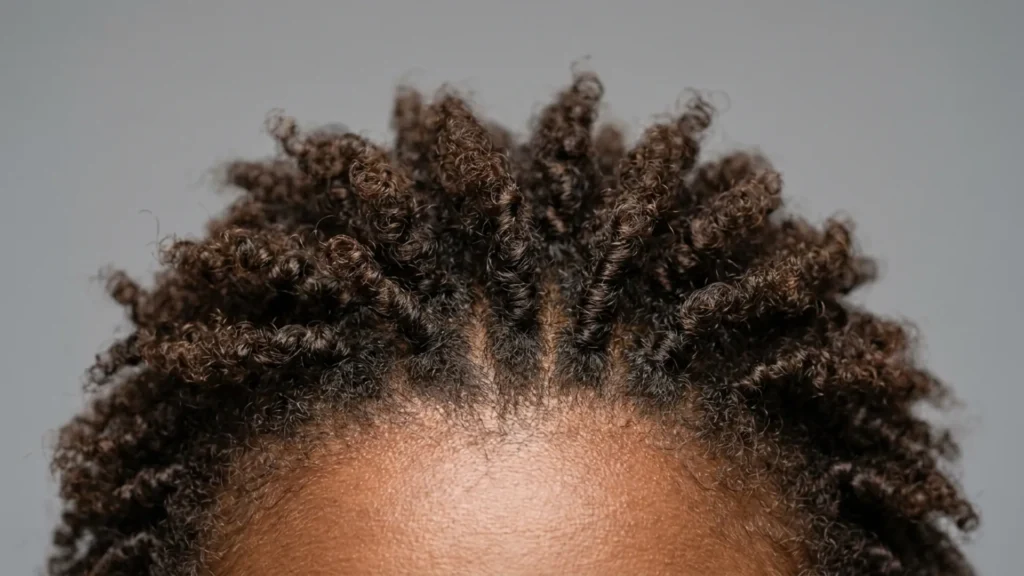
Growth happens underneath the scalp, at the root, where you can’t see or influence it much beyond basic scalp health. Retention happens above the scalp, to hair that has already grown, and this part is almost entirely about handling.
4c strands have more bends per inch than straighter hair types, and each bend is a weak point. Water and oils also have a harder time traveling down a tightly coiled shaft, so 4c hair tends to run drier by default. Dry hair loses elasticity, and hair without elasticity snaps instead of stretching under normal, everyday tension like combing or a ponytail pulling loose.
None of that means 4c hair is fragile in a bad way. It means it needs a routine built around keeping strands intact, not just one aimed at “growing faster,” because faster growth was never really the issue.
Also Visit : How to Use Hair Growth Oil the Right Way
The Real Reasons Length Stalls
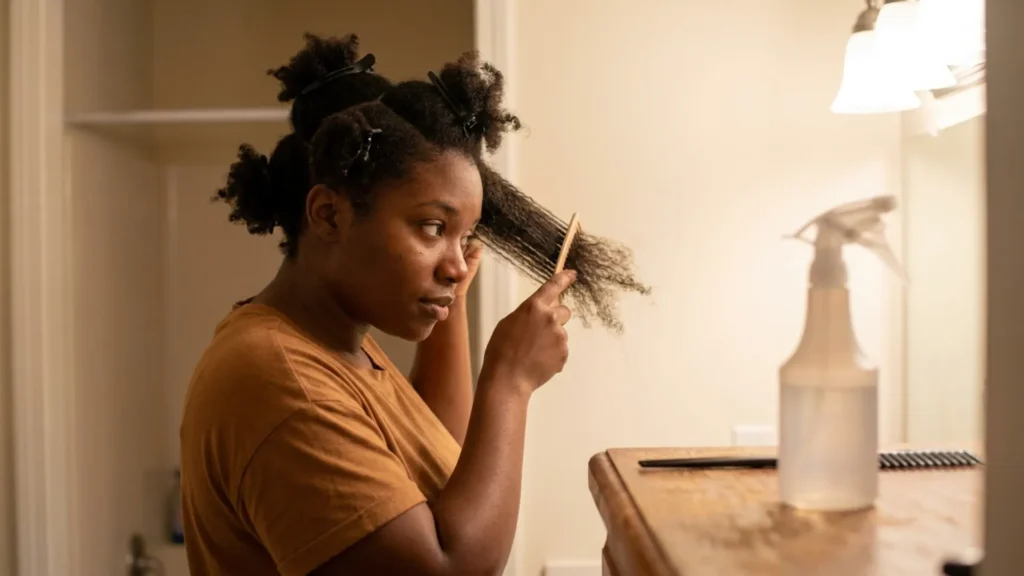
A handful of habits account for most of the breakage people mistake for slow growth. They tend to show up in the same three places.
Breakage at the Nape and Crown
These two spots take the most friction: the nape rubs against collars and pillowcases, and the crown is where most detangling tension concentrates. If your ends look noticeably thinner or wispier at the nape than everywhere else, that’s breakage, not a growth pattern.
Cotton pillowcases and rough collars are common, boring culprits here. Swapping to satin or silk at night removes a source of friction you’re otherwise fighting every single night without realizing it.
Dryness That Builds Up Between Washes
4c hair can look and feel moisturized right after a wash day and still be bone-dry by day four, because the coil pattern makes it hard for natural oils to travel down the strand. Dermatologists who work with curly and coily hair note that it’s more prone to dryness and breakage than straighter hair types for exactly this reason.
The fix isn’t more product. It’s more frequent, lighter moisture — a water-based spray between washes does more than a heavy cream applied once a week.
Manipulation from Styling and Detangling
Dry detangling, rough brushing, and tight elastics all add up. Everyday habits like these are common causes of hair damage that dermatologists point to across hair types, and coily hair simply shows the wear sooner because it has less give.
Detangling with fingers first, then a wide-tooth comb, on soaked and conditioned hair, removes most of this tension before it becomes breakage.
Growth Problem or Retention Problem? Quick Comparison
Most people can tell which one they’re actually dealing with by checking a few signs.
| Sign | Usually points to a growth-rate issue | Usually points to a retention issue |
|---|---|---|
| New growth at the edges or nape | Little to no new growth felt at the root | New growth is there, but breaks off before it lengthens |
| Shed hairs on the pillow or in the shower | Shedding is sudden, heavy, or patchy | Shedding is light and even, typical daily loss |
| Ends after a trim | N/A — this isn’t a growth-rate sign | Ends look ragged, split, or thin again within weeks |
| Hair length over 6–12 months | No length change anywhere, including protected sections | Length stalls only where hair is left out or manipulated most |
If shedding is sudden or comes with visible bald patches, that’s worth mentioning to a dermatologist rather than solving with a hair-care routine. Most people reading this, though, are dealing with the right-hand column.
A Retention-First Routine for 4c Hair

A retention-focused routine doesn’t need to be complicated. It needs to be consistent in three places: wash day, the days in between, and nighttime.
On wash day, detangle before you shampoo, not after. Hair is most fragile when it’s wet and freshly cleansed, so working out knots beforehand means less pulling on hair that’s already at its weakest. Section your hair into four to six parts before you start; trying to detangle the whole head at once is how most snapping happens.
Between washes, focus on adding moisture rather than sealing it in over and over. A light water- or aloe-based spray, applied to two-day-old hair before bed, keeps the strand flexible enough to survive normal handling. Sealing with an oil only works after there’s actual water underneath it — oil on dry hair just sits on top and does very little.
At night, protect what you’ve already built. A satin or silk bonnet, or a pineapple-style loose gather on top of the head, cuts down on the friction that undoes a whole week of careful handling in a single night of tossing on a cotton pillowcase.
None of these steps promise faster growth, because growth rate was never the variable you could control. What they do is stop erasing the length you’re already producing every month.
Also Visit : Biotin Hair Growth: What It Actually Does to Your Hair
Trims, Protective Styles, and How Much Manipulation Is Too Much

Trims feel counterproductive when you’re trying to grow length, but split ends travel up the hair shaft if they’re left alone, turning a small problem into a bigger one. A trim every 10 to 14 weeks, just enough to remove visibly split or thinning ends, protects the length above it.
Protective styles help for the same reason a satin bonnet does: they reduce daily manipulation. But “protective” only holds if the style itself isn’t causing damage. Styles pulled tight enough to create tension headaches or a raised, bumpy hairline are doing the opposite of protecting anything. The American Academy of Dermatology notes that hairstyles that pull too tightly can cause a lasting form of hair loss at the hairline, and this risk is higher on chemically treated or already-stressed hair.
A good rule of thumb: if you can’t move your face muscles normally an hour after a style is installed, it’s too tight. Loosen it or take it out. Leaving a protective style in for six to eight weeks is usually the upper limit before buildup and root stress start to outweigh the benefit.
What Realistic Growth Timelines Actually Look Like
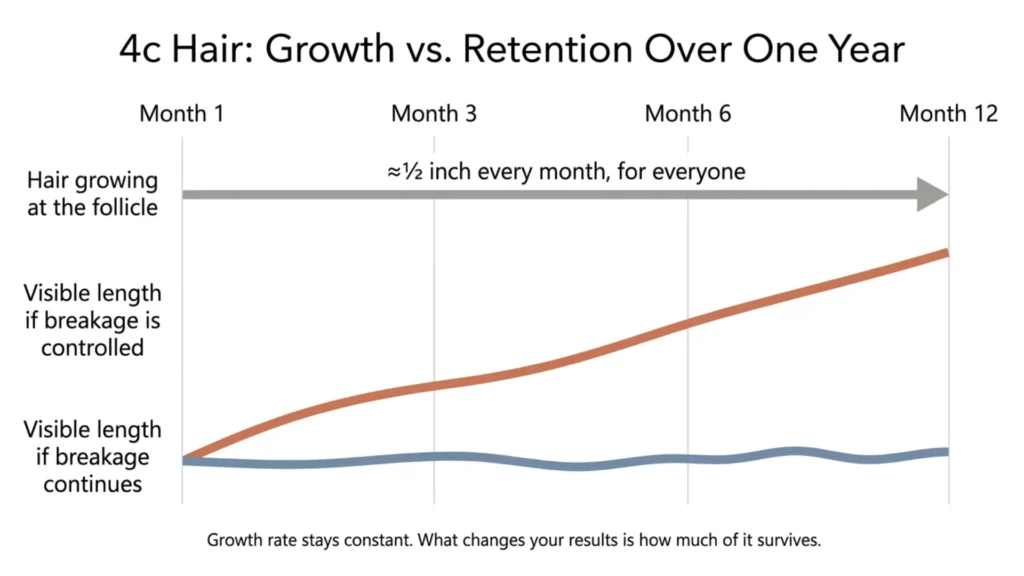
Scalp hair grows roughly half an inch a month, on average, and that number is remarkably consistent across hair types and textures. Genetics decide the exact figure for you, not curl pattern.
What a retention-focused routine changes is how much of that half-inch you actually keep. Over three months, that’s the difference between a barely noticeable change and roughly an inch and a half of real, visible length. Over a year, the gap between “still breaking off” and “mostly retained” can be the difference between hair that looks stuck and hair that’s visibly longer at the same length setting.
Don’t expect a dramatic before-and-after in four weeks. Length changes you can actually see tend to show up around the three-month mark, once a full cycle of trims, moisture, and reduced manipulation has had time to work.
Also Visit : Hair Growth Recipes That Actually Match Your Hair Problem
- 4c hair grows at the same rate as any other hair type — the follicle doesn’t know or care about curl pattern.
- Slow-looking 4c hair growth is almost always a retention problem: breakage keeping pace with new growth.
- Dryness, friction at the nape, and rough detangling are the three biggest, most fixable causes of breakage.
- A trim every 10–14 weeks protects length instead of undoing it.
- Real, visible change from a retention-first routine usually takes about three months, not four weeks.
Frequently Asked Questions
Does 4c hair actually grow slower than other hair types?
No. The growth rate at the follicle is essentially the same across hair types, averaging about half an inch per month. What looks like slower 4c hair growth is almost always breakage keeping length from accumulating.
How often should 4c hair be trimmed to support growth?
Roughly every 10 to 14 weeks, trimming only the visibly split or thin ends. Skipping trims for a year or more usually causes more length loss than the trims themselves ever would.
What ingredients actually help with 4c hair growth?
No ingredient changes how fast a follicle produces hair. Water-based leave-ins, lightweight oils used to seal in moisture, and gentle, sulfate-free cleansers support the conditions that let existing growth survive, which is where the real gains come from.
Can protective styles slow down 4c hair growth?
Protective styles don’t affect the follicle, but styles installed too tightly can damage it over time through constant tension at the root, which is a separate and more serious problem than ordinary breakage.
How long does it take to notice a difference from a new hair-care routine?
Most people notice visible change around the three-month mark. A single wash day of good habits won’t show results; three consistent months usually will.
This article is for general information only and isn’t medical advice. For persistent hair loss, scalp pain, or sudden shedding, see a dermatologist or trichologist.
Written by Anna Anderson for Trend Cottage.