Palm Oil for Hair: Benefits, How to Use It, and What to Expect
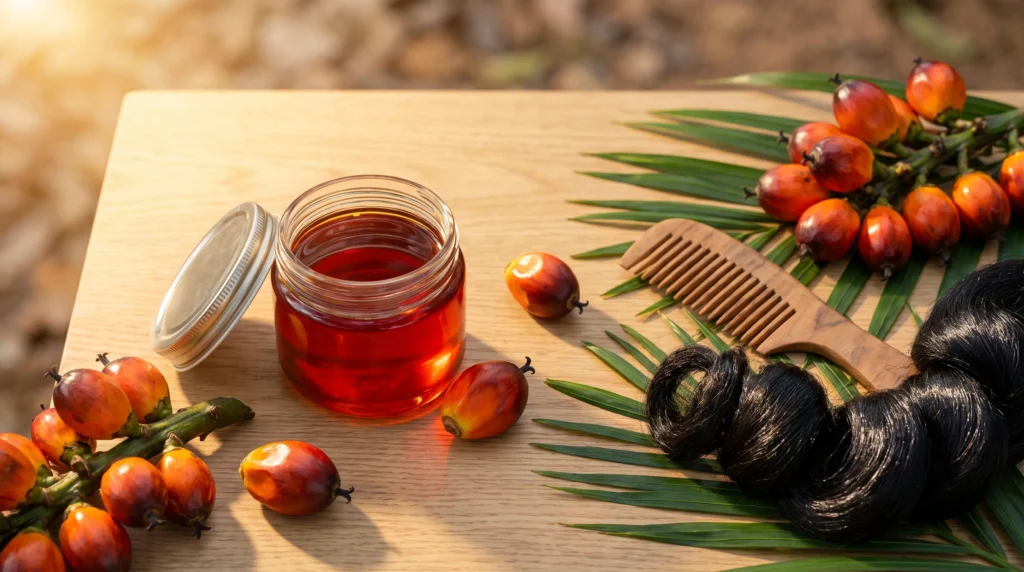
If you have been searching for a deep, truly nourishing oil that your hair actually absorbs — not one that just sits on top and makes things greasy — you might want to take a closer look at palm oil.
Palm oil has been used for centuries across West and Central Africa as a staple hair and scalp treatment. Long before beauty store shelves were packed with “miracle” hair products, grandmothers were reaching for this rich, red oil to keep hair moisturized, strong, and growing. And honestly? They were onto something real.
In this guide, we will walk through everything you need to know about using palm oil for hair — what it actually does, how to apply it correctly, which hair types benefit the most, and what to realistically expect from it.
What Is Palm Oil?
Palm oil is a natural vegetable oil extracted from the fruit of the oil palm tree (Elaeis guineensis), which is native to West Africa. There are two main types you will come across:
- Red (crude) palm oil — Unrefined, rich reddish-orange in color, and packed with nutrients including beta-carotene, vitamin E (tocotrienols), and antioxidants. This is the one traditionally used for hair.
- White/refined palm oil — Processed and bleached, lighter in color, but most of its natural nutrients have been stripped away. Far less beneficial for hair care.
For hair care purposes, always choose unrefined, raw red palm oil. The color and nutrient content is exactly what makes it work.
Why Palm Oil Works So Well for Hair
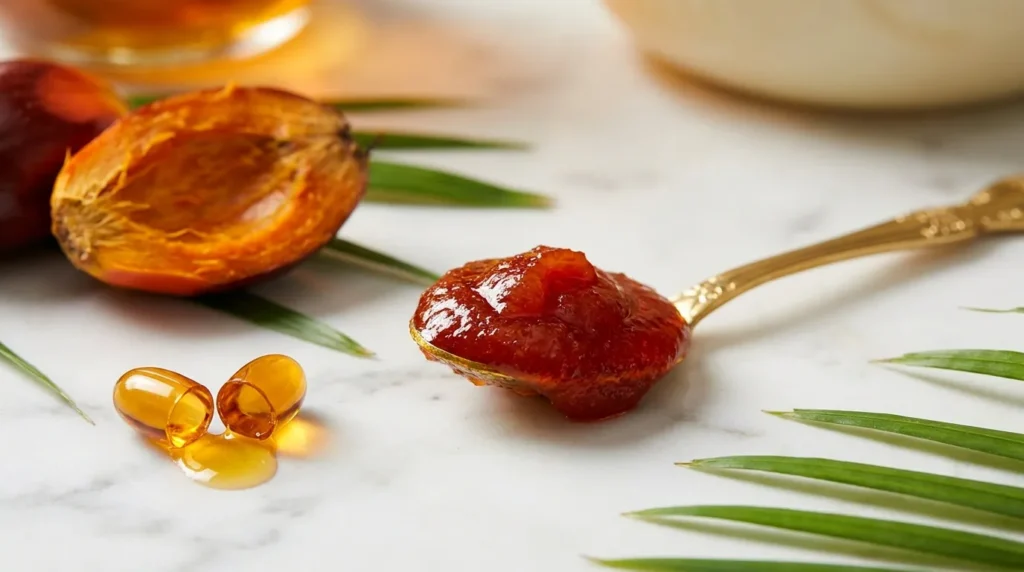
Palm oil is not just another oil you slap on your ends and call it a day. Its unique combination of nutrients targets several common hair problems at once.
Rich in Vitamin E (Tocotrienols)
Palm oil is one of the richest natural sources of tocotrienols — a powerful form of vitamin E. Tocotrienols are known to support scalp health, reduce oxidative stress on the follicles, and in some research studies, have been linked to reduced hair loss. When your scalp is healthier, your hair grows in stronger from the root.
Packed with Beta-Carotene
The deep red-orange color of unrefined palm oil comes from beta-carotene, a precursor to vitamin A. Vitamin A helps your scalp produce the right amount of sebum — your hair’s natural conditioner. Too little sebum leads to dry, brittle hair. Beta-carotene helps balance this naturally.
Contains Healthy Fatty Acids
Palm oil contains a mix of saturated and unsaturated fatty acids that benefit your hair in different ways:
- Palmitic acid — Coats the hair shaft, adds smoothness and visible shine
- Oleic acid — Penetrates the hair cortex for genuine deep moisture
- Linoleic acid — Helps retain moisture and reduce scalp inflammation
These fatty acids work together to seal moisture inside the strand while keeping the outer cuticle smooth and protected from daily wear.
Antioxidant Protection for Your Hair
Pollution, heat styling, UV rays — your hair faces a lot of daily damage. The antioxidants in palm oil help fight the free radicals that cause oxidative damage to your hair follicles and strands over time. Think of it as a daily shield for your hair, working quietly in the background.
Top Benefits of Using Palm Oil for Hair
Let us break down the specific results you can expect when you add palm oil for hair to your regular routine:
1. Deep Moisture Without the Grease
Unlike some heavier oils that just coat the surface, the oleic acid in red palm oil has a molecular structure small enough to partially penetrate the hair shaft. This means you get genuine hydration, not just the appearance of it. Your strands feel soft from the inside out, not just slicked down on the outside.
2. Strengthens Hair Against Breakage
Breakage is often caused by weak, dry, or over-processed strands. The combination of vitamin E and fatty acids in palm oil helps reinforce the hair’s protein structure, making each strand more resistant to snapping when you detangle, stretch, or style. Over several weeks of consistent use, you will notice noticeably less hair in your comb.
3. Promotes a Healthy Scalp
A well-nourished scalp is the foundation of healthy hair growth. Palm oil’s natural anti-inflammatory properties can help soothe an irritated scalp, reduce dandruff caused by excessive dryness, and improve blood circulation when massaged in regularly. When your scalp is happy, your follicles produce stronger, thicker hair.
4. Adds Real, Natural Shine
The palmitic acid in palm oil lays down the hair cuticle smoothly. When light hits a flat cuticle, hair looks significantly shinier. This is why many women notice a beautiful gloss to their hair after using palm oil — it is not artificial shine from silicones or synthetic ingredients, it is your actual hair reflecting light the way it is supposed to.
5. Protects Against Heat Damage
Palm oil creates a light protective layer around each strand. This makes it a very useful pre-heat treatment before blow-drying or flat ironing — it reduces the direct impact of high temperatures on your hair’s protein bonds. Apply a small amount before heat styling and you will notice less frizz and dryness afterward.
6. May Help Reduce Hair Loss
Several studies on tocotrienol supplementation — the form of vitamin E dominant in palm oil — have shown promising results in reducing hair loss. While applying it topically is different from oral supplementation, regular scalp massage with palm oil appears to support follicle health and reduce shedding over time for many women.
Which Hair Types Benefit Most from Palm Oil?
Palm oil for hair works across multiple hair types, but the results and application method vary depending on your specific hair:
| Hair Type | How It Helps | Recommended Frequency |
|---|---|---|
| Natural / Type 4 hair | Excellent — deeply moisturizes tight coils, reduces shrinkage appearance, defines curl pattern | 1–2x per week |
| Low porosity hair | Use in small amounts as a pre-poo or hot oil treatment to help open the cuticle with heat | Once a week |
| High porosity hair | Seals moisture in very effectively after water-based conditioner — great as a sealant | 2–3x per week |
| Fine hair | Use sparingly — a very small amount on ends only to avoid weighing hair down | Once a week, ends only |
| Damaged / color-treated hair | Helps restore the lipids lost during chemical processing and heat damage | 1–2x per week |
| Dry scalp / dandruff | Scalp massage to reduce dryness, soothe irritation, and restore scalp balance | 2–3x per week |
How to Use Palm Oil for Hair: Step-by-Step Methods
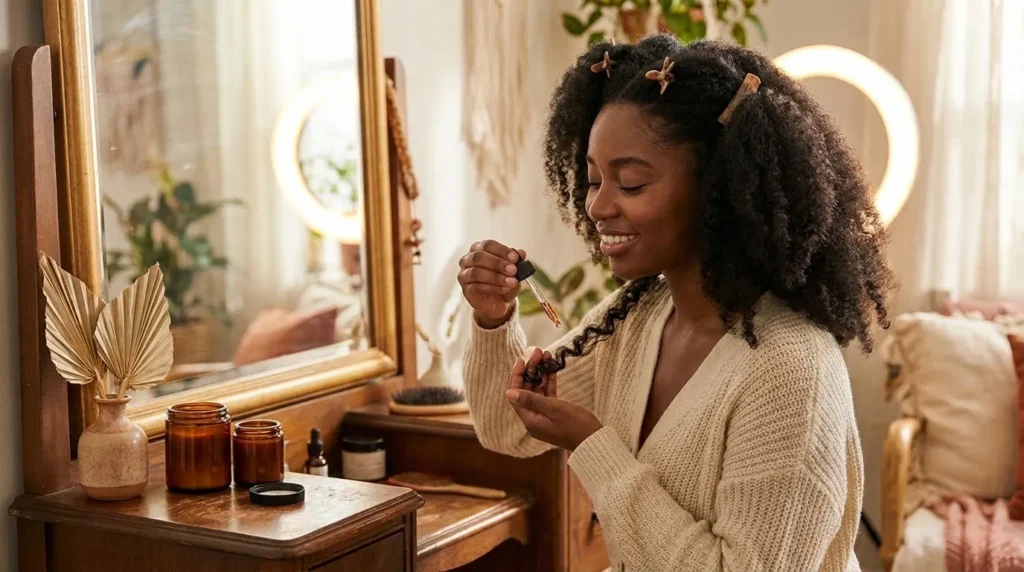
Here are the most effective ways to use palm oil for hair, depending on what your hair needs most right now:
Method 1: Pre-Poo Treatment (Before Shampooing)
This is the most popular and effective way to use palm oil if you have natural or dry hair. It protects your strands from the stripping effect of shampoo while delivering deep moisture.
What you need: Raw red palm oil, shower cap, warm towel
- Start with dry hair before your wash day.
- Section your hair into 4–6 parts for even coverage.
- Warm 2–3 tablespoons of palm oil in your palms by rubbing them together, or place the jar in a bowl of warm water for a few minutes.
- Apply the oil from roots to ends on each section, massaging your scalp gently in circular motions for 2–3 minutes per section.
- Smooth the remaining oil down the full length of each section.
- Put on a shower cap and leave it on for 30 minutes to 1 hour. For deeper penetration, wrap a warm towel around your head over the cap.
- Proceed with your regular shampoo and conditioner routine as normal.
Method 2: Leave-In Sealant After Moisturizing
This method works perfectly if you follow the LOC or LCO method for natural hair moisture retention.
- Apply your water-based leave-in conditioner to damp hair as usual.
- Take a very small amount of palm oil — about the size of a pea for each section — and rub it between your palms until it melts.
- Apply over the leave-in conditioner to seal in moisture and prevent evaporation.
- Style as usual.
Important: A little goes a very long way with palm oil. Too much will make hair feel heavy and difficult to manage.
Method 3: Scalp Massage for Healthy Growth
- Warm 1 tablespoon of palm oil between your palms.
- Optional: Mix in a few drops of rosemary essential oil or peppermint oil for added scalp stimulation and a pleasant scent.
- Apply directly to your scalp using a dropper or your fingertips.
- Massage in circular motions for 5–10 minutes, covering your entire scalp.
- Leave on for at least 1 hour, or overnight covered with a satin bonnet or shower cap.
- Wash out thoroughly with shampoo.
Method 4: Deep Hot Oil Treatment
- Mix 2 tablespoons of palm oil with 1 tablespoon of a lighter oil such as argan or jojoba to make it easier to apply and rinse.
- Warm the mixture gently — it should feel warm to the touch, never hot enough to burn your skin.
- Apply to clean, damp hair from scalp to ends, making sure every strand is coated.
- Cover with a plastic cap and sit under a hooded dryer, or use a warm towel wrapped around your head, for 20–30 minutes.
- Rinse thoroughly and follow with your regular conditioner.
Important Things to Keep in Mind Before You Start
Before you grab a jar and go all in, here are a few things worth knowing that will save you from common mistakes:
Start with a small amount. Palm oil is a heavier oil. Begin with less than you think you need and increase gradually based on how your hair responds. Fine hair especially needs very little — sometimes just a drop or two.
It stains fabric. Red palm oil can stain towels, clothing, and pillowcases due to its beta-carotene content. Protect your clothing with an old towel during application and wash your hands thoroughly after use.
Use a dark satin bonnet overnight. If you use palm oil as an overnight treatment, a dark-colored satin bonnet or satin pillowcase will protect your bedding from staining while keeping your hair moisturized.
Do a patch test first. If you have a sensitive scalp, apply a small amount to your inner wrist and wait 24 hours to check for any irritation before applying to your scalp for the first time.
Blonde and light-colored hair — read this. Red palm oil contains beta-carotene which can temporarily give very light or bleached hair a warm yellow tone. For blonde or silver hair, use refined white palm oil instead, though you will get fewer nutritional benefits. A strand test is always a good idea first.
Quality matters a lot. Always choose cold-pressed, unrefined, raw red palm oil for maximum hair benefits. Refined (white) palm oil has been processed and has far fewer active nutrients. Check the label before buying.
Palm Oil vs. Other Popular Hair Oils
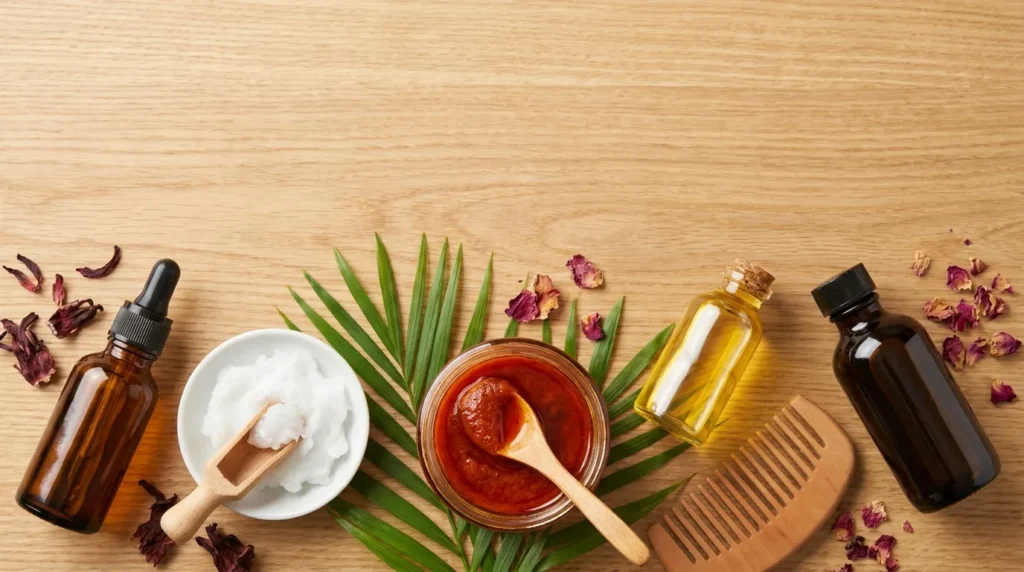
How does palm oil stack up against the other oils you might already be using? Here is an honest comparison:
| Oil | Best For | Penetrates Hair? | Main Benefit |
|---|---|---|---|
| Palm Oil | Moisture, scalp health, shine | Yes (partially) | Vitamin E + complete fatty acid profile |
| Coconut Oil | Protein retention, shine | Yes (deeply) | Lauric acid for deep penetration |
| Castor Oil | Thickness, edges, growth | No (coating) | Ricinoleic acid for scalp stimulation |
| Argan Oil | Frizz control, heat protection | Yes | Lightweight, oleic acid, fast absorbing |
| Jamaican Black Castor Oil | Growth, damaged edges | No (heavy coating) | Ash content for deep scalp stimulation |
| Jojoba Oil | Scalp balance, fine hair | Yes | Closely mimics the scalp’s natural sebum |
The verdict: Palm oil fills a unique gap that most single oils cannot cover on their own. It both partially penetrates and seals, it nourishes the scalp with antioxidants, and its vitamin E content is difficult to match in other common hair oils. For best results, combine palm oil with a lighter penetrating oil like argan or jojoba — you get the deep nourishment of palm oil and the easy application of a lighter carrier.
Frequently Asked Questions About Palm Oil for Hair
Can I use palm oil on my hair every day?
Daily use is generally not recommended unless you have extremely dry or very coarse hair. Using palm oil 2–3 times per week as a sealant, or once a week as a deep pre-poo or hot oil treatment, gives your hair what it needs without over-coating the strands. If your hair starts to feel heavy, greasy, or difficult to manage, that is a clear sign you are using too much or applying it too often.
Does palm oil make hair grow faster?
Palm oil does not directly speed up the rate at which your hair grows — nothing applied topically can truly change how quickly new hair is produced at the follicle level. However, by improving scalp health, significantly reducing breakage, and strengthening existing strands so you retain length, palm oil can make your hair appear to grow much faster. Over several months of consistent use, the difference in length retention is very real and noticeable.
Will red palm oil stain my blonde or light-colored hair?
This is a valid concern. Red palm oil contains beta-carotene, which can temporarily tint very light-colored or bleached hair a slightly warm or yellow tone, especially if left on for extended periods. For blonde, silver, or gray hair, it is safer to use refined white palm oil — though you will lose some of the nutritional benefits. Always do a small strand test on a hidden section of hair first before applying all over.
Can I mix palm oil with other oils?
Absolutely — and this is actually recommended for most hair types. Mixing palm oil with lighter oils like argan, jojoba, or sweet almond oil makes it easier to apply evenly, easier to rinse out, and allows you to customize the blend for your specific hair type and concerns. A popular starting blend is 50% palm oil and 50% lighter oil. Adjust from there based on how your hair responds.
Is palm oil safe for a sensitive scalp?
For most people, yes. Palm oil is generally non-irritating and has natural anti-inflammatory properties that are actually beneficial for sensitive or reactive scalps. However, everyone’s scalp chemistry is different. Always do a patch test on your inner wrist first, especially if you have known allergies to plant oils, latex, or if your scalp is prone to reactions. Wait 24 hours and check before full application.
How do I wash out palm oil without leaving residue?
The most effective trick is to apply your shampoo directly to dry hair — before getting your hair wet in the shower — and work it into the roots and lengths before adding any water. This helps break down the oil molecules more effectively than applying shampoo to already-wet, oil-covered hair. For heavier treatments, you may need two rounds of shampooing. Following up with a light rinse-out conditioner will leave hair feeling clean, soft, and manageable.
Final Thoughts
There is a reason palm oil for hair has stood the test of centuries — it genuinely works. The combination of vitamin E, beta-carotene, and a complete profile of fatty acids makes it one of the most well-rounded natural oils you can add to your hair care routine, regardless of your hair type.
Whether you are struggling with persistent dryness, frustrating breakage, slow length retention, or a flaky scalp that nothing seems to fix, red palm oil offers a natural, affordable, and deeply effective solution. The key is simply using it the right way — the right amount, the right method, and the right frequency for your specific hair type.
If you have never tried it before, start with a simple pre-poo treatment once a week. Give it a solid four to six weeks of consistent use. Your hair will tell you the rest — and we are willing to bet you will be reaching for that jar on every wash day after that.
💕 Save this to your Hair Care board and come back to it on your next wash day!
Also Visit : Is coconut oil good for low porosity hair? Find out here