How to Pick a Hair Mask for Growth That Works
Most people go looking for a hair mask for growth right after they notice their ends splitting or their ponytail feeling thinner than it used to. That’s usually the wrong starting point, and it’s worth saying plainly: no hair mask, however expensive, tells your follicles to work faster. Hair growth starts under your scalp, in a part of the follicle a rinse-out product never touches.
Quick answer: a hair mask for growth won’t speed up your growth rate, but the right one can stop your hair from breaking off at the same rate it grows, which is often the real reason length seems stuck. Pick a mask matched to what your hair actually needs, protein for damage or moisture for dryness, use it consistently for eight to twelve weeks, and judge it by less breakage and softer ends, not a faster ruler measurement.
That distinction matters more than any ingredient list. Once you understand it, picking the right hair mask for growth gets a lot simpler.
Why Hair “Growth” Often Means Keeping the Length You Already Have
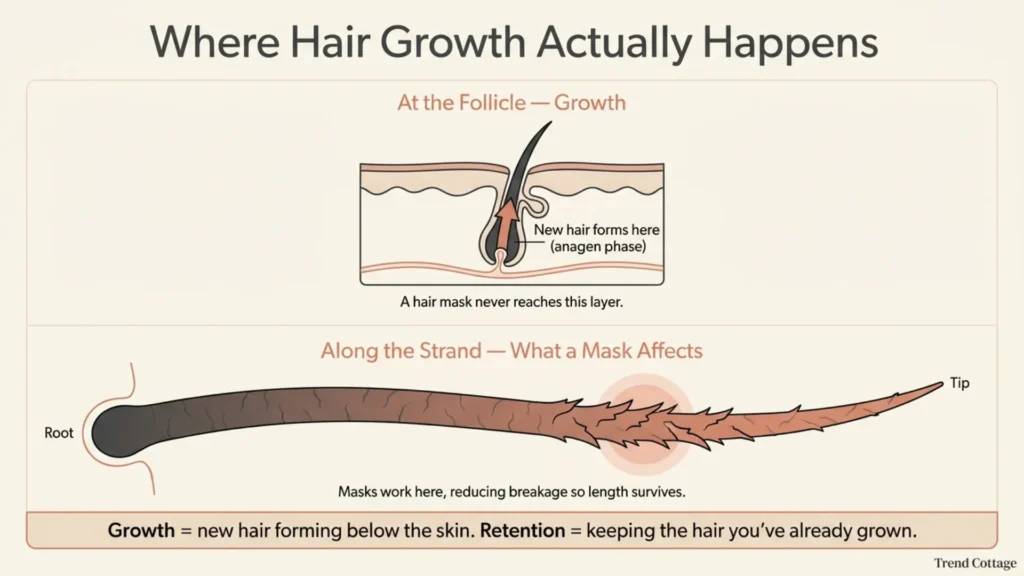
Every hair on your head grows from a follicle sitting under your scalp, where follicle cells rapidly divide and differentiate to produce the visible strand you eventually see and touch. That process runs on its own timeline and has nothing to do with what you apply to the strand once it’s out and visible. A mask sits on hair that has already left the follicle. In a sense, it’s finished growing at the point you can touch it.
So where does “growth” actually come from, if a mask can’t reach the follicle? From what doesn’t fall off. Hair grows around half an inch a month for most people, and that pace barely shifts no matter what you apply externally. What does change, constantly, is how much of that new length survives long enough to stay attached. Dry, brittle ends snap. Overworked strands split. Every inch that breaks off is an inch you grew and then lost, and that’s the gap a hair mask for growth is actually built to close.
Who Actually Benefits from a Hair Mask for Growth
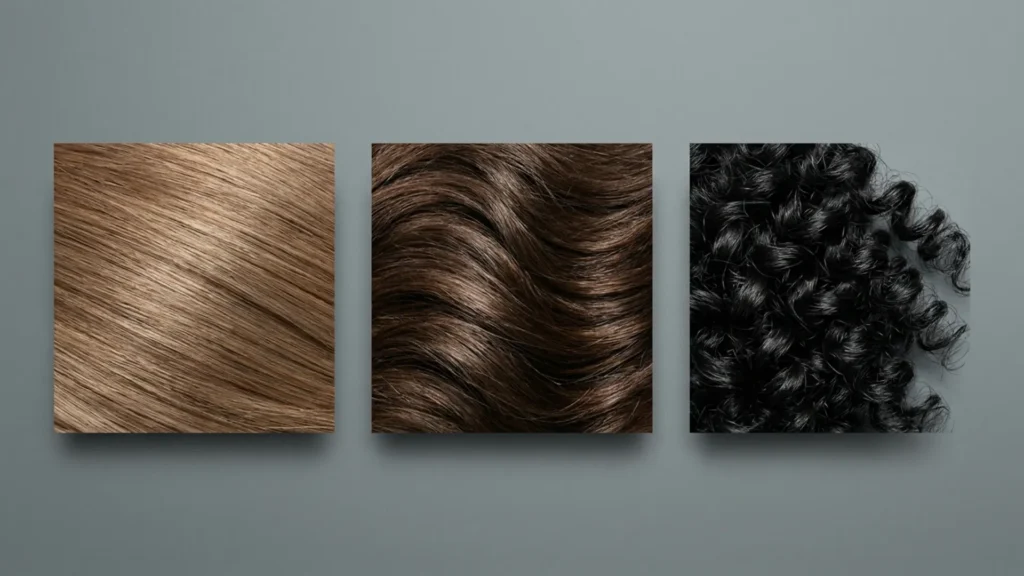
Not everyone needs the same fix here, which is part of why mask reviews online so often contradict each other. Someone with fine, low-porosity hair usually just needs lighter, more frequent moisture. A heavy mask will sit on top of the strand and leave it limp by midday. Someone with coarse, high-porosity, or chemically treated hair typically needs protein and richer oils to patch up a cuticle that’s lifted and rough.
If your hair is color-treated, relaxed, or regularly heat-styled, breakage is probably your biggest obstacle, and a protein-forward mask used every week or two will do more for retained length than any growth serum on the shelf. If your hair is naturally fine or rarely processed, the mask’s job is mostly softness and manageability rather than repair. That still matters; it just shows up differently.
Basic care habits sit alongside any mask, not instead of it. Gentler brushing and lower heat styling cut down on breakage no matter which product you use, and skipping that step undercuts whatever the mask is trying to do. There’s also a scalp side to this that’s easy to overlook. A tight, flaky, or oily scalp can slow new growth from showing at all, even when the follicle itself is healthy, and a mask applied only to the lengths won’t touch that.
Also Visit : Hair Growth Tips That Actually Change Your Rate
What to Look for on the Ingredient List
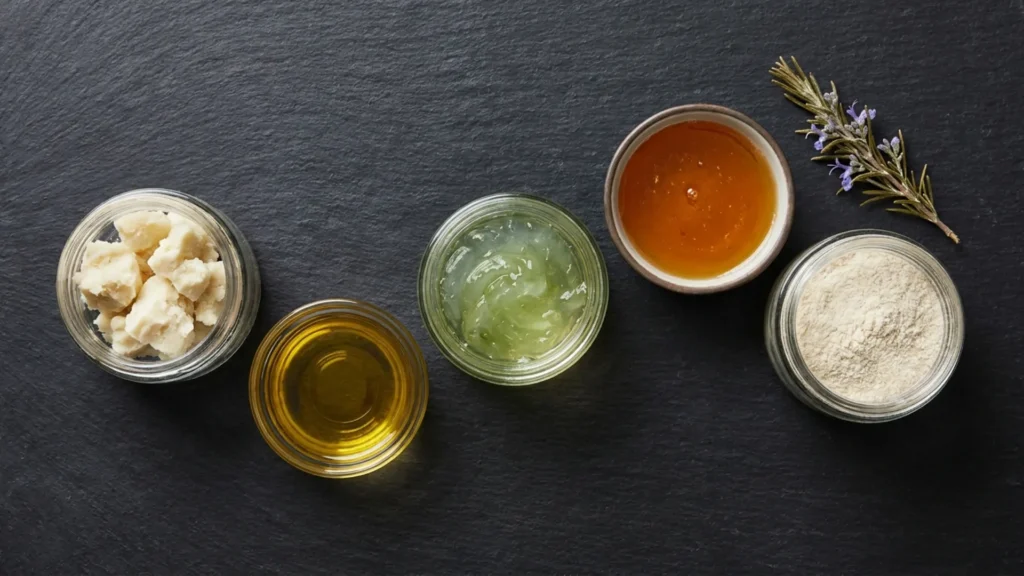
Skip the front-of-bottle claims and read the ingredient list instead. Four categories show up again and again in masks that genuinely help retained length, and each one solves a different problem.
| Ingredient type | What it actually does | Best for |
|---|---|---|
| Proteins (hydrolyzed keratin, silk amino acids, wheat protein) | Temporarily fill gaps in a damaged cuticle so the strand feels smoother and resists snapping | Chemically treated, heat-damaged, or over-brushed hair |
| Humectants (glycerin, aloe vera, honey, panthenol) | Pull moisture into the hair shaft from the air and the product itself | Dry, coarse, or high-porosity hair that feels rough |
| Fatty acids and oils (argan, jojoba, sweet almond) | Coat the cuticle and cut down friction between strands, a common cause of mechanical breakage | Frizz-prone hair or dry, flyaway ends |
| Butters and heavier oils (shea butter, castor oil, mango butter) | Seal in moisture longer and add slip for detangling | Very dry, thick, or textured hair; usually too heavy for fine hair |
Match the category to what your hair is actually doing, not to whichever bottle says growth in bold letters on the front. A protein mask on hair that’s already protein-heavy from over-treatment will make it feel stiffer, not stronger. A rich, butter-based mask on fine hair usually just weighs it down and looks greasy by the next day.
Marketing Claims Worth Reading Twice
Biotin shows up on more growth-mask labels than almost any other ingredient, and it’s worth knowing what the evidence says. Biotin deficiency is rare in the general population, and most people already get enough from food, which means adding more, especially in a product that rinses off your hair in minutes, isn’t likely to change much for someone who wasn’t deficient to begin with.
Caffeine and rosemary oil get similar treatment on labels. Early research on both mostly involves leave-on scalp treatments applied daily over several months, not a mask you rinse out after ten minutes once a week. The mechanism might be real. The delivery method in a typical mask usually isn’t strong enough to matter much.
None of this makes the mask useless. It just means the growth language on the label is doing more work than the formula behind it. Judge the product by what it does for breakage and shaft condition, and treat any growth-rate claim with real skepticism.
Also Visit : How to Use Hair Growth Oil the Right Way
How Often and How to Use a Hair Mask for Growth

Once you’ve matched a mask to your hair, timing and technique decide whether it earns its keep. Skip the numbered-steps approach and think of it as a stretch of weeks instead.
In week one, apply the mask to damp, freshly washed hair, focusing on the mid-lengths and ends rather than the scalp, since that’s where the oldest, most damaged hair lives. Leave it on for the time the product recommends, usually ten to twenty minutes, then rinse with cool water to help the cuticle lie flat against the strand.
By week four, you should notice less hair collecting in your brush and fewer split ends catching on your fingers when you run them down a section. That’s the breakage slowing down, not the follicle speeding up, but it’s the clearest sign the mask is doing its job.
By week eight to twelve, the length that was already growing has had time to survive instead of snapping off, so a ponytail or braid may look and feel noticeably longer even though the growth rate underneath hasn’t changed at all. If nothing’s different by then, the mask probably isn’t matched to what your hair needs. Go back to the ingredient categories above and reconsider the fit.
When to See a Professional Instead
A mask helps with breakage, not with a follicle that’s stopped producing hair on schedule. If you notice sudden shedding, a widening part, round bald patches, or scalp pain and itching, that’s outside what any topical product, mask or otherwise, can fix.
The NHS recommends seeing a GP about sudden or patchy hair loss before trying more products, since an underlying cause needs ruling out first. This isn’t meant to alarm you. Most hair loss isn’t serious, but it’s a different problem than the one a mask solves, and no amount of patience with your routine will fix it on its own.
Also Visit : Does Hair Growth Serum Really Work, or Is It Marketing?
Key Takeaways
- A hair mask can’t make your follicles produce hair faster; that happens under the scalp, out of a mask’s reach.
- What a good hair mask for growth actually does is cut breakage, so the length you’re already growing survives instead of snapping off.
- Match ingredients to your hair’s real problem: protein for damage, humectants for dryness, oils and butters to seal it in.
- Growth claims like biotin and caffeine rarely hold up in a rinse-out product at typical concentrations.
- Sudden or patchy hair loss needs a dermatologist’s opinion, not a stronger mask.
Frequently Asked Questions
Do hair masks really help hair grow faster?
Not directly. They work on the visible strand, not the follicle, so a hair mask for growth doesn’t speed up how fast new hair forms. What it can do is reduce breakage, which is often why length seems to plateau even when new hair keeps coming in underneath.
How often should I use a hair mask for growth?
Once a week is a reasonable starting point for most hair types. Very dry or damaged hair can often handle it twice a week, while fine or low-porosity hair usually does better with a lighter mask every ten to fourteen days so it doesn’t build up.
What ingredients should I avoid in a hair mask for growth?
There’s nothing to avoid across the board; it depends on your hair. Heavy silicones and butters can weigh down fine hair, and too much protein on hair that isn’t actually damaged can leave it feeling stiff and brittle rather than stronger.
Is coconut oil or castor oil better for growth?
Neither reaches the follicle, so neither grows hair in the literal sense. Coconut oil is better at reducing protein loss during washing for some hair types, while castor oil is thicker and mainly useful for sealing moisture into very dry ends.
Can a hair mask fix damaged, splitting ends?
It can smooth them temporarily and slow further splitting, but a split end is already separated hair fiber and no product reattaches it. Trimming is the only real fix; the mask’s job is preventing the next one from happening.
This article is for general information only and isn’t medical advice. For persistent hair loss, scalp pain, or sudden shedding, see a dermatologist or trichologist.
Written by Anna Anderson for Trend Cottage.