Black Hair Growth: Why Retention Is the Real Work

Black hair grows. Not slowly, not reluctantly — it grows consistently, governed by the same biological timeline as every other hair type. What doesn’t always accumulate is length. That’s a different problem, and the difference matters.
If the follicle isn’t producing, the conversation is about nutrition, hormones, and scalp health. If growth is happening but length isn’t building, the conversation is about retention — the rate at which grown hair stays on the strand rather than breaking off before it has a chance to accumulate. Most people dealing with slow-looking black hair growth are in that second category.
Quick answer: Black hair growth follows the same basic biology as all hair. Tightly coiled strands — particularly Type 4 patterns — are more structurally vulnerable to breakage at their curl bends, which means more grown inches are lost before they can show. Building visible length is almost always a retention problem, not a production one.
The Myth That Slows Everyone Down
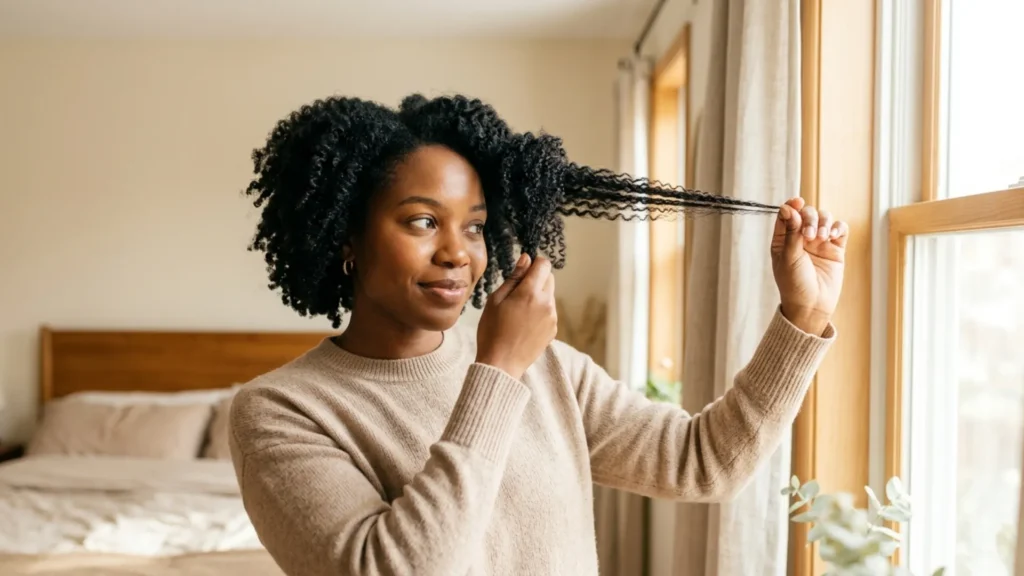
Most explanations for why Black hair “doesn’t grow” share a common flaw: they start from the wrong premise. The follicle is growing. In most people with natural Black hair, it’s producing several inches a year. The problem isn’t production — it’s what happens to those inches after they emerge from the scalp.
Part of what sustains the myth is shrinkage. Type 4 coily hair can shrink to anywhere from 25 to 50 percent of its actual stretched length when dry. Someone who has grown four inches may see only one or two when the hair is in its natural unstreched state, which makes progress genuinely hard to track without measuring. Growth is happening; it’s hidden inside the curl.
The other part is breakage. When strands break regularly at the mid-shaft or at the ends, length doesn’t accumulate — it cycles. New growth arrives at the scalp while older growth breaks off at the tips at roughly the same rate, leaving the visible length looking unchanged even though the follicle is doing its job.
Black hair growth, understood this way, isn’t a mystery at the follicle level. It’s a question of what’s happening to the strand between the scalp and the ends — and why those ends aren’t staying on long enough to build real length.
Also Visit : Hair Growth Challenge: How to Build One That Works
Why the Coil Structure Changes Everything
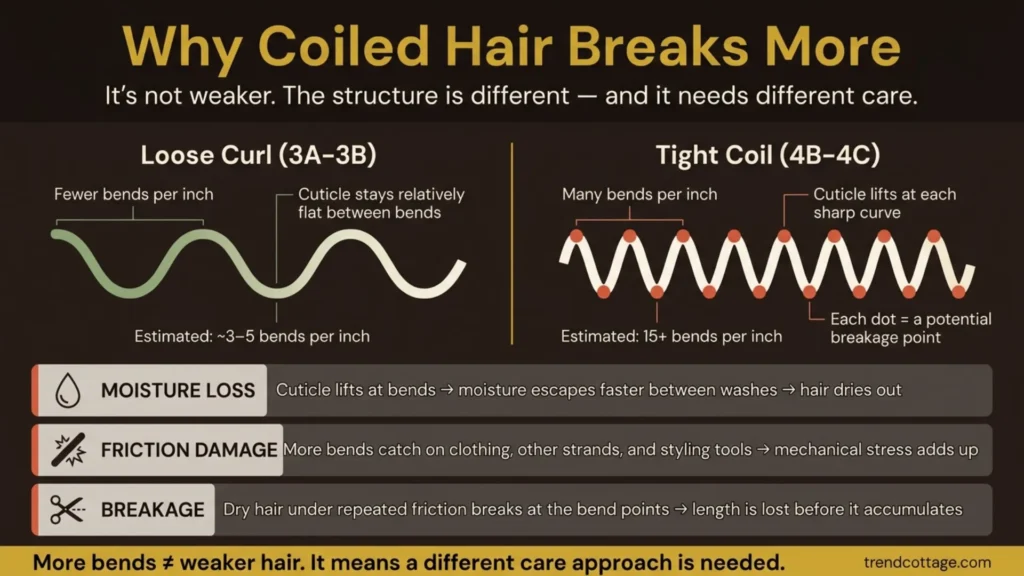
A Type 4C strand bends tightly and repeatedly per inch — in some samples, researchers estimate 15 or more direction changes per inch, though the exact figure varies by individual. Each of those bends is a point where the strand changes direction sharply, and at each point the cuticle — the protective outer layer of the strand — sits at a steeper angle than it would on a straighter section. The cuticle doesn’t lie flat at a sharp curve. It’s more exposed there.
That exposure has two practical consequences. First, moisture escapes more easily from the strand at each bend, because the cuticle isn’t sealing as tightly as it does on a straight or gently curved section. Coily hair dries out faster than any other hair pattern for this reason — not because of some fundamental fragility, but because geometry means there are simply more points where moisture can leave. Second, friction from clothing, pillowcases, and styling catches at those bend points more readily, creating mechanical stress concentrated exactly where the strand is already most vulnerable.
Dry hair under repeated friction at a high-stress point breaks. That’s the mechanism. It has nothing to do with Black hair being inherently weak — it’s a structural reality that requires a care approach built around reducing dryness and friction at those specific points. The coil is the characteristic that defines the hair type. It’s also the reason retention demands more deliberate attention than it does for a straighter pattern.
Breakage vs. Shedding — Knowing Which You’re Dealing With
Before working on retention, it’s worth being clear about which kind of hair loss you’re actually dealing with. Breakage and shedding look similar at first — hair on the towel, hair in the brush — but they have different causes and respond to different approaches.
| Breakage | Shedding | |
|---|---|---|
| What it looks like | Short pieces in varying lengths, no root bulb at the end | Full-length strands with a small white or translucent bulb at the root end |
| Main causes | Dryness, over-manipulation, friction, heat, tight styles | Normal hair cycle completion, hormonal shifts, nutritional gaps, chronic stress |
| What it signals | Retention habits need work — moisture, gentler handling, or less tension | Usually normal; heavier-than-usual loss may signal a health factor worth investigating |
| What helps | Consistent moisture, reduced manipulation, gentler styling approach | Often resolves on its own; persistent heavy shedding is worth discussing with a GP |
The most reliable way to tell them apart is to look at what you’re finding. Shedding produces full strands with a root bulb — the hair completing its natural cycle. Breakage produces pieces: shorter, varied in length, no bulb at the end. If most of what you’re collecting is pieces, retention is the focus. If most of it is full strands, something in the hair cycle or overall health is worth looking at.
Moisture Is the Foundation, Not a Bonus
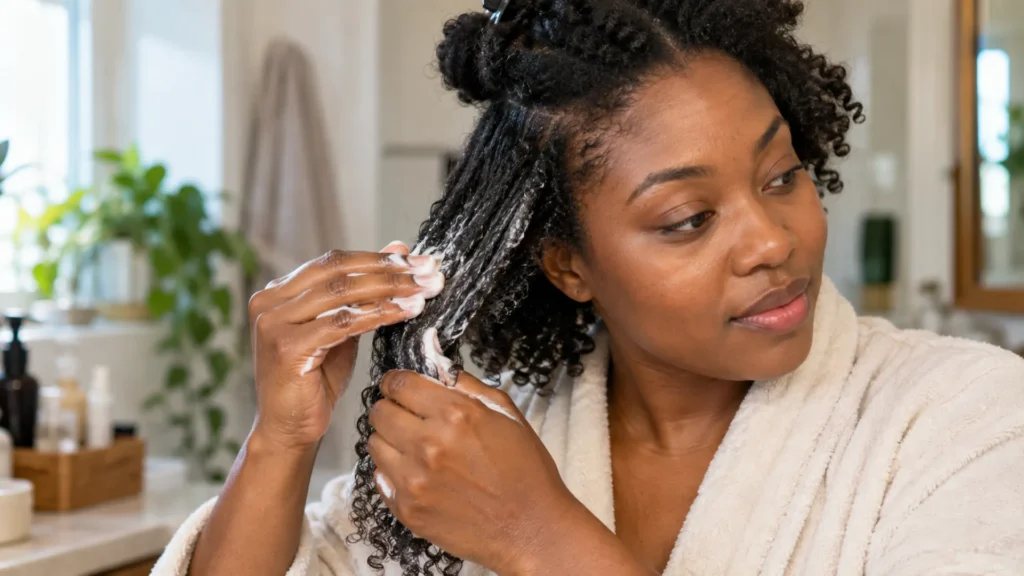
Every retention habit in a black hair growth routine depends on moisture. The coil structure means the hair loses it faster than other patterns, and a consistent moisturising approach is what gives every other habit something to build on. Without it, protective styles sit over dry hair, gentle detangling still breaks dry strands, and nothing compounds.
The wash is the starting point. Using a moisturising or hydrating shampoo — or co-washing with conditioner — starts the routine with hydrated strands rather than stripped ones. Following with a rinse-out conditioner while the hair is still wet, and then a leave-in while it’s still damp, matters because the product is working with moisture that’s already in the strand. Applying to dry hair adds product to the surface but doesn’t trap the moisture needed inside the cuticle.
Layering products in a specific order is one way to address the bend-point problem directly. A water-based leave-in provides the moisture; an oil layer applied after sits on the cuticle surface and slows evaporation; a cream or butter over both seals the oil layer in. This is the principle behind the LOC method (leave-in, oil, cream) or its variation LCO (leave-in, cream, oil). Neither is universally better — it depends on how your hair responds — but both are built around the same logic: add the moisture, then slow its escape. [EXTERNAL SOURCE NEEDED: specific study or dermatologist-authored guideline on oil occlusion and moisture retention in textured or Type 4 hair]
Protein and moisture also need to stay in balance. Too much protein leaves strands stiff and brittle; too little makes them limp and weak under tension. Neither retains well. If your hair feels gummy when wet and snaps easily when dry, it’s likely asking for protein. If it feels rough and dry regardless of how much moisture you apply, water content is the gap — not product quantity.
Also Visit : Hair Growth for Black Women: What Actually Works
What Protective Styling Actually Does (and What It Doesn’t)
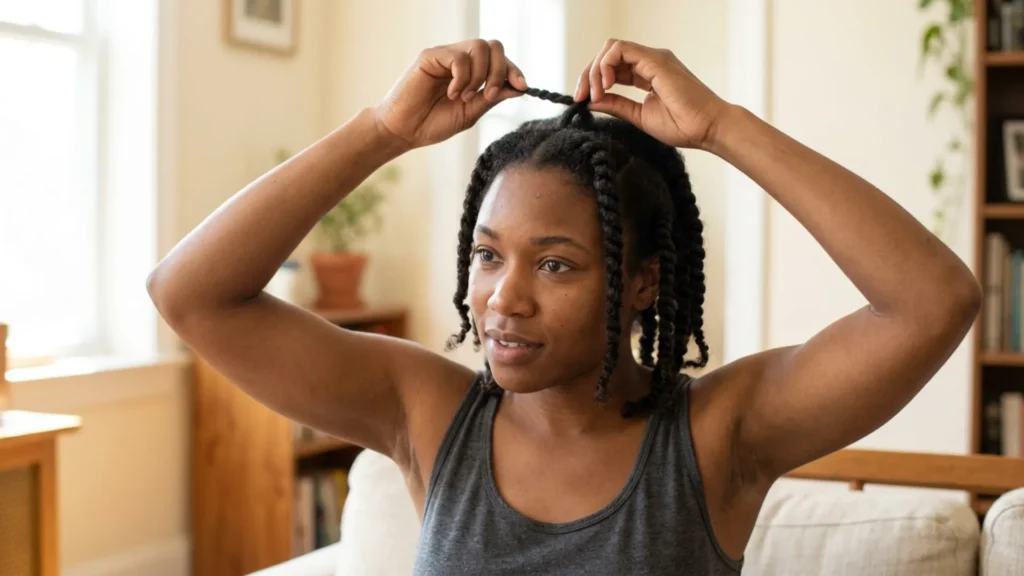
Protective styling reduces the manipulation and friction the ends of the hair experience over time. The ends are the oldest part of the strand — they’ve been through more wash cycles, more styling, more friction against clothing and pillowcases — which makes them the most vulnerable section and the most common site of breakage. Tucking ends away in a braid, twist, or another low-manipulation style reduces the mechanical stress those ends would otherwise face over days or weeks. That reduction in daily stress is where retention improves.
But the term covers a wide range of styles, and not all of them actually protect. The two variables that determine whether a style helps or harms are tension and maintenance.
Tension is where many protective styles cause damage instead of preventing it. A style braided tightly at the edges, installed with excess weight from extensions, or sewn under significant tension creates traction on the follicle rather than protecting the strand. Wearing tight styles repeatedly over a long period can lead to traction alopecia — [EXTERNAL SOURCE NEEDED: AAD or Cleveland Clinic page specifically on traction alopecia from tight braided or installed styles] — which in early stages is reversible, but becomes permanent if tension continues long enough. A style should feel comfortable to sleep in. If it’s painful in the hours after installation, it’s too tight.
Maintenance is the other common failure point. A style worn for six or eight weeks without any moisture added to the hair underneath is storing dry, brittle strands in a contained space where they’ll eventually break — the opposite of protection. A light spritz of water or a water-based product worked gently through the style periodically extends both the life of the style and the health of the hair underneath it. Most styles are best worn for two to four weeks before being taken down, with the hair properly moisturised before re-styling.
Taking down the style carefully matters too. Rushing through removal or detangling dry causes the same breakage the style was supposed to prevent. Removing each section slowly, with a detangling product and a wide-tooth comb, preserves what the weeks of wearing the style protected.
Scalp Health and Black Hair Growth
Growth starts at the follicle, and the follicle lives in the scalp. Most black hair growth conversations move straight to the strand — moisturisers, protective styles, breakage — and skip the scalp entirely, which is where everything actually begins.
Product buildup is a particular concern for natural hair routines that use multiple layered products. Heavy butters, thick gels, and dense leave-ins accumulate at the scalp and around the roots over time if the scalp isn’t cleansed with something strong enough to clear them. A congested follicle environment isn’t ideal for growth. A clarifying wash every two to four weeks — depending on how many products you use and how often you wash — clears that buildup without disrupting the rest of the routine when followed by a deep conditioner.
Scalp massage for four to five minutes daily improves blood flow to the follicle area. It takes nothing except time and has a reasonable amount of evidence behind it for contributing to strand health over several months of consistent practice.
One condition worth knowing specifically: central centrifugal cicatricial alopecia, or CCCA, is a form of scarring alopecia that disproportionately affects Black women. It typically starts at the crown and spreads outward over time, with the scalp in the affected area sometimes looking shiny or feeling tender. This isn’t a retention problem — it won’t respond to a better moisturising routine or a gentler protective style. It needs a dermatologist, and catching it early produces meaningfully better outcomes than leaving it unaddressed.
On the nutritional side, the NIH Office of Dietary Supplements notes that iron deficiency can contribute to increased hair shedding. If retention struggles are accompanied by heavier-than-usual loss — particularly in people who menstruate — having iron levels checked through a blood panel is more useful than guessing at supplements.
Also Visit : The Hair Growth Secrets Behind a Healthier Scalp
A Retention-First Approach to Black Hair Growth

Pull all of this together and a clear order of priority emerges. The follicle is doing its job. What follows is about protecting what it produces.
Moisture comes first, every time. No other retention habit performs reliably on chronically dry hair. A consistent wash routine with a proper leave-in and a sealing step is the baseline — get those stable before adding anything else on top.
After that, the way you handle the hair matters. How you detangle — whether wet or dry, which direction you work, which tool you reach for — determines how much breakage happens at the manipulation stage. Wet detangling with a slippery conditioner and a wide-tooth comb, working from the ends upward before tackling the roots, produces far less breakage than detangling dry hair or rushing through it.
Protective styling is the third layer, not the first. It’s a useful tool when the hair underneath it is moisturised and the installation isn’t pulling. It doesn’t substitute for the first two steps — and it can make things worse if used as a shortcut around them.
Throughout all of this, the scalp needs its own attention: cleansing regularly, massaging, and noticing when something looks or feels different from the usual.
Black hair growth, understood this way, isn’t about finding the right product. It’s about maintaining the conditions that let grown hair stay on the strand long enough to become visible length. The follicle handles its part. The rest is retention.
Frequently Asked Questions
Does Black hair actually grow slower than other hair types?
Research on hair growth rates across different hair types shows some variation, but the differences in growth rate are modest compared to the variation in retention. The more practical answer is that Type 4 hair — particularly 4B and 4C — experiences more breakage per inch due to coil structure, which makes it look like growth isn’t happening when growth is occurring and being lost. Addressing retention produces far more visible change than anything aimed at accelerating growth from the follicle.
How can I tell if I’m dealing with breakage or shedding?
Look at what you’re finding. Shedding produces full-length strands with a small white bulb at the root end — the hair completing its natural growth cycle. Breakage produces shorter pieces in varying lengths without any bulb. Most people dealing with slow-looking black hair growth are dealing primarily with breakage. If the majority of what you’re finding is full strands with bulbs, that’s shedding, and the causes are different.
How often should natural Black hair be washed?
Every one to two weeks is a common range for Type 4 hair, but this depends on scalp activity and how many products you use. Washing too infrequently allows product buildup and scalp congestion to develop; washing too often can strip moisture faster than a routine can replace it. A clarifying wash every few weeks, followed by a deep conditioning session, tends to be more effective than frequent light washes that don’t fully clear buildup.
Can you retain length on natural Black hair without protective styles?
Yes. Protective styling is one retention tool, not a requirement. People with strong moisture routines, gentle handling habits, and low-manipulation styling grow significant length without formalised protective styles. The goal is reducing friction and breakage at the ends — protective styling is one way to get there, not the only way.
What if my hair doesn’t seem to grow no matter what I try?
Start by measuring. Shrinkage means visible length can look unchanged even when growth is occurring — without a baseline and consistent measurements, it’s hard to know whether anything is actually stalling. If measuring confirms minimal change over three or more months of consistent care, it’s worth looking at health factors: iron levels, thyroid function, and chronic stress are common culprits that a retention routine alone won’t address. A GP or dermatologist is more useful at that point than another product switch.
If this reframes how you’re thinking about your hair, save it for reference — the underlying logic doesn’t change even as products and routines evolve. Questions about your specific hair type or what’s been blocking your progress are welcome in the comments.
This article is for general information only and isn’t medical advice. For persistent hair loss, thinning at the crown, scalp pain, or sudden changes in shedding, see a dermatologist or trichologist.
Key Takeaways
- The widespread belief that Black hair grows slowly is mostly wrong — the follicle is producing, but the coil structure means more of that growth breaks off before it shows as visible length.
- Tightly coiled strands have more bends per inch than looser patterns; each bend is a point where the cuticle is more exposed and moisture escapes faster.
- Retention — keeping grown hair on the strand — is where most visible length is won or lost in black hair growth.
- Moisture retention is harder in Type 4 patterns; a consistent moisturising routine is the foundation everything else builds on.
- Protective styling only helps when the style is worn loosely, maintained with moisture, and taken down before the hair dries out underneath.
Written by Anna Anderson for Trend Cottage.