
Simple Hair Care Routine That Actually Fits Your Week

Most routines fall apart for one boring reason: they’re built for a week nobody actually has. Five products, a weekly mask, a night-time serum. It all looks great on the shelf, then Wednesday hits and you’re back to a rushed shampoo and nothing else.
Quick answer: A simple hair care routine has three steps. Shampoo your scalp, condition your lengths and ends, then dry and detangle gently. Wash as often as your scalp gets oily, not on a fixed schedule, and add an extra step only when a specific problem shows up.
The rest of this guide covers that bare base first. Then it shows which add-ons are worth having, which habits you can drop, and what a few example weeks look like.
What a Simple Hair Care Routine Actually Includes
Strip a minimal hair care routine back and it does three jobs. It cleans your scalp, softens your lengths, and keeps hair from snapping while it’s wet. Everything else is optional.
Shampoo goes on the scalp, and mostly only there. Use your fingertips, not your nails, and let the suds rinse down through the rest of your hair on their own. Oil, sweat and leftover product all collect on the scalp. The lengths are older and drier, so they don’t need scrubbing. If your hair is long or thick, wash it in sections so it tangles less.
Fine or straight hair usually needs conditioner only on the ends. Dry, curly or thick hair often needs it all the way up, and dermatologist advice on caring for curly hair says to condition all of it, not just the ends. Follow the time on the bottle, then rinse.
Drying is the step people rush. Hair is more fragile when it’s wet, so squeeze the water out with a soft towel or an old cotton t-shirt instead of rubbing. Then detangle with a wide-tooth comb, starting at the ends and working up. Thick or curly hair usually combs more easily in the shower with conditioner still in.
That’s the base. If your hair feels good after those three jobs, you don’t need a fourth.
Also Visit : How to Pick Hair Care Routine Products What You Actually Need
Picking Products Without Overthinking It
Two bottles get you started on a simple hair care routine: a shampoo and a conditioner. Dermatologists suggest picking ones that say they’re made for your hair type, such as fine, coarse, curly or straight.
Labels like “for curly hair” or “for fine hair” are a fair starting point. You don’t need to decode the numbers and letters some charts use for hair types. If you can tell whether your hair is fine or thick, straight or curly, dry or oily, you know enough.
Then give the pair a few washes before you judge them. Swap one at a time if you’re unhappy, because changing both at once hides which bottle is the problem.
How Often to Wash Your Hair Depends on Your Scalp
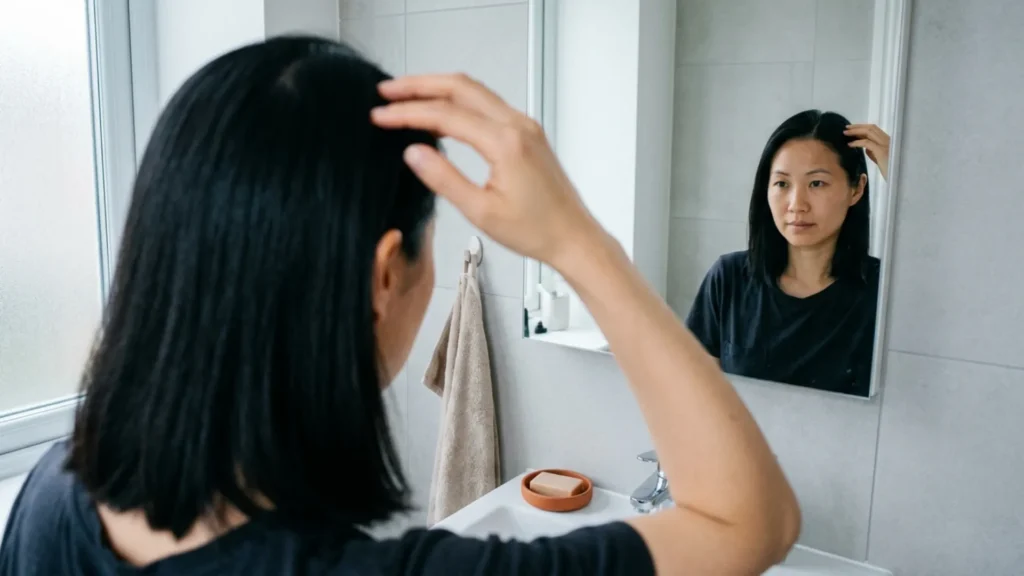
There’s no magic number. A simple hair care routine follows how fast your scalp gets oily, and that changes with hair type, age and how much product you use.
The dermatologists’ healthy hair washing tips give a useful range. A straight, oily scalp can handle a shampoo every day. Dry, textured, curly or thick hair can wait much longer, and the advice is to wash when needed, at least once every two to three weeks.
You’ll probably sit somewhere in between, so test it. Look at your roots the morning after a wash. If they look greasy or flat, wash again. If they still look fine, stretch the gap by a day and look again.
A few things move the schedule. Chemically treated hair can be drier, so it often does better with fewer washes. Scalps also make less oil as you get older, so the gaps can grow. And if you see flakes, you might be washing too seldom, or using a conditioner that doesn’t suit your hair type.
Add One Step Only When You Need It
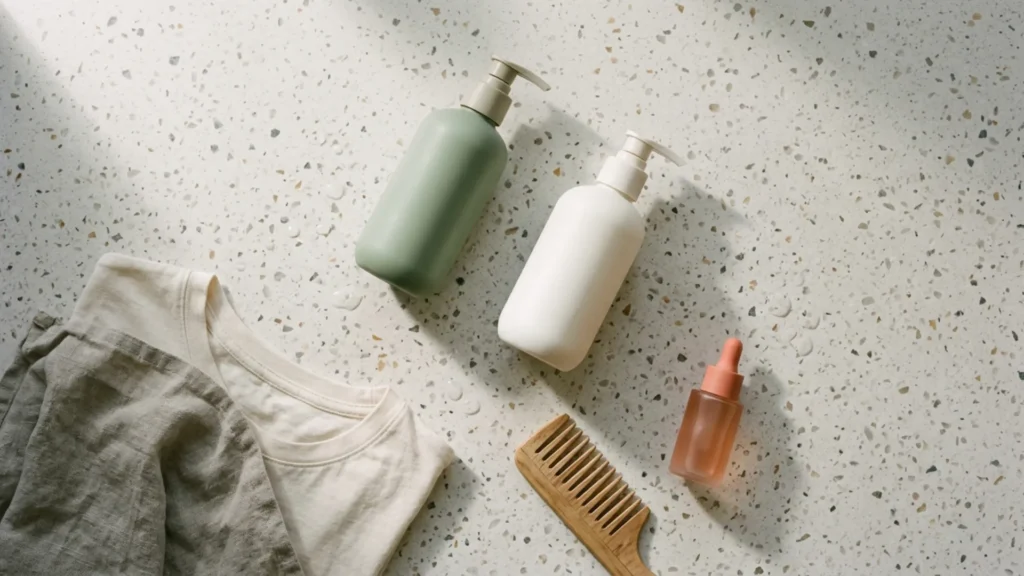
This is the rule that keeps a simple hair care routine simple. When a specific problem shows up, you add one step. You give it a few washes. If nothing changes, you drop it. No problem, no extra product.
| Problem | Likely reason | Smallest fix |
|---|---|---|
| Dry, rough ends or frizz | Hair needs more moisture for its texture | Leave-in conditioner or a little oil on damp ends |
| Tangles that break when combed | Too little conditioner for the comb to glide | Comb with conditioner in, using a wide-tooth comb |
| Greasy roots by day two | Scalp makes oil faster than your schedule allows | Wash a day sooner |
| Flat, coated, dull hair | Styling products building up | Clarifying shampoo before your usual one, now and then |
| Flakes or an itchy scalp | Washing too seldom, an unsuitable conditioner or oil, or dandruff | Adjust the schedule first, then try an anti-dandruff shampoo |
Dry ends and frizz
Before you buy anything, try changing where and when you use what you already own. If hair is very dry or hard to detangle, dermatologists say you can also put conditioner on before you shampoo. Still dry? Add a leave-in conditioner or a little oil to damp ends, and start with less than you think you need.
Build-up and dull hair
Gels, creams, oils and pomades can leave a film that makes hair look flat. If that’s you, dermatologists suggest a clarifying shampoo before your regular one. Use it occasionally, not every wash. If you barely use styling products, skip this step altogether.
A flaky or itchy scalp
Dandruff isn’t a sign you’re unclean. NHS advice on treating dandruff calls it common, harmless and not contagious, and says poor hygiene doesn’t cause it. The usual first move is an anti-dandruff shampoo with an ingredient like ketoconazole or selenium sulfide. Use it for a month before judging it, and keep it on your scalp rather than your lengths.
See a doctor if your scalp is red, swollen or very itchy, if you get flaky patches on your face or body, or if nothing improves after a month of treatment. Those aren’t jobs for a new product.
Also Visit : A Hair Care Routine for Dry Frizzy Hair That Actually Works
A Week Built Around Your Real Schedule
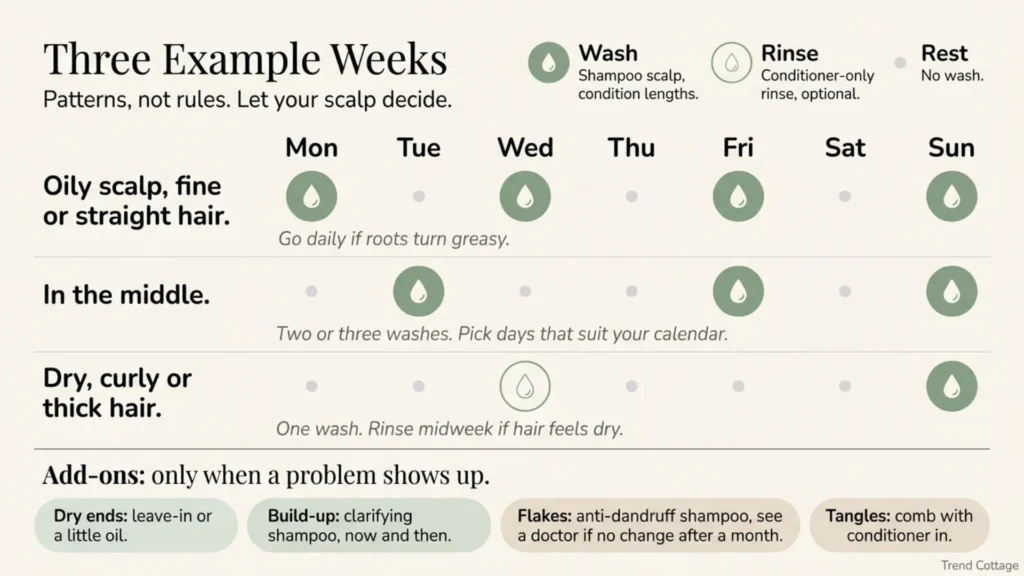
Here’s how a simple hair care routine stretches or shrinks across a week. Treat these as example patterns, not rules. Your scalp gets the final say.
With an oily scalp and fine, straight or wavy hair, you might shampoo every other day, or daily if things go greasy by afternoon. Condition the ends each time. Off days need nothing.
If you sit in the middle, two or three washes a week is a sensible place to start. Pick days that suit your calendar, like a weekday evening and a weekend morning. Add a fix from the table only if a problem appears.
Dry, curly or thick hair can go longer between washes. One wash a week is a reasonable starting point, with a conditioner-only rinse midweek if your hair feels dry. That sits well inside the two-to-three-week limit dermatologists give for this hair type, so you have room to move in either direction.
Notice what’s missing: no night routine, no weekly treatment day, no shower shelf full of bottles. When a week goes sideways, shrink the routine to shampoo and conditioner and leave the rest. That still counts.
Habits You Can Drop
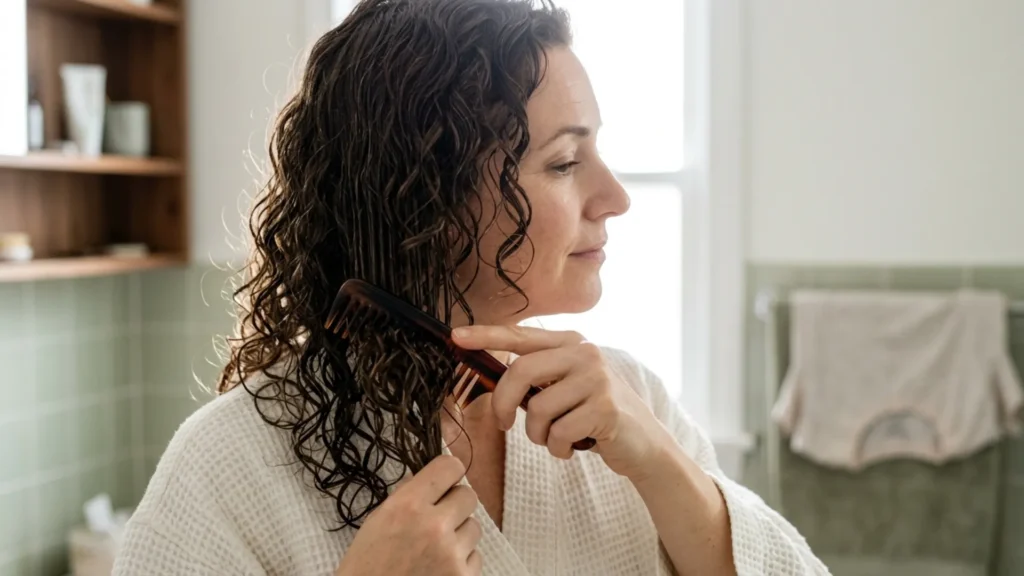
Cutting steps is half the job. If you’re starting from a crowded shelf, these are the first habits to question:
- Shampooing the whole length of your hair every wash. The suds running down are enough.
- Brushing wet hair from the roots down. A wide-tooth comb, ends first, does less harm.
- Rubbing your hair with a towel. Squeeze and pat instead.
- Owning two conditioners that do the same job. One rinse-out conditioner is plenty, plus a leave-in if you have a reason for it.
- Buying for problems you don’t have. If the table above doesn’t describe you, skip the add-on.
A simple hair care routine makes it easier to spot what’s working. If your hair changes after you add one thing, you know what caused it. With five new products at once, you’d be guessing.
Also Visit : Hair Care Routine for Coloured Hair: Keep Colour Longer
Key Takeaways
- A simple hair care routine has three jobs: shampoo the scalp, condition the lengths (all the way up if your hair is dry or curly), and dry and detangle gently.
- Your scalp sets the wash schedule. A straight, oily scalp can take a daily wash, while dry, curly or thick hair can stretch to two or three weeks between washes.
- Add an extra step only for a named problem, give it a few washes, and drop it if nothing changes.
- Flakes that last through a month of anti-dandruff shampoo, or a red, swollen or very itchy scalp, are a reason to see a doctor.
Common Questions About Building a Routine
What order should hair care products go in?
Cleanse first, condition second, leave-in last. If you use a clarifying shampoo, it goes before your regular one. Anti-dandruff shampoo goes on the scalp only, and you should follow the timing on the label. Leave-in conditioner or oil goes on damp ends after you towel-dry.
Does a simple hair care routine still work if I swim?
Yes, with two additions. Wet your hair and work conditioner through it before you get in the water, and wear a snug swim cap if you swim often. Afterward, wash with a shampoo made for swimmers and use a deeper conditioner to replace lost moisture.
How can I tell if my routine is working?
Check three things. Your comb should glide through without snagging, your ends shouldn’t feel like straw, and your roots should stay fresh until your next planned wash. If one of them fails, find that problem in the table above and change only that step.
Which step would you drop first? Tell us in the comments, and save this simple hair care routine for the next time your shelf gets crowded.
This article is for general information only and isn’t medical advice. For persistent hair loss, scalp pain, or sudden shedding, see a dermatologist or trichologist.
Written by Anna Anderson for Trend Cottage.