
Hair Care Routine for Hair Fall That Actually Works

Here’s the thing nobody wants to hear: most people treat hair fall with a shopping cart, not a routine. They add a serum here, swap a shampoo there, and wonder why the shedding continues. A hair care routine for hair fall isn’t about finding one magic product. It’s about getting the basics done in the right order and with the right timing, so you stop working against your own hair.
Quick answer: if you’re dealing with hair fall, build your routine around gentle, scalp-focused washing two to three times a week, minimal heat and tension on the hair, and a short weekly scalp-care step. Then give it eight to twelve weeks before judging results, since shedding shows up on a delay. If the loss is sudden, patchy, or comes with other symptoms, see a dermatologist alongside any routine change.
The Mistake That Keeps a Hair Fall Routine From Working
Open ten hair fall routines online and you’ll find the same pattern: a growth serum, a “strengthening” shampoo, maybe a supplement, all added at once with no order and no timeline. When shedding doesn’t stop in two weeks, the products get swapped out and the cycle starts over. The routine never gets a fair test.
Losing 50 to 100 hairs a day is normal. New hair grows in to replace it, so you don’t notice. Hair fall becomes a problem when that balance tips, and you see it clumped in the shower drain, tangled in your brush, or scattered on the pillow in a way that feels new. A routine can’t fix a hormonal or medical cause of shedding on its own. What it can do is stop the extra loss that comes from how you wash, dry, brush, and style your hair every single day, which is often a bigger piece of the problem than people expect.
That’s the shift this article makes. Instead of another product list, it’s a sequence: what to do daily, what to do on wash day, what to do weekly, and what a realistic timeline actually looks like.
What’s Actually Behind the Hair Fall You’re Seeing
Every hair on your head cycles through growth, rest, and shedding phases on its own schedule. Most of the time, roughly 90% of your hair is actively growing at any given moment. A stressor, whether that’s illness, a crash diet, childbirth, or a big emotional shock, can push a larger share of hair into the shedding phase all at once. Dermatologists call this telogen effluvium, a temporary stress-related shedding pattern, and it typically shows up two to three months after the trigger, which is part of why the cause can feel like a mystery.
Gradual, pattern-based thinning (usually at the part line or temples) is a different mechanism, tied to genetics and hormones, and it responds to medical treatment more than to a routine. A daily hair care routine mostly targets a third category: breakage and shedding made worse by habits, like tight hairstyles pulling at the follicle, rough towel drying snapping strands, or daily heat styling weakening the hair shaft over time. That’s the part you have real, immediate control over.
Also Visit : How to Build a Natural Hair Care Routine That Actually Holds
Your Daily Routine: Mornings and Nights

Mornings start with detangling, not brushing. Work from the ends upward with your fingers or a wide-tooth comb, holding the hair above where you’re combing so tension lands on your hand, not the root. If you wear your hair up during the day, choose a soft scrunchie or loose braid over a tight elastic. A ponytail pulled tight every day, in the same spot, is a slow, steady cause of thinning at the hairline that people rarely connect back to the hairstyle itself.
At night, swap a cotton pillowcase for silk or satin if you can. Cotton grips hair and creates friction while you sleep, which shows up as extra breakage over weeks and months. Never go to bed with soaking wet hair pinned up. Wet hair is at its weakest, and a tight bun overnight combines two stressors at once.
If you use heat tools, that’s a daily decision worth making consciously rather than out of habit. A heat protectant spray and the lowest setting that still does the job go a long way. Skipping heat two or three days a week, even without changing anything else, noticeably reduces how brittle the ends feel by the end of a month.
Wash-Day Routine: What Order Actually Matters

Detangle before you get in the shower, not after. Wet hair stretches and snaps more easily, so working out knots while it’s dry, gently, saves you from tugging through them mid-wash. Use lukewarm water, not hot. Hot water strips natural oils faster than your scalp can replace them, leaving hair drier and more prone to breaking.
Shampoo goes on the scalp, not the length of your hair. Massage it in with your fingertips, never your nails, and let the lather rinse down through the rest of your hair rather than scrubbing it in separately. Rubbing shampoo directly into the length of your hair is one of the most common habits dermatologists flag as damaging, and it’s an easy one to fix once you notice you’re doing it.
Conditioner works the other way: mid-lengths to ends only, kept away from the roots so it doesn’t weigh down the scalp or trap buildup. A cool final rinse helps smooth the outer layer of each strand, which makes hair look shinier and resist tangling. When you get out, skip the vigorous towel rub. Squeeze water out gently, or wrap hair in a microfiber towel or old t-shirt and let it sit for a few minutes instead. Detangle the wet hair with a wide-tooth comb, starting at the ends, never a brush.
Also Visit : Build a Hair Care Routine for Thick Hair Step by Step
A Weekly Scalp-Care Add-On (Not a Daily One)
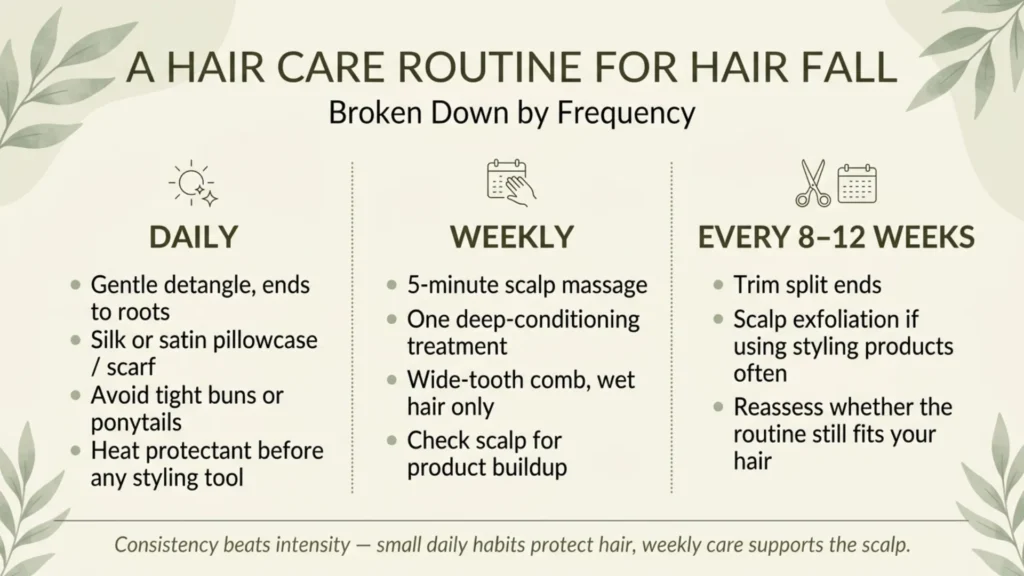
A few things belong in the routine weekly, not every day. A five-minute scalp massage with your fingertips, done while dry or during a shampoo, increases blood flow to the follicles and takes almost no extra time. One deep-conditioning treatment a week keeps mid-lengths and ends from drying out between washes, especially if you’re washing less often to protect the scalp.
It’s worth saying plainly: more isn’t better here. Daily oiling can actually work against you, since a heavy layer left on too long traps dirt and product residue at the scalp instead of nourishing it. Once a week, applied a few hours before a wash and then rinsed out properly, does more than a daily habit that never fully clears.
- Scalp massage, five minutes, once or twice a week
- One deep conditioner or hair mask on wash day
- A light scalp exfoliant if you use dry shampoo or styling products often
What to Expect: A Realistic Timeline

Hair doesn’t respond overnight, and that’s the part that trips people up. Because shedding follows the hair’s growth cycle rather than the calendar, a routine change you make today won’t show visible results for a couple of months. Judging it after ten days sets you up to quit right before it would have worked.
| Timeframe | What’s Happening | What You’ll Likely Notice |
|---|---|---|
| Week 1–2 | Habits are changing; hair itself hasn’t caught up yet | Little to no visible difference, sometimes similar shedding |
| Week 4 | Reduced breakage from gentler handling starts compounding | Slightly less hair in the brush or drain |
| Week 8–12 | New growth from the current cycle becomes visible | Shorter “baby hairs” along the part or hairline |
| Week 16+ | A full growth cycle has had time to complete | A fuller feel, especially if the underlying cause has resolved too |
Also Visit : Hair Care Routine: Build One That Actually Sticks
When Hair Fall Needs a Dermatologist, Not Just a Routine
A routine helps with the everyday, habit-driven side of hair fall. It won’t resolve shedding caused by thyroid changes, iron deficiency, medication side effects, or an underlying scalp condition. Sudden loosening of hair, patchy bald spots, or hair loss that affects your whole body are signs worth having a doctor look at, rather than something to wait out on your own.
See a dermatologist if shedding is sudden and heavy, if you notice round or patchy bald spots rather than general thinning, if your scalp is itchy, painful, or scaling, or if the hair loss comes alongside fatigue, unexplained weight change, or irregular periods. None of that is something a shampoo swap fixes, and getting it checked early tends to lead to better outcomes than waiting to see if it improves on its own.
Frequently Asked Questions
How often should you wash your hair if it’s falling out?
Two to three times a week works for most people. Washing daily can dry out the scalp and strip natural oils, while going too long between washes lets product and oil build up at the root, which isn’t friendly to shedding hair either.
Can a hair care routine actually stop hair fall, or just slow it down?
It depends on the cause. If habits like heat, tension, or rough handling are adding to the shedding, a better routine genuinely reduces it. If the underlying cause is hormonal or medical, the routine helps protect what you have while the real cause gets treated separately.
Is it normal to lose more hair in some seasons than others?
Yes. Many people notice more shedding in late summer and early autumn, which lines up with a seasonal shift in hair growth cycles. It’s usually temporary and settles on its own within a few months.
Do oiling and scalp massage really help with hair fall?
Scalp massage has a modest, real effect on circulation and is worth the five minutes it takes. Oiling can help with dryness and manageability, but used too often or left on too long, it can do more harm than good by trapping buildup at the scalp.
When should you stop trying a routine and see a doctor instead?
If shedding hasn’t eased at all after twelve weeks of a consistent routine, or if you notice patchy bald spots, scalp pain, or hair loss alongside other symptoms, that’s the point to bring in a dermatologist rather than keep adjusting products on your own.
Key Takeaways
- Hair fall routines fail most often from stacking products, not from choosing the wrong ones — order and consistency matter more than ingredients.
- Daily habits (detangling method, pillowcase, tight hairstyles) cause more breakage than most people realize.
- Wash-day order matters: scalp-focused shampoo, ends-focused conditioner, cool rinse, gentle drying.
- Weekly scalp care beats daily oiling — more frequency isn’t automatically better.
- Give any routine change eight to twelve weeks before judging it, since hair sheds on a delay.
This article is for general information only and isn’t medical advice. For persistent hair loss, scalp pain, or sudden shedding, see a dermatologist or trichologist.
Written by Anna Anderson for Trend Cottage.