Oils for Low Porosity Hair That Actually Absorb and Work
If you have tried oil after oil on your natural hair and watched every single one sit on top without absorbing, you likely have low porosity hair — and using the wrong oils is the reason nothing is working. The right oils for low porosity hair are not just “lightweight oils” picked randomly. They are specific oils chosen based on molecular size, fatty acid composition, and how they interact with a tightly closed cuticle. This guide explains exactly which oils work, which ones make things worse, and the technique that makes even the right oils absorb properly.
By the end of this article, you will understand your hair type, know precisely which oils to use and avoid, and have a complete application method that actually delivers moisture instead of buildup.
What Low Porosity Hair Actually Means — The Cuticle Science
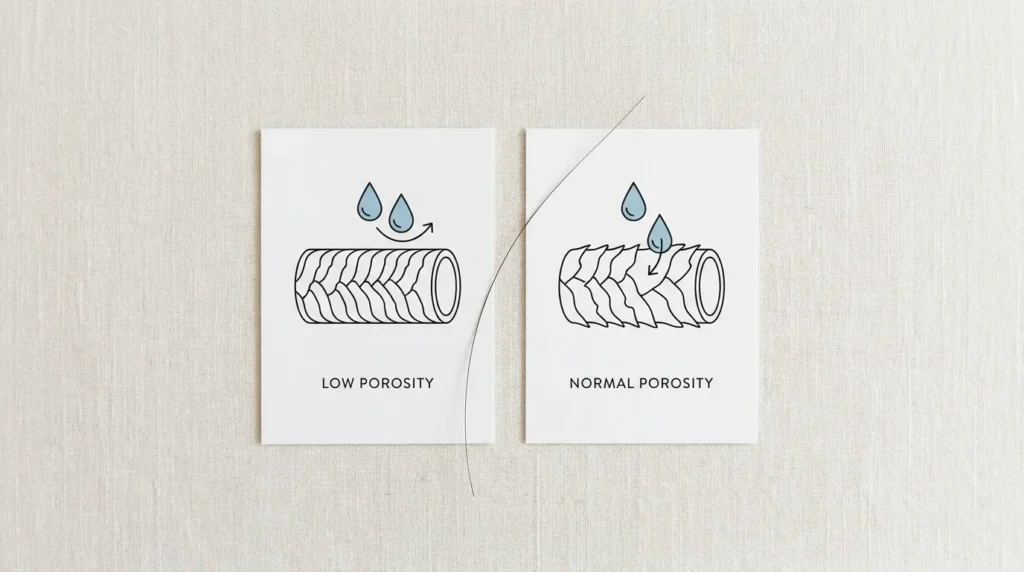
Hair porosity refers to how easily your hair absorbs and retains moisture. Every hair strand is covered in overlapping scales called the cuticle. The angle and tightness of these scales determine how easily water, oil, and other products enter the hair shaft.
Low porosity hair has cuticle scales that lie extremely flat and tightly packed together — like closed roof tiles with no gaps between them. When water or oil is applied, it sits on top of these closed scales instead of passing through into the hair’s cortex where moisture is actually needed. This is why low porosity hair takes a very long time to get fully wet, takes even longer to dry, and feels consistently dry and product-resistant despite regular oiling and conditioning.
Low porosity is primarily genetic, though it can also occur in very healthy, undamaged hair that has never been chemically processed or heat-damaged. It is not a sign of unhealthy hair — it is simply a structural characteristic that requires a specific approach to care.
The float test — identify your porosity in two minutes:
- Take a clean strand of hair (washed, with no product on it) and drop it into a glass of room-temperature water.
- Watch for two to four minutes without disturbing the water.
- If the strand floats on top: low porosity. The tightly closed cuticle prevents water from entering quickly enough to make it sink.
- If the strand slowly sinks after two to three minutes: medium porosity.
- If the strand sinks immediately: high porosity. The open cuticle absorbs water instantly.
Why Heavy Oils Fail on Low Porosity Hair — The Molecular Size Reason
Understanding why certain oils work for low porosity hair and others do not comes down to molecular size. Different oils have different sized molecules based on their fatty acid composition. Oils with large molecules — like coconut oil (lauric acid), castor oil (ricinoleic acid), and olive oil (oleic acid) — cannot fit through the tightly closed cuticle gaps of low porosity hair. They sit on the surface of the shaft, creating a thick coating that blocks rather than moisturizes.
Oils with smaller molecular structures — primarily those rich in linoleic acid (an omega-6 fatty acid) — have a better chance of penetrating the narrow gaps between low porosity cuticle scales. Grapeseed oil, rosehip oil, and hemp seed oil are all high in linoleic acid and absorb significantly better than their large-molecule counterparts.
This is also why the best oils for low porosity hair tend to feel light and absorb almost instantly on the skin — their small molecules move quickly through the cuticle gaps rather than pooling on the surface.
The Heat Method — The Most Important Technique for Low Porosity Hair
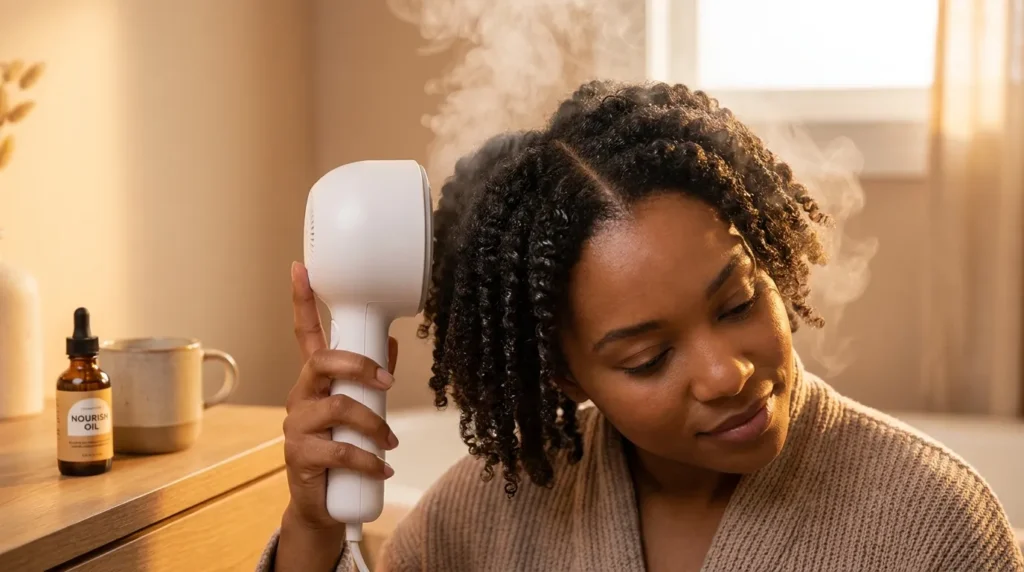
Even the best oils for low porosity hair will not absorb optimally if applied to hair with a fully closed cuticle. The single most effective technique for improving oil and moisture absorption in low porosity hair is using heat to temporarily open the cuticle before and during product application.
Heat causes the cuticle scales to lift slightly — creating the small gaps that allow oils, water, and conditioning agents to enter the hair shaft. This is not damaging when done correctly without direct high heat — the goal is gentle warmth, not heat styling temperature.
Three ways to use heat for low porosity oil absorption:
Method 1 — Steam treatment (best for wash day):
- After washing your hair, apply your leave-in conditioner and lightweight oil to damp hair as usual.
- Cover your hair with a plastic shower cap.
- Sit under a hooded dryer on low heat for 20 to 30 minutes, or wrap a warm towel around the shower cap. The trapped warmth creates steam that gently opens the cuticle.
- Remove and allow hair to cool before styling — the cuticle closes as it cools, sealing in what you applied.
Method 2 — Handheld hair steamer (most effective for scalp oil treatments):
- Apply your oil blend directly to your scalp and hair in sections.
- Use a handheld hair steamer over each section for 30 to 60 seconds before massaging the oil in.
- The steam opens the cuticle locally, allowing the oil to penetrate rather than sit on the surface.
Method 3 — Warm oil application:
- Warm your oil blend by placing the bottle in a bowl of hot water for two to three minutes.
- Apply the warm (not hot) oil directly to your hair while both the oil and hair are warm.
- Cover with a shower cap immediately to maintain the warmth while the oil penetrates.
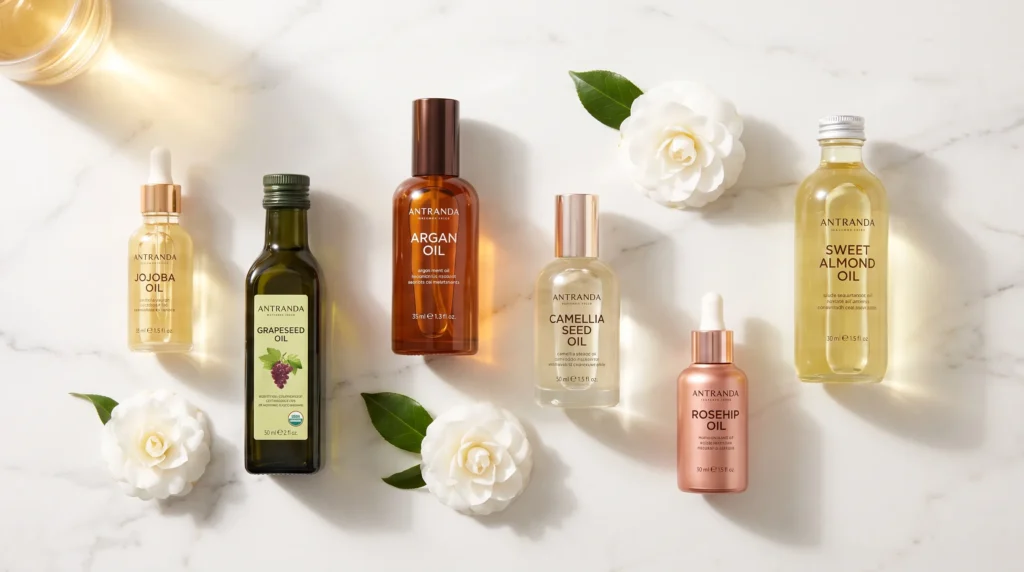
The 7 Best Oils for Low Porosity Hair
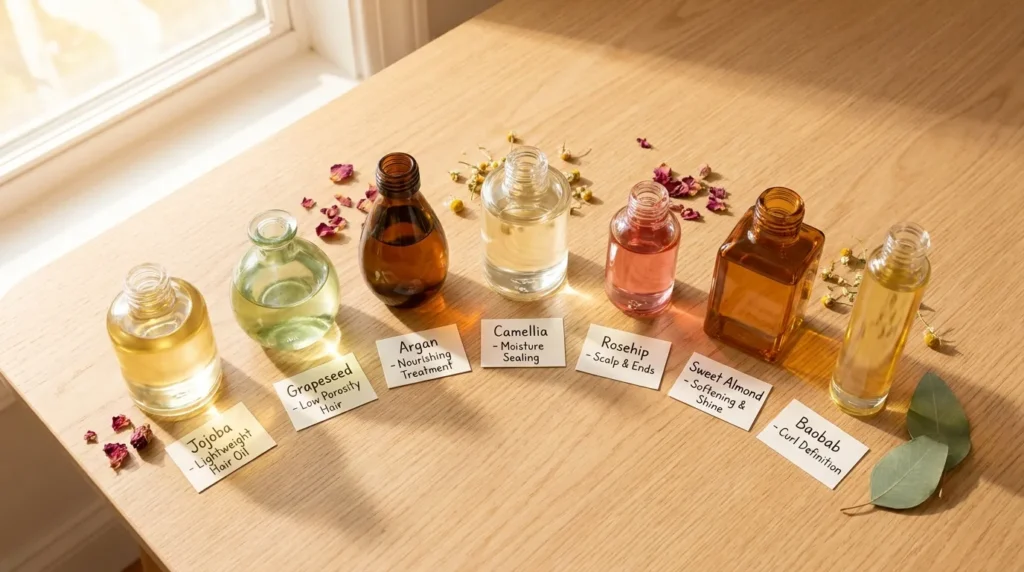
These are the oils for low porosity hair that absorb rather than sit, chosen based on molecular weight, linoleic acid content, and real-world performance on tightly closed cuticles.
1. Jojoba Oil — The Top Choice for Low Porosity Hair
Jojoba oil is technically a liquid wax, not an oil — and this is what makes it the best single choice for low porosity hair. Its molecular structure is nearly identical to the scalp’s natural sebum, which means the hair and scalp recognize it as “self” and absorb it without resistance. It is extraordinarily lightweight, absorbs with almost no residue, and does not create buildup even with regular use. It also regulates scalp oil production, balances pH, and works as an excellent carrier for essential oils. Use it as your primary scalp oil and as part of your sealing step after leave-in conditioner.
How to use: Apply 3 to 5 drops to the scalp on wash day and massage in. Apply 2 to 3 drops warmed in palms through damp hair as a sealing step.
2. Grapeseed Oil — The Lightest Absorbing Oil Available
Grapeseed oil is one of the most linoleic-acid-rich oils available, making it one of the smallest-molecule oils that can penetrate low porosity hair. It absorbs almost instantly, leaves zero residue, has virtually no scent, and is one of the few oils that genuinely moisturizes low porosity hair rather than coating it. It also has mild astringent properties that are beneficial for any scalp oiliness. For very fine low porosity hair, grapeseed oil is often the only oil that works without any buildup or heaviness at all.
How to use: Apply to damp hair immediately after leave-in conditioner as your sealing oil. Use as the base carrier oil when mixing essential oils for scalp treatments.
3. Argan Oil — Best Finishing Oil for Low Porosity Hair
Argan oil contains a balance of oleic and linoleic acid, making it moderately penetrating — lighter than coconut or olive oil but slightly heavier than grapeseed. For low porosity hair, it works best as a finishing oil applied in very small amounts to dry styled hair rather than as a scalp treatment or deep moisturizer. Two to three drops warmed between the palms and smoothed over the top layer of styled hair gives an immediate shine without any greasy buildup. Its high vitamin E content also protects the cuticle from UV and environmental damage.
How to use: Two drops maximum warmed between palms. Smooth over dry styled hair mid-lengths to ends only. Avoid roots and scalp.
4. Sweet Almond Oil — Gentle Daily Moisturizer
Sweet almond oil is rich in vitamins E, A, and B, and has a lighter consistency than olive oil while being more nourishing than grapeseed. It absorbs well into low porosity hair when applied to warm, damp hair and is particularly effective at reducing scalp dryness and flaking without creating greasy buildup. It works best as part of the LOC (Liquid-Oil-Cream) method applied to damp hair just after a leave-in conditioner — the warmth from the damp hair helps open the cuticle slightly for better absorption.
How to use: Apply to damp hair after leave-in conditioner as part of the LOC method. Use 3 to 4 drops through mid-lengths and ends.
5. Camellia Seed Oil — The Japanese Secret for Shine and Penetration
Camellia seed (tea seed) oil has been used in Japanese hair care for centuries — and for good reason. It is extraordinarily lightweight, has one of the highest oleic acid contents of any natural oil, and absorbs into the hair shaft faster than almost any other oil including argan. It leaves a natural, non-greasy shine that is particularly beautiful on low porosity natural hair. It is also one of the best oils for sealing moisture into the hair overnight — apply to damp hair, cover with a satin bonnet, and wake up to noticeably softer hair.
How to use: As a lightweight daily sealant on damp hair. As an overnight treatment: 4 to 5 drops applied to damp hair before bed under a satin bonnet.
6. Rosehip Oil — Rich in Linoleic Acid for Deep Penetration
Rosehip oil has one of the highest linoleic acid contents of any natural oil — approximately 35 to 40% — giving it small molecules that can penetrate through low porosity cuticles more effectively than larger-molecule oils. It is also rich in vitamin C, beta-carotene, and essential fatty acids that nourish the scalp and strengthen the hair structure from inside. Its natural pink-gold color fades on hair and does not stain. It is particularly effective for low porosity hair that is also fine, color-treated, or prone to breakage.
How to use: Mix 4 to 5 drops with grapeseed oil as a scalp treatment. Apply to warm damp hair before the steam method for best penetration.
7. Baobab Oil — The Underrated Penetrating Oil
Baobab oil from the African baobab tree contains an almost equal balance of oleic, linoleic, and palmitic fatty acids — a combination that makes it one of the most penetrating natural oils available. It absorbs without any greasy residue, adds softness and elasticity to dry low porosity hair, and is light enough for use as part of daily moisture sealing. It is particularly effective for low porosity hair that is also brittle or suffers from breakage, as its balanced fatty acid profile both penetrates and provides structural support to the hair shaft.
How to use: Apply 3 to 4 drops to damp hair as part of LOC method. Mix with jojoba oil as a daily scalp treatment.
Oils to Completely Avoid on Low Porosity Hair
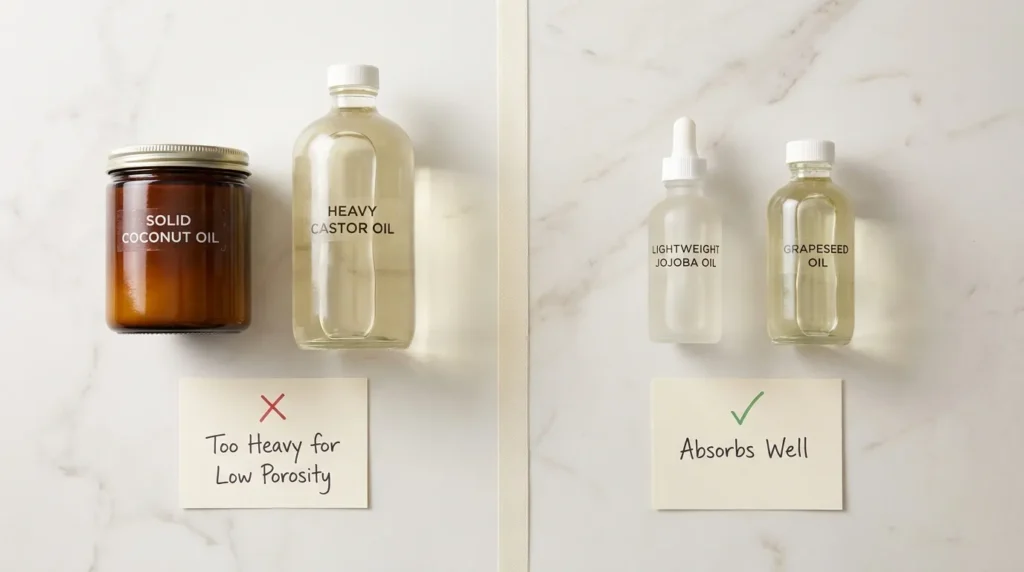
Knowing which oils to avoid is as important as knowing which ones to use. These oils create heavy buildup on low porosity hair that blocks moisture and makes the hair feel constantly coated, dull, and difficult to manage.
- Coconut oil: Despite being the most popular natural hair oil, coconut oil is one of the worst choices for low porosity hair. Its large lauric acid molecules cannot penetrate the closed cuticle and instead coat the surface, creating a thick film that blocks subsequent moisture from entering. Many low porosity hair types report that coconut oil makes their hair harder, more brittle, and more resistant to moisture over time — the opposite of what is intended.
- Castor oil: Castor oil is highly effective for scalp health and root strengthening on other hair types, but its extremely thick consistency and large ricinoleic acid molecules make it one of the heaviest and most buildup-prone oils for low porosity hair. Even diluted, it tends to sit on the cuticle surface and attract lint and debris.
- Olive oil: Olive oil has a moderately large oleic acid molecule that does not penetrate well through tightly closed cuticles. It creates a heavy coating similar to coconut oil over time and can make low porosity hair feel greasy and limp rather than moisturized.
- Shea butter: Not an oil but often used as one — shea butter’s thick, fatty consistency makes it completely unsuitable as a primary moisturizer or oil for low porosity hair. It seals too aggressively, trapping any dryness already present. If you use shea butter at all with low porosity hair, use it in tiny amounts as the final step in a cream, not as an oil replacement.
The Correct Application Method for Oils on Low Porosity Hair
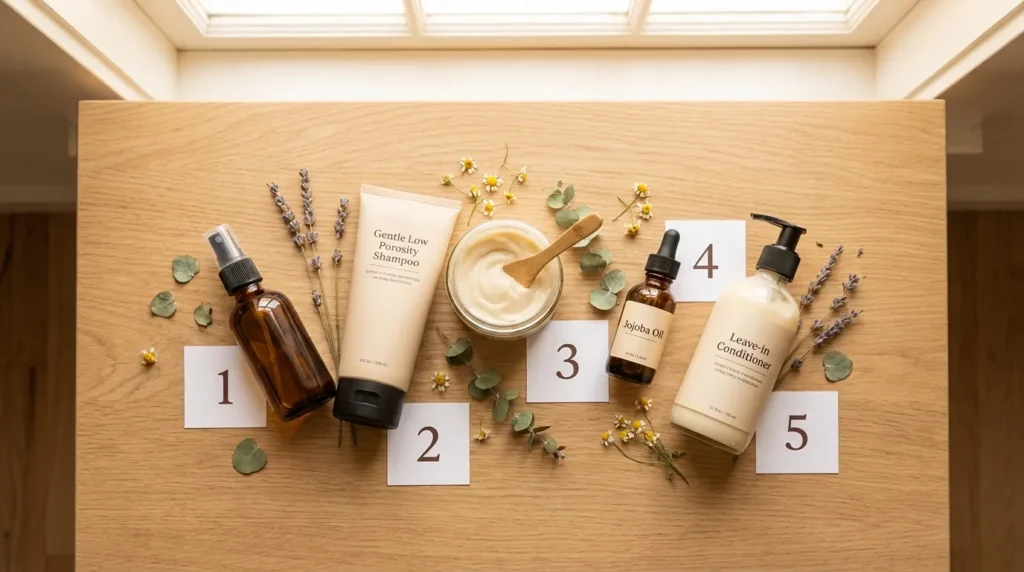
Even with the right oils for low porosity hair, applying them in the wrong order or at the wrong time undermines the results. Low porosity hair requires a modified LOC method and specific timing to actually get moisture inside the hair shaft.
Modified LOC method for low porosity hair:
L — Liquid (water or water-based leave-in): Always start with water or a very light, water-based leave-in conditioner on damp hair immediately after washing. This is the only true source of moisture for hair — oils seal it in, they do not add it. Apply while hair is warm and slightly damp from washing.
O — Oil: Apply your chosen lightweight oil (jojoba, grapeseed, or camellia) while the leave-in is still damp on the hair. The dampness creates slight warmth and softness in the cuticle that improves oil absorption. Use only 2 to 4 drops — less is significantly more for low porosity hair.
C — Cream: Apply a light styling cream or butter last to seal everything in. For low porosity hair, use the lightest cream possible — heavy butters defeat the purpose of using lightweight oils.
Key timing rules for low porosity oil application:
- Always apply oil to damp, warm hair — never to dry hair where the cuticle is fully closed.
- Use the steam/heat method before oiling for maximum absorption.
- Apply oil in very small amounts — two to four drops is usually sufficient for low porosity hair. More oil does not mean more moisture — it means more buildup.
- Clarify with a clarifying shampoo once a month to remove any accumulated buildup that prevents moisture from entering.
Complete Low Porosity Wash Day Routine
This full routine incorporates the right oils for low porosity hair in the correct order and with the correct techniques for maximum moisture retention:
- Pre-poo (optional): Apply a light oil like grapeseed or jojoba to dry hair 30 minutes before washing. This provides a protective layer that prevents excessive moisture stripping during shampooing without heavy buildup.
- Shampoo: Use a gentle, sulfate-free or low-sulfate shampoo on the scalp. Low porosity hair is particularly prone to product buildup, so a slightly stronger shampoo than high porosity hair would use is appropriate. Clarify once a month with a clarifying shampoo to reset the hair.
- Deep condition with heat: Apply a lightweight, protein-free deep conditioner to damp hair, cover with a shower cap, and sit under a hooded dryer or use a warm towel wrap for 20 to 30 minutes. The heat opens the cuticle for deep conditioner penetration — without heat, most conditioners sit on top of low porosity hair.
- Rinse with cool water: Always finish your rinse with cool water to close the cuticle and lock in the conditioning treatment.
- Apply leave-in while hair is still warm: Apply a light water-based leave-in conditioner while hair is still warm from the dryer or from being in a warm shower. Warm cuticles accept products more readily.
- Seal with lightweight oil: Apply 2 to 3 drops of jojoba, grapeseed, or camellia oil to damp hair immediately after the leave-in.
- Style: Apply the lightest styling cream or gel possible and style as desired.
DIY Lightweight Oil Blend for Low Porosity Hair
Instead of using oils individually, this blend combines four of the best oils for low porosity hair for maximum absorption and benefit:
Low Porosity Daily Blend:
- 3 tablespoons grapeseed oil (base — lightest, fastest absorbing)
- 1 tablespoon jojoba oil (scalp balance, sebum-mimicking)
- 1 tablespoon camellia seed oil (shine and overnight moisture)
- 5 drops rosemary essential oil (scalp stimulation and growth)
- 3 drops lavender essential oil (scalp health and soothing)
Mix in a small dark glass dropper bottle and shake well before each use. Apply 3 to 4 drops to warm, damp hair after leave-in conditioner. Store away from direct sunlight. Use within 3 months.
Frequently Asked Questions
Can I use coconut oil on low porosity hair if I warm it up first?
Warming coconut oil slightly helps it apply more smoothly, but it does not change the molecular size that causes it to sit on the cuticle rather than penetrate. Even warmed, the lauric acid molecules in coconut oil are too large to effectively pass through tightly closed low porosity cuticles. Over time, regular coconut oil use on low porosity hair creates progressive buildup that makes moisture absorption worse. Switch to grapeseed or jojoba oil — the difference in how your hair feels within one wash cycle is typically immediate and noticeable.
Why does my low porosity hair feel dry even after I oil it?
Because oil does not add moisture — it only seals it in. If your hair feels dry after oiling, the problem is that moisture (water) was not applied first, or the oil you are using is creating a barrier that prevents moisture from entering. Always start with water or a water-based leave-in conditioner, then seal with a lightweight oil while the hair is still damp. Also check that you are not using a heavy oil like coconut or castor oil that is blocking moisture rather than sealing it.
How often should I oil my low porosity hair?
Much less frequently than high porosity hair. Low porosity hair does not lose moisture as quickly as high porosity hair, and its closed cuticle means oils accumulate on the surface rather than absorbing in with each application. For most low porosity hair types, oiling once or twice a week — as part of the LOC method on wash day and as a mid-week refresh — is sufficient. Daily oiling causes heavy buildup very quickly on low porosity hair.
Is low porosity hair the same as healthy hair?
Low porosity is often a sign of very healthy, undamaged hair. The tightly closed cuticle of low porosity hair is structurally intact — it has not been opened by heat damage, chemical processing, or mechanical stress. High porosity hair, on the other hand, often has cuticle damage that makes it absorb products easily but also lose moisture quickly. Low porosity hair retains moisture better once it gets inside — the challenge is just getting it there in the first place.
Do I need to clarify my low porosity hair more often?
Yes. Because oils and products sit on the cuticle surface rather than absorbing in, low porosity hair accumulates buildup faster than other hair types. A clarifying wash once every three to four weeks — more often if you use products daily — is necessary to remove this buildup layer and allow fresh moisture and oils to reach the hair shaft. Without regular clarifying, even the right oils for low porosity hair will not work properly because they cannot get through the accumulated layer of previous products.
The Right Oil and the Right Technique — Both Are Essential
Using the correct oils for low porosity hair is only half the solution. The heat method — whether steam, a hooded dryer, or warm oil application — is what makes the difference between oil sitting on top and oil actually absorbing into the hair shaft where it can do something useful.
Start with the grapeseed and jojoba blend this wash day. Apply with the heat method. Use less than you think you need. Notice how differently your hair responds compared to heavier oils applied to dry hair. That difference is what good low porosity hair care feels like — and once you experience it, going back to oils that sit on your hair will not feel like an option anymore.
Also Visit : Tips to Repair Damaged Hair Fast Without Cutting It All Off