Benefits of Castor Oil for Natural Hair Growth: Fact vs. Hype
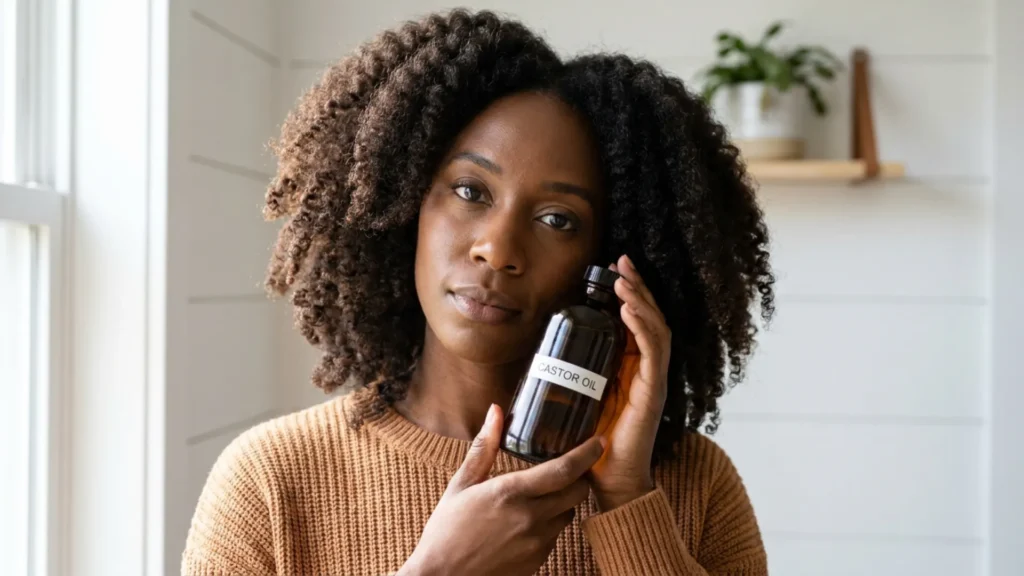
Castor oil grows hair. That’s the claim — on product labels, in YouTube tutorials, across every corner of the natural hair internet, usually with before-and-after photos that are hard to verify and timelines that stretch credibility.
The more accurate version is also the more useful one. The benefits of castor oil for natural hair growth are real and specific, grounded in the oil’s actual chemistry. They’re just different from what most of those labels imply. Understanding where the evidence actually stops — and where the marketing starts — is what determines whether castor oil earns a consistent place in your routine or gets abandoned after two underwhelming months.
Short answer: castor oil supports hair retention and scalp health in ways that meaningfully reduce breakage and create a better environment around the follicle. It does not directly speed up how fast hair grows from the follicle. That distinction matters enormously in practice.
Key Takeaways
- Ricinoleic acid — castor oil’s dominant compound — has documented anti-inflammatory and antimicrobial properties that benefit scalp health.
- No published clinical trial has demonstrated castor oil directly accelerates the biological hair growth cycle.
- Its real value is in retention and scalp environment — not follicle stimulation.
- JBCO and cold-pressed castor oil contain comparable ricinoleic acid levels; differences are in processing, pH, and texture.
- Meaningful results require three to six months of consistent use — and what you’re measuring is length retention, not growth speed.
What’s Actually Inside Castor Oil

Castor oil is pressed from the seeds of the Ricinus communis plant and is chemically dominated by a single compound: ricinoleic acid, which makes up approximately 85–90% of its total fatty acid content. That level of single-compound dominance is unusual. Most carrier oils are a blend of several fatty acids in broadly comparable proportions — coconut oil, for example, is a mix of lauric, myristic, caprylic, and other acids. Castor oil is, chemically speaking, almost entirely one thing.
Ricinoleic acid is a hydroxyl fatty acid. It carries a hydroxyl (–OH) group attached to its carbon chain — a structural feature ordinary fatty acids don’t have — and that difference gives it two properties directly relevant to scalp health: documented anti-inflammatory activity, and antimicrobial behaviour against certain bacteria and fungi. These properties have been studied in non-hair contexts, but the mechanisms translate to how the scalp environment functions. The research base for ricinoleic acid’s anti-inflammatory properties is indexed across multiple studies on PubMed for anyone who wants to look at the source literature directly.
Castor oil is also one of the most viscous carrier oils in common use — far thicker than argan, jojoba, or sweet almond oil. That thickness is a direct consequence of its ricinoleic acid concentration, and it has real implications for both application and function. It is a powerful occlusive: applied to the scalp or strand, it forms a dense barrier that dramatically slows water evaporation from the surface. For natural hair that loses moisture rapidly between wash days, that’s a meaningful practical advantage. The challenge — and it’s a real one — is distributing it evenly through dense coily textures, which is why most practical guides recommend warming or diluting it before application.
The Real Benefits of Castor Oil for Natural Hair Growth
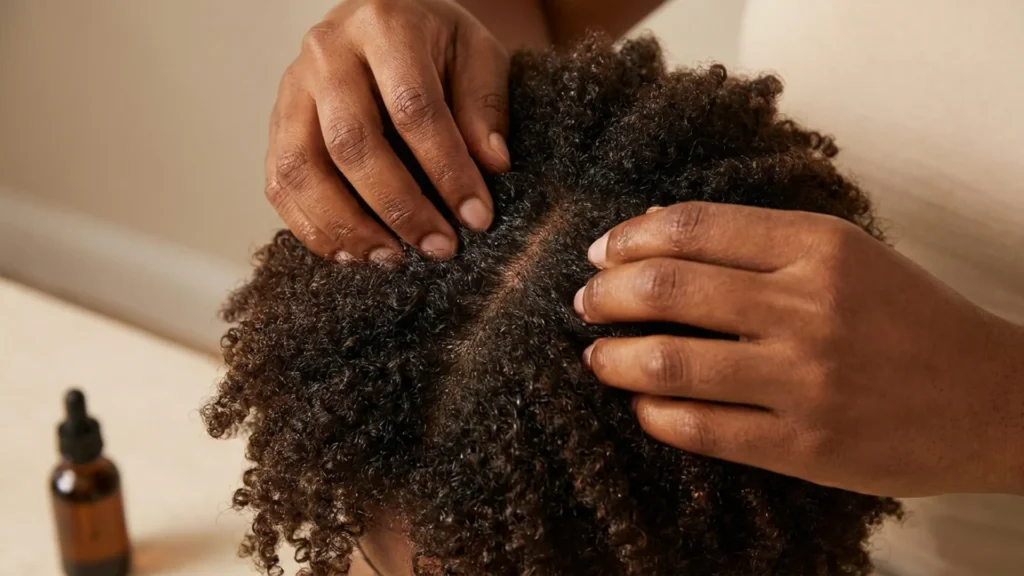
A Healthier Scalp Environment for the Follicle
Chronic low-level scalp inflammation — from tight protective styles, environmental stress, product buildup, or persistent dryness — can shorten the active growth phase of individual hairs over time. Ricinoleic acid’s anti-inflammatory action offers a plausible mechanism for how regular castor oil scalp application might help maintain a less reactive follicle environment. This isn’t treatment territory — it’s the difference between a scalp that’s chronically fighting irritation and one that isn’t. That baseline matters for how reliably each follicle completes its full growth cycle before entering a resting phase.
Antimicrobial Support Against Scalp Imbalances
Scalp microbiome imbalances — including overgrowth of the Malassezia fungi associated with dandruff — are common among natural hair wearers, particularly those who go longer periods between wash days. Ricinoleic acid has demonstrated antimicrobial activity in laboratory settings against several microorganisms. Regular scalp application may help moderate the kind of bacterial or fungal imbalance that shows up as persistent itch, flaking, and follicle irritation. To be direct: this is supportive, not medical treatment. A clinically diagnosed scalp condition needs dermatologist-directed care, not a carrier oil.
Intense Moisture Sealing for Dry Ends
The ends of natural hair are the oldest, driest, and most porous section of the strand — furthest from the scalp’s sebum, and the part most likely to break before it reaches length. Castor oil’s dense occlusive layer, applied over a water-based moisturiser, dramatically slows how quickly that moisture evaporates from the strand surface. On low-humidity days or for hair that dries out noticeably between wash sessions, this sealing function is one of the most practically valuable things castor oil delivers — and it works consistently, not just in theory.
Reduced Breakage at High-Manipulation Points
Natural hair breaks most often where manipulation concentrates: tangled sections during detangling, the sharp curves in tight coil patterns, areas that bear repeated styling tension. Castor oil’s lubricating and occlusive coating reduce how brittle the strand behaves at these vulnerable moments. It doesn’t structurally strengthen the hair — that requires protein. But reducing mechanical breakage frequency means more of the hair that grows from the follicle survives to a visible length. This is the actual mechanism behind most “castor oil grew my hair” experiences. Growth happened; what changed was how much of it stayed.
Visual Thickness and Strand Fullness
A strand coated in castor oil appears and feels noticeably thicker than an uncoated one. Part of this is temporary — the coating adds physical bulk that washes out with clarifying. But for natural hair that runs fine-stranded or lower-density, the visual and tactile effect of castor oil’s coating is genuinely useful on wash days and for styles that benefit from the appearance of fullness. Just be clear-eyed that coated thickness and actual strand diameter are different things — the former is a routine tool, the latter is determined by genetics.
Pre-Shampoo Strand Protection
Applied to dry hair 30–45 minutes before shampooing, castor oil creates a protective barrier layer before the detergent makes contact. Shampoo — particularly sulphate-based formulas — lifts the cuticle forcefully to remove buildup, but takes natural lipids with it in the process. A pre-poo application of castor oil on ends and mid-lengths buffers how aggressively that stripping happens, leaving the hair softer and less stripped post-wash. For dry hair types that come out of shampooing feeling tight and fragile, this single habit often has a noticeable effect on post-wash texture and ease of detangling.
What Castor Oil Cannot Do for Hair Growth
This section matters — because understanding the ceiling is what prevents the disappointment that causes people to abandon otherwise useful habits.
No published clinical trial has demonstrated that castor oil directly accelerates the biological hair growth cycle. The follicle’s anagen phase — the period of active growth that determines how fast and how long hair grows — is governed by genetics, hormones, nutrition, and scalp blood circulation. A topical oil, however rich in ricinoleic acid, does not alter those variables.
Some sources reference a potential connection between ricinoleic acid and prostaglandin pathways — specifically, the idea that it might inhibit PGD2, a compound linked to follicle miniaturisation. That hypothesis exists in the research literature. It has not been tested in rigorous clinical hair growth trials and remains speculative, not established.
The American Academy of Dermatology’s guidance on hair loss outlines treatments with genuine clinical evidence — minoxidil, finasteride, platelet-rich plasma therapy among them. Castor oil doesn’t appear on any of those lists. If you’re experiencing significant or sudden shedding, persistent thinning, or hairline recession that concerns you, castor oil is not a substitute for a professional assessment — it’s a scalp support tool, not a treatment.
Searching ClinicalTrials.gov for “castor oil hair growth” reflects the current clinical evidence base accurately. It’s a useful five-second reality check against some of the more expansive product claims you’ll encounter.
Also Visit: 7 Benefits of Jojoba Oil on Natural Hair (Backed by Science)
JBCO vs. Regular Castor Oil — What’s the Actual Difference?
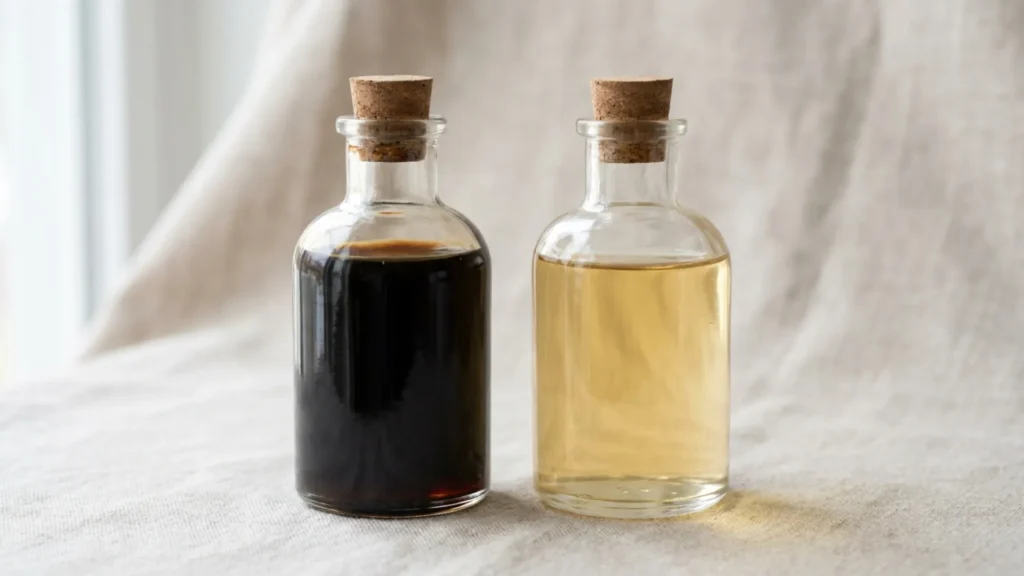
Both versions come from the same plant — Ricinus communis — but the processing diverges significantly. Cold-pressed castor oil extracts the oil without heat, producing a pale yellow, relatively neutral-pH liquid with clean ricinoleic acid content. Jamaican Black Castor Oil uses beans that are first dry-roasted, ground by hand, then boiled with water — a traditional Jamaican method. The roasting process generates ash, primarily potassium carbonate, which is incorporated into the final oil.
That ash creates JBCO’s distinctive dark colour, higher pH, smoky smell, and slightly grittier texture. Claims that the ash specifically stimulates follicle activity or meaningfully exceeds the benefits of cold-pressed castor oil are not supported by clinical evidence. What higher pH does in practice is alter how the scalp environment feels — some people find it more comfortable, particularly those with a scalp that trends toward acidity and dryness. Others find it irritating. It’s individual.
Ricinoleic acid content is broadly comparable in both forms. The core functional benefits are essentially the same. Where the two genuinely differ:
| Feature | Jamaican Black Castor Oil | Cold-Pressed Castor Oil |
|---|---|---|
| Colour | Dark brown to black | Pale yellow |
| Smell | Smoky, earthy | Mild, slightly nutty |
| pH | Higher (alkaline, from ash content) | More neutral |
| Texture | Very thick, slightly gritty | Very thick, smooth |
| Ricinoleic acid | ~85% (comparable) | ~85–90% |
| Best use case | Scalp treatments, edges, nape | Ends, mid-lengths, pre-poo |
| Evidence for ash benefits | Anecdotal — not clinically proven | Same limited clinical base |
If choosing between the two: cold-pressed for ends and pre-poo applications where smooth distribution matters; JBCO for scalp focus if you prefer the texture and tolerate the stronger scent. Many people keep both for different steps in their routine.
Also Visit: Avoid Natural Hair Protective Styling Mistakes That Cause Breakage
How to Apply Castor Oil on Natural Hair
Castor oil’s viscosity is its main practical challenge. Straight from the bottle, it’s difficult to spread evenly through dense coily hair — and applying too much creates a heaviness that requires several clarifying washes to fully remove. These methods address that directly:
- Diluted scalp oil: Combine castor oil with a lighter carrier — jojoba, grapeseed, or sweet almond — in a 1:3 ratio (one part castor to three parts lighter oil). Apply to the scalp in sections using a dropper bottle or fingertip application. This distributes evenly and absorbs far more comfortably than undiluted castor oil applied directly.
- Warm oil treatment: Place a small amount in a bowl set over hot water — not microwaved directly — for two to three minutes. Apply warm to hair and scalp, cover with a shower cap and warm towel, leave 20–30 minutes, then shampoo out. Warmth reduces viscosity significantly, making even distribution through thick textures achievable.
- Pre-shampoo application: Apply to dry hair 30–45 minutes before shampooing, focusing on ends and mid-lengths. No heat required, though a shower cap helps. Rinse or shampoo out as normal.
- Edges and nape treatment: A very small amount — enough to barely coat the fingertips — applied gently to the hairline and nape edges. These areas see the highest manipulation and, for many people, the earliest signs of stress or thinning. The small quantity involved makes daily or near-daily application practical here where it wouldn’t be for the full head.
Start with less than you think you need. Half a teaspoon to one teaspoon covers the whole scalp when diluted. A pea-sized amount handles the ends. Adding more is easy; removing an over-application of castor oil takes effort and multiple wash sessions.
Also Visit: Coconut Oil for Natural Hair Growth Moisture and Strength
What Realistic Results Look Like — and When
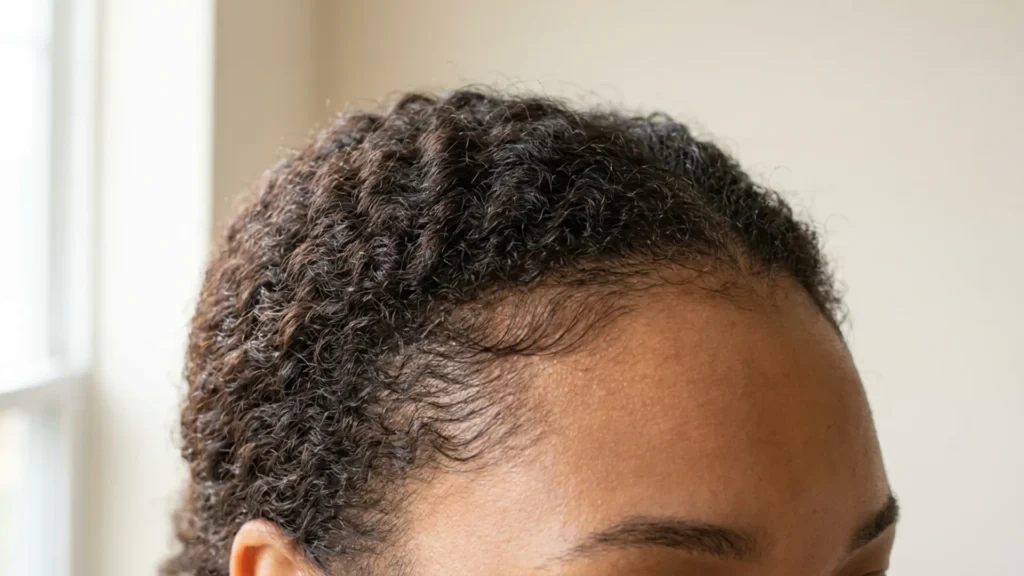
The first changes most people notice — within the first two to four weeks of consistent use — are in scalp feel: less tightness, less visible flaking, a more comfortable base between wash days. Hair texture may also feel softer at the ends and less prone to snapping during mid-week styling.
Visible length retention — the effect that most people interpret as “castor oil grew my hair” — typically becomes noticeable after three to six months of consistent use, and only if the rest of the routine supports it. Castor oil alone, without adequate moisturisation and protective handling, won’t prevent breakage. It works as one component of an intentional routine.
What won’t change is biological growth rate. If your hair grows approximately half an inch per month, castor oil will not increase that figure. What can improve is how much of each half-inch survives the month intact — and over twelve months, that difference accumulates into something visible.
Frequently Asked Questions
Can castor oil help thinning edges?
Regular, gentle scalp application to the hairline can support the follicle environment in that area — reducing inflammation and providing a moisture barrier against the dryness and tension that contribute to edge fragility. Edges thin for many reasons: traction from tight styles, hormonal shifts, nutritional gaps, or underlying conditions. Castor oil can meaningfully address the scalp-environment component. It won’t reverse traction alopecia or hormonally-driven thinning. Significant, ongoing, or sudden edge loss warrants a dermatologist visit alongside any topical routine change.
How often should I use castor oil on natural hair?
Two to three times per week for scalp application is sustainable for most hair types without significant accumulation. For ends and mid-lengths, once or twice per week as part of your moisture-sealing routine is sufficient. A monthly clarifying wash clears any buildup that develops over time. Daily full-scalp application isn’t necessary and, for most people, creates more buildup than it resolves.
Can I mix castor oil with other oils?
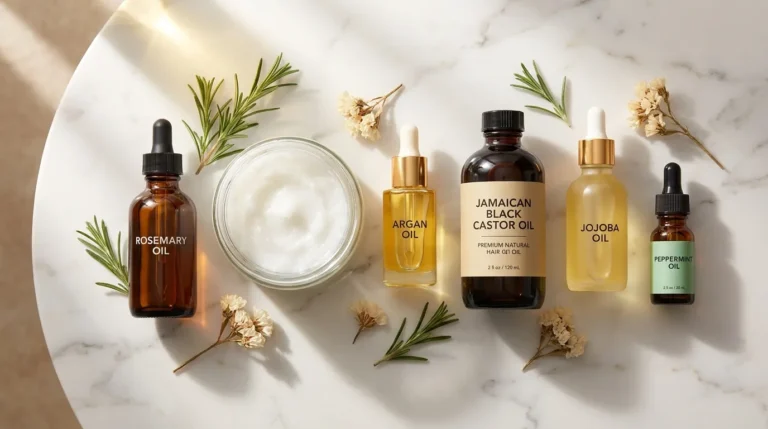
Yes — and for most natural hair types, mixing is the recommended approach rather than applying undiluted castor oil. Common pairings that work well: castor with jojoba (the latter being light and sebum-mimicking), castor with grapeseed (very lightweight, good for fine-stranded natural hair), or castor with peppermint oil for scalp application — if using an essential oil like peppermint, cap it at a 2% dilution maximum, as essential oils are highly concentrated and can cause scalp irritation at higher ratios.
Is castor oil safe for coloured natural hair?
Generally yes. Castor oil is gentle and doesn’t interact negatively with colour-treated strands. The occlusive barrier it creates may slightly slow colour or toner penetration if applied immediately before a colour service — rinse it out thoroughly before any chemical treatment. For routine use on coloured natural hair, it’s well-suited and may offset the dryness that colour processing accelerates.
If you’re still working out exactly where castor oil fits into your routine — whether it belongs at the pre-poo stage, the sealing step, or the scalp-only part — drop your specific question in the comments. Hair type, porosity, and styling habits all change the answer, and the specifics are worth getting right.
This article is for general information only and is not medical advice. For persistent hair loss, sudden shedding, scalp pain, or thinning that concerns you, see a dermatologist or trichologist.