3 Things That Actually Affect Hair Growth

Most people spend their energy on the one factor that barely moves the needle and skip the one that does most of the actual work. Ask someone what affects hair growth and they’ll usually mention vitamins, maybe a specific oil, maybe genetics as an afterthought. The order is almost always backwards.
Quick answer: hair growth comes down to three things, genetics and age, general health and nutrition, and hair care practices, and they’re not equally important. Genetics sets a ceiling you can’t move. Health and nutrition matter, but only within a narrow band, since most people aren’t actually deficient in anything. Hair care practices, mostly avoiding breakage, are where almost all of the real, controllable difference lives.
Ranking these three by how much control you actually have over them changes where effort should go.
Why Ranking These Three Factors Matters
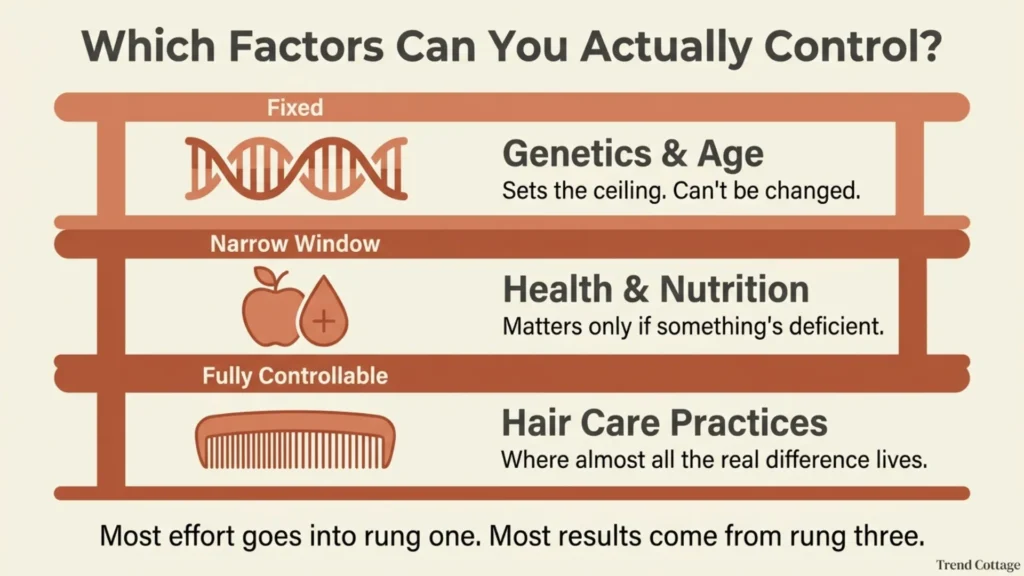
Sorting hair growth into these three factors matters because they’re not the same kind of problem. One is fixed, one has a narrow window where it matters, and one is genuinely within your control every single day. Treating all three as equally actionable is how people end up spending money on the wrong one.
Genetics and Age

Genetics is the biggest single factor in how your hair grows, and it’s the one thing on this list you can’t influence at all. It determines how many follicles you have, how long each one stays in its active growth phase before resting, and how thick or fine each strand grows. Some people’s hair follicles cycle through active growth phases for six or seven years before resting; others cycle through in two or three, which is the main reason some people can grow waist-length hair and others hit a natural length ceiling no matter what they do.
Age changes this ceiling gradually over time. Growth cycles tend to shorten as people get older, and the ratio of actively growing to resting follicles shifts too, which is part of why hair often feels thinner in your forties and fifties than it did at twenty even with identical care. Family pattern hair loss, which affects both men and women, sits at the far end of this same genetic spectrum, and it’s a condition that may result from heredity or medical conditions rather than anything in a daily routine.
Also Visit : How to Use Hair Growth Oil the Right Way
Health and Nutrition
Health and nutrition genuinely affect hair growth, but the effect only shows up when something is actually off, not as a dial you can keep turning for more results. A body under stress from illness, rapid weight loss, or a real nutrient deficiency will divert resources away from hair production, since growing hair isn’t essential to survival and gets deprioritized first.
Thyroid function is a good example of how this works in practice. An underactive or overactive thyroid can cause hair loss or halt growth entirely until hormone levels are brought back into a normal range, at which point growth typically resumes on its own. Iron deficiency works similarly. Both are worth ruling out with a blood test if hair loss shows up alongside fatigue or other symptoms, rather than guessing with a supplement.
Rapid weight loss, crash dieting, and major surgery can trigger a similar pause in growth, usually a few months after the event rather than immediately, which is why people are often confused about the cause. The follicle simply shifts into a resting phase early in response to the stress on the body, and growth typically restarts once the body stabilizes.
Once someone is eating a reasonably varied diet and isn’t dealing with an undiagnosed deficiency, adding more of any single nutrient rarely does anything measurable. This is the part most hair growth content gets wrong: it treats nutrition like a lever you can keep pulling, when for most people it’s closer to a threshold you either clear or you don’t.
Hair Care Practices
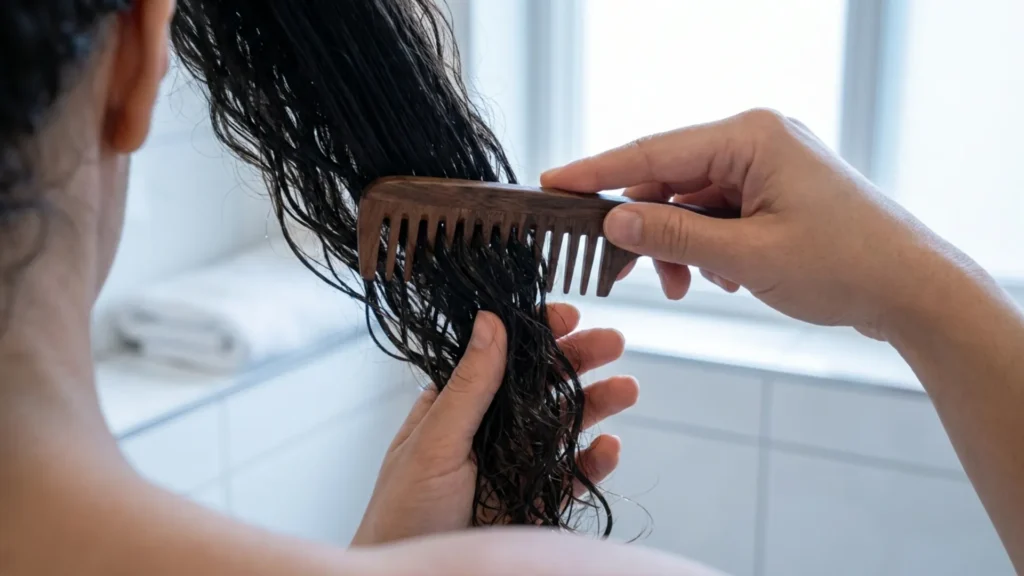
Hair care practices are where almost all of the controllable difference in visible hair length actually comes from, and it’s mostly about what you’re not doing rather than what you’re adding. Heat styling, tight hairstyles worn constantly, harsh chemical treatments, and rough handling while wet all contribute to breakage, and breakage is what actually stops hair from reaching a length its genetics would otherwise allow.
Dermatologists point to a handful of specific habits that quietly cause the most damage over time, and repeated damage can lead to thinning or bald patches if it continues unaddressed, even in hair that was never genetically prone to loss. Traction from tightly pulled styles, in particular, can cause permanent damage to the follicle if it goes on long enough, which makes it one of the few care-related issues that isn’t fully reversible.
Scalp health belongs in this category too, since a clean, well-cared-for scalp gives new hair a better environment to grow into, even though it doesn’t speed up the growth itself. This is also the one category where consistent, unglamorous habits genuinely compound over months and years: gentler detangling, lower heat, and regular trims to catch split ends before they travel up the strand. None of it changes how fast hair grows at the root, but all of it changes how much of that growth actually survives to be visible.
Also Visit : Does Hair Growth Serum Really Work, or Is It Marketing?
How Fast Does Hair Actually Grow
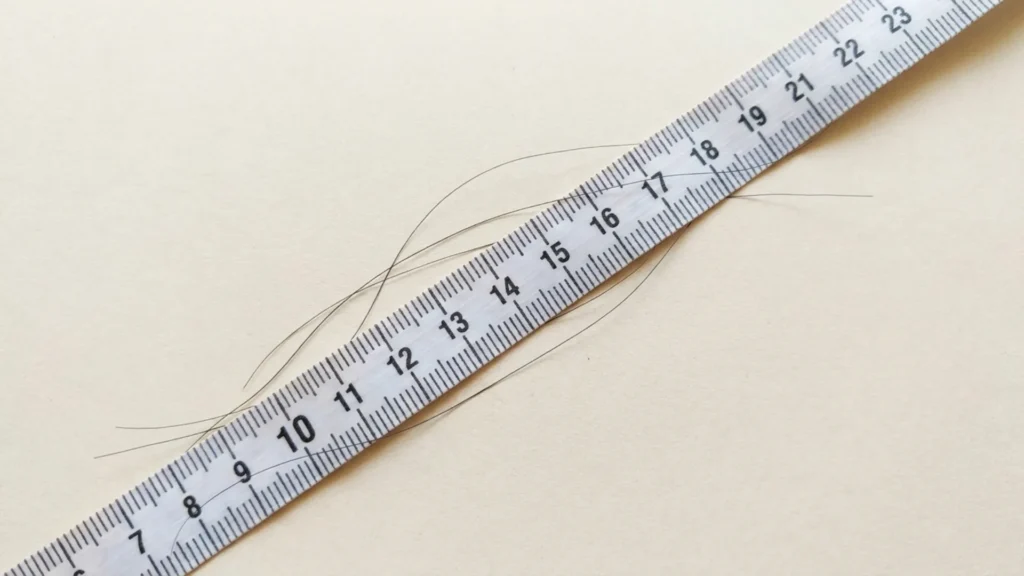
Hair grows at roughly half an inch per month for most people, and that figure barely shifts regardless of diet, products, or routine, because it’s set by how the follicle cycles through active growth phases, not by anything happening on the surface of the strand. What varies enormously between people isn’t the monthly growth rate so much as how much of each month’s new growth actually survives instead of breaking off.
| Factor | Can you change it? | Realistic impact |
|---|---|---|
| Genetics and age | No | Sets the ceiling for follicle count, growth-cycle length, and eventual thinning |
| Health and nutrition | Only if something’s deficient | Restores normal growth once a real deficiency or imbalance is corrected; adds little beyond that |
| Hair care practices | Yes, daily | Determines how much of your genetic growth potential actually shows up as visible length |
This is why two people with identical growth rates can end up with dramatically different hair lengths after a year. One is retaining nearly everything they grow; the other is losing a meaningful chunk of it to breakage every month, which looks and feels like slower growth even though the underlying rate is the same.
Most of the effort people put in goes toward the factor they have the least control over. Chasing a faster growth rate through supplements, when no deficiency exists, or comparing routines with someone whose genetics simply allow for longer hair, sets up disappointment that has nothing to do with effort or consistency.
The better use of that same energy is almost always aimed at retention: reducing breakage, protecting the ends, and being patient with a process that moves in months, not weeks. It’s a less exciting answer than a new serum, but it’s the one actually backed by how hair growth works.
When Slower Growth Signals Something Else
Slower or worsening hair growth sometimes points to something beyond genetics, diet, or daily habits, and it’s worth knowing the difference. Sudden shedding, noticeable thinning over a period of weeks rather than years, or hair loss that doesn’t match a family pattern are reasons to loop in a doctor rather than adjust a routine further.
A dermatologist can rule out thyroid issues, iron deficiency, and other medical causes with straightforward testing, which is faster and more reliable than trying every product on a shelf to see what helps. Most hair loss isn’t caused by anything serious, but ruling it out first saves months of guessing.
Also Visit : How to Choose Hair Growth Products That Fit Your Hair
Key Takeaways
- Genetics and age set a ceiling on follicle count, growth-cycle length, and eventual thinning that no product or habit can move.
- Health and nutrition matter only within a narrow band; correcting a real deficiency helps, but adding more once you’re not deficient rarely does anything.
- Hair care practices, mostly avoiding breakage from heat, tight styles, and rough handling, are where almost all of the controllable difference actually lives.
- Most people spend the most effort on the factor they control the least and the least effort on the one they control the most.
- Sudden shedding or thinning that doesn’t match your family pattern is worth a doctor’s opinion before you adjust your routine any further.
Frequently Asked Questions
What affects hair growth the most?
Genetics and age set the biggest limits, but they’re fixed. Health and nutrition matter only if something is actually deficient. Day-to-day hair care, mainly preventing breakage, is the factor most people can meaningfully influence.
How fast does hair actually grow?
About half an inch a month for most people, a rate set by the follicle’s growth cycle rather than anything applied to the strand. What differs between people is usually how much of that new length survives instead of breaking off.
Can you actually make hair grow faster?
Not the underlying rate, no. Correcting a genuine deficiency can restore normal growth if something was suppressing it, but for most people the more realistic goal is retaining more of what’s already growing by reducing breakage.
This article is for general information only and isn’t medical advice. For sudden shedding or hair loss that doesn’t match your family pattern, see a dermatologist.
Written by Anna Anderson for Trend Cottage.